



 Chat with AI
Exam 5: Market in Motion and Price Controls

Exam 1: The Role and Method of Economics194 Questions
Exam 2: Eight Powerful Ideas212 Questions
Exam 3: Scarcity, Trade-Offs, and Production Possibilities182 Questions
Exam 4: Demand, Supply, and Market Equilibrium231 Questions
Exam 5: Market in Motion and Price Controls252 Questions
Exam 6: Elasticities271 Questions
Exam 7: Market Efficiency and Welfare128 Questions
Exam 8: Market Failure259 Questions
Exam 9: Public Finance and Public Choice62 Questions
Exam 10: Consumer Choice Theory206 Questions
Exam 11: The Firm: Production and Costs147 Questions
Exam 12: Firms in Perfectly Competitive Markets124 Questions
Exam 13: Monopoly and Antitrust62 Questions
Exam 14: Monopolistic Competition and Product Differentiation207 Questions
Exam 15: Oligopoly and Strategic Behavior68 Questions
Exam 16: The Markets for Labor, Capital, and Land131 Questions
Exam 17: Income, Poverty and Health Care252 Questions
Exam 18: Introduction to Macroeconomics: Unemployment, Inflation, and Economic Fluctuations152 Questions
Exam 19: Measuring Economic Performance152 Questions
Exam 20: Economic Growth in the Global Economy163 Questions
Exam 21: Financial Markets, Saving, and Investment146 Questions
Select questions type


Which of the following is not likely to result from an increase in the federal minimum wage?
(Multiple Choice)
4.8/5  (60)
(60) If buyers expected the future price of a good to increase, it would tend to increase the current quantity exchanged.
(True/False)
4.9/5 (79)
(79) Exhibit 5-7 
-Refer to Exhibit 5-7. The movement from ____ to ____ is consistent with a decrease in the price of cotton (a substitute).
-Refer to Exhibit 5-7. The movement from ____ to ____ is consistent with a decrease in the price of cotton (a substitute). (Multiple Choice)
4.9/5 (81)
(81) When demand decreases and supply increases, there will be a decrease in the equilibrium price.
(True/False)
4.9/5 (73)
(73) Assume a price floor is imposed in the wheat market at the equilibrium price and that a price ceiling is imposed in the gasoline market at the equilibrium price. An increase in supply in both the wheat and gasoline markets will create:
(Multiple Choice)
4.9/5 (73)
(73) Which of the following is likely to result in a larger equilibrium quantity exchanged?
(Multiple Choice)
4.7/5 (83)
(83) If the demand for apples increases at the same time the supply of apples falls, the price of apples will tend to fall.
(True/False)
4.7/5 (79)
(79) Suppose the equilibrium price of bread is $2.00 per loaf. If the government sets a price ceiling of $2.50 per loaf:
(Multiple Choice)
4.9/5 (84)
(84) Exhibit 5-10 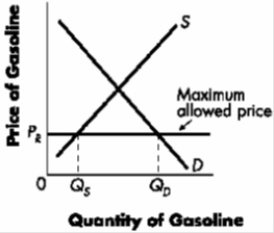
-Refer to Exhibit 5-10. The graph portrays the market for gasoline for which a ____ has been imposed, and, as a result, a ____ of gasoline occurs.
-Refer to Exhibit 5-10. The graph portrays the market for gasoline for which a ____ has been imposed, and, as a result, a ____ of gasoline occurs. (Multiple Choice)
4.9/5 (90)
(90) The invention of machinery that can double the amount of gold extracted from raw ore will likely:
(Multiple Choice)
4.8/5 (83)
(83) Exhibit 5-1

-Refer to Exhibit 5-1. A price floor set at $15 would create a shortage of 20 units
-Refer to Exhibit 5-1. A price floor set at $15 would create a shortage of 20 units (True/False)
5.0/5 (74)
(74) Exhibit 5-4
 -Refer to Exhibit 5-4. A movement from S1 to S2 could occur if:
 (Multiple Choice)
4.9/5 (79)
(79) A binding price floor
I.causes a surplus.
II.causes a shortagE.
iii.is set at a price above the equilibrium pricE.
iv.
Is set at a price below the equilibrium pricE.
(Multiple Choice)
4.9/5 (78)
(78) Which of the following is likely to result in a higher equilibrium price?
(Multiple Choice)
4.8/5 (79)
(79) If both market demand and supply increase simultaneously by the same magnitudes, then equilibrium quantity will (be) ____ and equilibrium price will (be) ____.
(Multiple Choice)
4.7/5 (77)
(77) Exhibit 5-2
The diagram below represents the market for butter.  -Refer to Exhibit 5-3. For a price floor to be binding in this market, it could be set at
 (Multiple Choice)
4.7/5 (100)
(100) Exhibit 5-11
Panel (a)
Panel (b) 
 -Refer to Exhibit 5-11. The price ceiling shown in panel (a)
 (Multiple Choice)
4.8/5 (76)
(76) 
Filters
- Essay(0)
- Multiple Choice(0)
- Short Answer(0)
- True False(0)
- Matching(0)