



 Chat with AI
Exam 5: Market in Motion and Price Controls

Exam 1: The Role and Method of Economics194 Questions
Exam 2: Eight Powerful Ideas212 Questions
Exam 3: Scarcity, Trade-Offs, and Production Possibilities182 Questions
Exam 4: Demand, Supply, and Market Equilibrium231 Questions
Exam 5: Market in Motion and Price Controls252 Questions
Exam 6: Elasticities271 Questions
Exam 7: Market Efficiency and Welfare128 Questions
Exam 8: Market Failure259 Questions
Exam 9: Public Finance and Public Choice62 Questions
Exam 10: Consumer Choice Theory206 Questions
Exam 11: The Firm: Production and Costs147 Questions
Exam 12: Firms in Perfectly Competitive Markets124 Questions
Exam 13: Monopoly and Antitrust62 Questions
Exam 14: Monopolistic Competition and Product Differentiation207 Questions
Exam 15: Oligopoly and Strategic Behavior68 Questions
Exam 16: The Markets for Labor, Capital, and Land131 Questions
Exam 17: Income, Poverty and Health Care252 Questions
Exam 18: Introduction to Macroeconomics: Unemployment, Inflation, and Economic Fluctuations152 Questions
Exam 19: Measuring Economic Performance152 Questions
Exam 20: Economic Growth in the Global Economy163 Questions
Exam 21: Financial Markets, Saving, and Investment146 Questions
Select questions type


If a nonbinding price ceiling is imposed on a market, then the
(Multiple Choice)
4.9/5  (83)
(83) Which of the following would most likely increase the price of chicken, a normal good?
(Multiple Choice)
4.8/5 (83)
(83) If we observe both an increase in the price of flour and in the number of units sold, this could be explained by:
(Multiple Choice)
4.9/5 (87)
(87) Refer to Exhibit 5-9. If the government were to remove a $3.50 price floor in the milk market, the result would be:
(Multiple Choice)
4.9/5 (80)
(80) A legal maximum on the price at which a good can be sold is called a price
(Multiple Choice)
4.9/5 (74)
(74) When the demand and supply of grapes both decrease at the same time, we can safely predict that the:
(Multiple Choice)
4.9/5 (87)
(87) If a price ceiling of $5 per gallon is imposed on gasoline, and the market equilibrium price is $4.50, then the price ceiling is a binding constraint on the market.
(True/False)
4.8/5 (69)
(69) For a normal good, if incomes rise, we would expect that the equilibrium price will increase and that the equilibrium quantity will increase.
(True/False)
5.0/5 (59)
(59) A binding price ceiling causes quantity demanded to be less than quantity supplied.
(True/False)
4.8/5 (91)
(91) Ceteris paribus, if the price of jet fuel fell, what effect would it have on the market for air travel?
(Multiple Choice)
4.9/5 (75)
(75) A shortage exists in the market for corn at the prevailing price. The shortage will be eliminated by a price:
(Multiple Choice)
4.8/5 (75)
(75) If the government removes a binding price ceiling from a market, then the price received by sellers will
(Multiple Choice)
4.9/5 (75)
(75) Assuming that the demand and supply of a good both increased by the same amount, the new equilibrium would represent:
(Multiple Choice)
4.8/5 (88)
(88) In January, 2,500 quarts of ice cream are sold in Boston at $2 per quart. In February, 3,000 quarts are sold at $2.50 a quart. This change in the price and quantity sold of ice cream may have been caused by:
(Multiple Choice)
4.9/5 (77)
(77) Exhibit 5-1
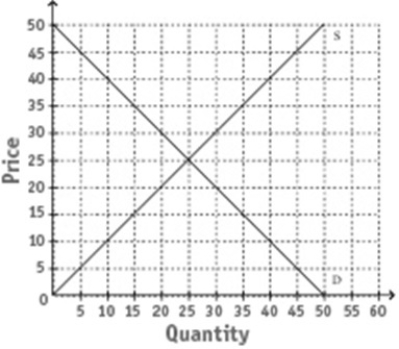
-Refer to Exhibit 5-1. A price ceiling set at $35 would not cause a shortage.
-Refer to Exhibit 5-1. A price ceiling set at $35 would not cause a shortage. (True/False)
4.8/5 (71)
(71) Which of the following is likely to result in a lower equilibrium price?
(Multiple Choice)
4.7/5 (72)
(72) Assuming that the demand and supply of a good have moved in the same direction, and by the same amount, the new equilibrium would represent:
(Multiple Choice)
4.9/5 (95)
(95) 
Filters
- Essay(0)
- Multiple Choice(0)
- Short Answer(0)
- True False(0)
- Matching(0)