



 Chat with AI
Exam 2: Patterns in the Skymotions of Earth

Exam 1: Why Learn Astronomy 86 Questions
Exam 2: Patterns in the Skymotions of Earth89 Questions
Exam 3: Motion of Astronomical Bodies78 Questions
Exam 4: Gravity and Orbits74 Questions
Exam 5: Light81 Questions
Exam 6: The Tools of the Astronomer88 Questions
Exam 7: The Birth and Evolution of Planetary Systems77 Questions
Exam 8: The Terrestrial Planets and Earths Moon82 Questions
Exam 9: Atmospheres of the Terrestrial Planets81 Questions
Exam 10: Worlds of Gas and Liquid the Giant Planets88 Questions
Exam 11: Planetary Adornments Moons and Rings91 Questions
Exam 12: Dwarf Planets and Small Solar System Bodies87 Questions
Exam 13: Taking the Measure of Stars83 Questions
Exam 14: Our Starthe Sun86 Questions
Exam 15: Star Formation and the Interstellar Medium84 Questions
Exam 16: Evolution of Low-Mass Stars88 Questions
Exam 17: Evolution of High-Mass Stars88 Questions
Exam 18: Relativity and Black Holes87 Questions
Exam 19: The Expanding Universe86 Questions
Exam 20: Galaxies93 Questions
Exam 21: The Milky Waya Normal Spiral Galaxy93 Questions
Exam 22: Modern Cosmology85 Questions
Exam 23: Large-Scale Structure in the Universe59 Questions
Exam 24: Life61 Questions
Select questions type


If you see a full moon tonight,how long would you have to wait to see the next full moon?
(Multiple Choice)
4.9/5  (80)
(80) The position of the autumnal equinox lies at the intersection of which two great celestial circles on the celestial sphere?
(Essay)
4.9/5 (78)
(78) When the Northern Hemisphere experiences fall,the Southern Hemisphere experiences:
(Multiple Choice)
5.0/5 (87)
(87) When in the New Moon phase,the moon will be visible in the eastern sky at sunrise.
(True/False)
4.7/5 (81)
(81) Earth has an average radius of approximately 6.4 × 10³ km.What is the average speed,in units of km/s,of the ground at the Earth's equator due to the daily rotation of Earth if there are 8.64 × 10⁴ seconds per day?
(Essay)
4.8/5 (75)
(75) The day with the smallest number of daylight hours over the course of the year for a person living in the Southern Hemisphere is the:
(Multiple Choice)
4.8/5 (81)
(81) On which day of the year does the Sun reach its northernmost point in the sky?
(Multiple Choice)
4.8/5 (76)
(76) At what latitude is the north celestial pole at your horizon?
(Multiple Choice)
4.9/5 (80)
(80) If a person on Earth currently views the Moon in a waxing crescent phase,in what phase would the Earth appear to a person on the Moon?
(Multiple Choice)
4.9/5 (93)
(93) The seasons on Earth are caused by the change in distance between the Sun and Earth.
(True/False)
4.8/5 (78)
(78) Earth experiences seasons due to the tilt of its axis.What are two consequences of this tilt that contribute to the seasons?
(Essay)
4.7/5 (79)
(79) The fact that we always see the same side of the Moon indicates that the Moon does not rotate about an axis.
(True/False)
4.9/5 (81)
(81) The center of the Milky Way lies approximately 30° south of the celestial equator.From what latitudes on the Earth is it impossible to view the center of our galaxy?
(Essay)
5.0/5 (99)
(99) If the Earth's axis were tilted by 35°,instead of its actual tilt,how would the seasons be different than they are currently?
(Multiple Choice)
4.8/5 (73)
(73) Based on the location of the moon in the diagram below,
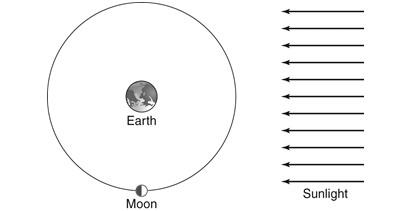 draw a picture of how the moon would appear to an observer located on Earth.
 (Essay)
4.8/5 (81)
(81) You and a friend go outside to view the stars at midnight tonight.Six months later,you go outside to find the stars in exactly the same position in the sky as when you and your friend viewed them.What time is it? Assume you can see the stars at any time,day or night.
(Multiple Choice)
4.8/5 (77)
(77) 
Filters
- Essay(0)
- Multiple Choice(0)
- Short Answer(0)
- True False(0)
- Matching(0)