



 Chat with AI
Exam 17: Evolution of High-Mass Stars

Exam 1: Why Learn Astronomy 86 Questions
Exam 2: Patterns in the Skymotions of Earth89 Questions
Exam 3: Motion of Astronomical Bodies78 Questions
Exam 4: Gravity and Orbits74 Questions
Exam 5: Light81 Questions
Exam 6: The Tools of the Astronomer88 Questions
Exam 7: The Birth and Evolution of Planetary Systems77 Questions
Exam 8: The Terrestrial Planets and Earths Moon82 Questions
Exam 9: Atmospheres of the Terrestrial Planets81 Questions
Exam 10: Worlds of Gas and Liquid the Giant Planets88 Questions
Exam 11: Planetary Adornments Moons and Rings91 Questions
Exam 12: Dwarf Planets and Small Solar System Bodies87 Questions
Exam 13: Taking the Measure of Stars83 Questions
Exam 14: Our Starthe Sun86 Questions
Exam 15: Star Formation and the Interstellar Medium84 Questions
Exam 16: Evolution of Low-Mass Stars88 Questions
Exam 17: Evolution of High-Mass Stars88 Questions
Exam 18: Relativity and Black Holes87 Questions
Exam 19: The Expanding Universe86 Questions
Exam 20: Galaxies93 Questions
Exam 21: The Milky Waya Normal Spiral Galaxy93 Questions
Exam 22: Modern Cosmology85 Questions
Exam 23: Large-Scale Structure in the Universe59 Questions
Exam 24: Life61 Questions
Select questions type


Using the formula g = GMNS/R2NS,calculate the acceleration of gravity on a neutron star of mass 3 solar masses and radius 10 km,and express this in terms of the acceleration of gravity on the surface of the Earth (g = 9.8 m/s2).

Free
(Multiple Choice)
4.9/5  (79)
(79) Correct Answer: Verified
D
A main-sequence star of 25 solar masses has about 12.5 times the luminosity of a 10 solar mass star.This is because:
Free
(Multiple Choice)
4.9/5 (76)
(76) Correct Answer:Verified
VerifiedA
The Type II supernova that created the Crab Nebula was seen by Chinese and Arab astronomers in the year 1054 CE.Because the star is 6,500 light-years away from us,we know the star exploded in the year:
Free
(Multiple Choice)
4.9/5 (81)
(81) Correct Answer:Verified
VerifiedD
With the Hubble Space Telescope,you discover a Cepheid variable star in a nearby galaxy that has a period of 30 days.If nearby Cepheids follow a period-luminosity relationship that says the luminosity of the star is L = 335 L⨀ × (P/1 day),then what is this Cepheid's luminosity and absolute magnitude? Recall that the Sun's absolute magnitude is M = 5.If the apparent magnitude of the Cepheid is 25,what is this galaxy's distance in Mpc?
(Essay)
4.8/5 (83)
(83) What is the minimum mass main-sequence star that becomes a Type II supernova?
(Multiple Choice)
4.8/5 (88)
(88) An iron core cannot support a massive main-sequence star because:
(Multiple Choice)
4.7/5 (86)
(86) When the core of a massive star collapses,a neutron star forms because:
(Multiple Choice)
4.9/5 (71)
(71) Massive stars synthesize chemical elements going from helium up to iron:
(Multiple Choice)
4.7/5 (85)
(85) The Crab Nebula is an important test of our ideas about supernova explosions because:
(Multiple Choice)
4.9/5 (74)
(74) Every pulsar is a neutron star,but not every neutron star is a pulsar.
(True/False)
4.7/5 (80)
(80) In the CNO cycle,carbon is used a catalyst for the fusion of hydrogen to helium.This means that:
(Multiple Choice)
4.9/5 (81)
(81) Neutron stars are sometimes found in binary systems,where matter overflowing from a companion star and accreting onto the neutron star will produce X-rays and other energetic phenomena.
(True/False)
4.9/5 (80)
(80) What characteristic of a star cluster is used to determine its age?
(Multiple Choice)
4.9/5 (80)
(80) Cepheid variable stars are important because we can use them to determine the distance to any stellar group that contains some of these stars.
(True/False)
4.9/5 (70)
(70) Why are star clusters helpful for testing our ideas of stellar structure and evolution?
(Essay)
4.9/5 (76)
(76) Suppose you measured H-R diagrams for the two star clusters pictured below.Which of the following statements is true? 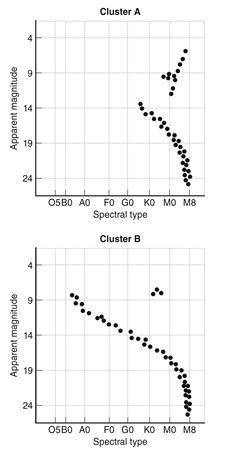
(Multiple Choice)
4.7/5 (74)
(74) When the first pulsar was discovered,scientists thought it might be a signal from a distant extraterrestrial civilization.However,this idea was quickly discarded because:
(Multiple Choice)
4.7/5 (78)
(78) The production of large numbers of neutrons in nuclear reactions at the core of a massive star helps rob the core of energy and speeds its eventual collapse.
(True/False)
4.9/5 (71)
(71) 
Filters
- Essay(0)
- Multiple Choice(0)
- Short Answer(0)
- True False(0)
- Matching(0)