



 Chat with AI
Exam 17: Evolution of High-Mass Stars

Exam 1: Why Learn Astronomy 86 Questions
Exam 2: Patterns in the Skymotions of Earth89 Questions
Exam 3: Motion of Astronomical Bodies78 Questions
Exam 4: Gravity and Orbits74 Questions
Exam 5: Light81 Questions
Exam 6: The Tools of the Astronomer88 Questions
Exam 7: The Birth and Evolution of Planetary Systems77 Questions
Exam 8: The Terrestrial Planets and Earths Moon82 Questions
Exam 9: Atmospheres of the Terrestrial Planets81 Questions
Exam 10: Worlds of Gas and Liquid the Giant Planets88 Questions
Exam 11: Planetary Adornments Moons and Rings91 Questions
Exam 12: Dwarf Planets and Small Solar System Bodies87 Questions
Exam 13: Taking the Measure of Stars83 Questions
Exam 14: Our Starthe Sun86 Questions
Exam 15: Star Formation and the Interstellar Medium84 Questions
Exam 16: Evolution of Low-Mass Stars88 Questions
Exam 17: Evolution of High-Mass Stars88 Questions
Exam 18: Relativity and Black Holes87 Questions
Exam 19: The Expanding Universe86 Questions
Exam 20: Galaxies93 Questions
Exam 21: The Milky Waya Normal Spiral Galaxy93 Questions
Exam 22: Modern Cosmology85 Questions
Exam 23: Large-Scale Structure in the Universe59 Questions
Exam 24: Life61 Questions
Select questions type


Describe the physical mechanism that causes pulsations in Cepheid variables.
(Essay)
4.9/5  (75)
(75) Name three processes that speed the collapse of the core of a dying high-mass star.
(Essay)
4.8/5 (72)
(72) As a high-mass main-sequence star evolves off the main sequence,it follows a: __________ on the H-R diagram.
(Multiple Choice)
4.8/5 (83)
(83) Once silicon burning begins to fuse iron in the core of a high-mass main-sequence star,it only has a few __________ left to live.
(Multiple Choice)
4.8/5 (85)
(85) Type I and Type II supernovae can be distinguished by what combination of observations?
(Multiple Choice)
4.8/5 (77)
(77) Why do main-sequence high-mass stars lose so much mass compared to low-mass stars?
(Essay)
4.9/5 (67)
(67) If a 25M⨀ main-sequence star loses mass at a rate of 10−6 M⨀/yr,then how much mass will it lose in its lifetime of 3 million years?
(Multiple Choice)
4.8/5 (71)
(71) We can determine the age of a star cluster because stars of different masses go through their lives at different rates.
(True/False)
4.8/5 (74)
(74) Of all the main-sequence stars ever formed with a mass equal to 25 percent of the Sun's mass,how many are still on the main sequence today?
(Multiple Choice)
4.8/5 (80)
(80) The acceleration from gravity on the surface of a neutron star can be how large compared to the value on the surface of the Earth? For reference,the typical mass of a neutron star is 2 M⨀ and its radius is approximately 10 km.
(Multiple Choice)
4.8/5 (88)
(88) We can identify only a fraction of all the radio pulsars that exist in our galaxy because:
(Multiple Choice)
4.8/5 (73)
(73) How does the energy in light emitted by a supernova compare to the energy emitted by the Sun during its lifetime?
(Multiple Choice)
4.8/5 (91)
(91) 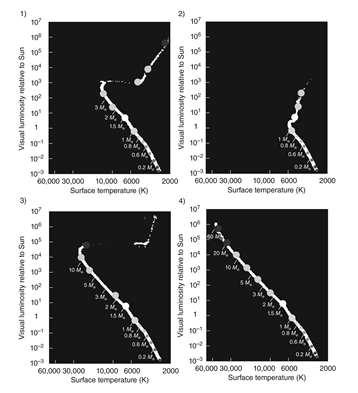
What is one way that massive stars differ from low-mass stars?
(Multiple Choice)
4.9/5 (75)
(75) Each stage of nuclear burning in 25 M⨀ star is __________ in duration than in a star of 15 M⨀.
(Multiple Choice)
4.9/5 (73)
(73) 
Filters
- Essay(0)
- Multiple Choice(0)
- Short Answer(0)
- True False(0)
- Matching(0)