



 Chat with AI
Exam 14: Our Starthe Sun

Exam 1: Why Learn Astronomy 86 Questions
Exam 2: Patterns in the Skymotions of Earth89 Questions
Exam 3: Motion of Astronomical Bodies78 Questions
Exam 4: Gravity and Orbits74 Questions
Exam 5: Light81 Questions
Exam 6: The Tools of the Astronomer88 Questions
Exam 7: The Birth and Evolution of Planetary Systems77 Questions
Exam 8: The Terrestrial Planets and Earths Moon82 Questions
Exam 9: Atmospheres of the Terrestrial Planets81 Questions
Exam 10: Worlds of Gas and Liquid the Giant Planets88 Questions
Exam 11: Planetary Adornments Moons and Rings91 Questions
Exam 12: Dwarf Planets and Small Solar System Bodies87 Questions
Exam 13: Taking the Measure of Stars83 Questions
Exam 14: Our Starthe Sun86 Questions
Exam 15: Star Formation and the Interstellar Medium84 Questions
Exam 16: Evolution of Low-Mass Stars88 Questions
Exam 17: Evolution of High-Mass Stars88 Questions
Exam 18: Relativity and Black Holes87 Questions
Exam 19: The Expanding Universe86 Questions
Exam 20: Galaxies93 Questions
Exam 21: The Milky Waya Normal Spiral Galaxy93 Questions
Exam 22: Modern Cosmology85 Questions
Exam 23: Large-Scale Structure in the Universe59 Questions
Exam 24: Life61 Questions
Select questions type


If a coronal mass ejection occurs on the Sun that expels material at a speed of 800 km/s,how long will it take these charged particles to reach the Earth?

Free
(Multiple Choice)
4.9/5  (73)
(73) Correct Answer: Verified
D
The Sun exhibits differential rotation.Explain what differential rotation is.Which planets also do this? Why don't the others?
Free
(Essay)
4.7/5 (89)
(89) Correct Answer:Verified
VerifiedDifferential rotation means that the equator of an object rotates more rapidly than the higher latitude regions.In addition to the Sun,the giant planets all do this.The terrestrial planets can't have differential rotation because they all have solid surfaces that must rotate together.
The picture below shows a diagram of the Sun with zones labeled A,B,and C. 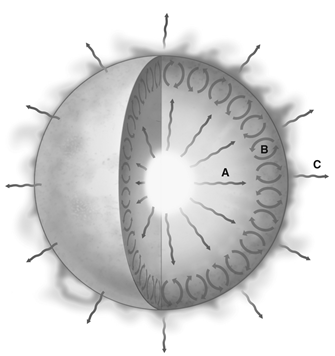 Explain how energy is being transferred in each of the three regions.
Free
(Essay)
4.8/5 (80)
(80) Correct Answer:Verified
VerifiedRegion A is the radiative zone,where energy is being carried by photons.Region B is the convective zone,where moving gas carries the energy.Region C is outside the Sun,where the energy is again being carried by photons.
The magnetic field of the Sun is continuously produced and deformed by:
(Multiple Choice)
4.9/5 (70)
(70) In the radiative zone inside the Sun,photons are transported from the core to the convective zone in a matter of seconds.
(True/False)
4.9/5 (70)
(70) Which of the following is NOT a result of an increase in solar activity?
(Multiple Choice)
4.8/5 (69)
(69) The best wavelength to use to observe a solar prominence is:
(Multiple Choice)
4.8/5 (72)
(72) Solar wind particles hit the surface of the Moon,but they don't make it to the surface of the Earth because the Earth:
(Multiple Choice)
4.8/5 (85)
(85) What do astronomers mean when they say that the Sun makes energy by hydrogen burning?
(Multiple Choice)
4.8/5 (80)
(80) What keeps the gas in the Sun's corona from flying away from the Sun?
(Multiple Choice)
4.8/5 (84)
(84) When you turn on the heater in a car,the passengers in the front seat warm up first,then eventually the warm air gets to the passengers in the back seat.This is an example of energy being transported by:
(Multiple Choice)
4.9/5 (80)
(80) Through hydrogen fusion,the Sun loses approximately 4 million tons of mass each second.If it burns hydrogen at this rate for 10 billion years,what percentage of its original mass will it lose in all? (Note: The mass of the Sun is 1.99 × 1030 kg,and 1 ton = 1,000 kg. )
(Essay)
4.9/5 (82)
(82) Density,temperature,and pressure increase as you move inward in the interior of the Sun.This means that the force of gravity, (Fg = GMm/r2),_________ as you move inward toward the core.
(Multiple Choice)
4.9/5 (89)
(89) The Sun's internal magnetic field becomes tangled up over time because of:
(Multiple Choice)
4.8/5 (81)
(81) Why is hydrogen burning the main energy source for main-sequence stars? Give at least two reasons.
(Essay)
4.9/5 (81)
(81) If coronal holes covered a larger fraction of the Sun's surface,the solar wind would contain a higher density of particles.
(True/False)
4.9/5 (80)
(80) If a sunspot appears one-quarter as bright as the surrounding photosphere,and the average temperature of the photosphere is 5800 K,what is the temperature of the gas in this sunspot?
(Multiple Choice)
4.7/5 (84)
(84) 
Filters
- Essay(0)
- Multiple Choice(0)
- Short Answer(0)
- True False(0)
- Matching(0)