



 Chat with AI
Exam 2: Patterns in the Skymotions of Earth

Exam 1: Why Learn Astronomy 86 Questions
Exam 2: Patterns in the Skymotions of Earth89 Questions
Exam 3: Motion of Astronomical Bodies78 Questions
Exam 4: Gravity and Orbits74 Questions
Exam 5: Light81 Questions
Exam 6: The Tools of the Astronomer88 Questions
Exam 7: The Birth and Evolution of Planetary Systems77 Questions
Exam 8: The Terrestrial Planets and Earths Moon82 Questions
Exam 9: Atmospheres of the Terrestrial Planets81 Questions
Exam 10: Worlds of Gas and Liquid the Giant Planets88 Questions
Exam 11: Planetary Adornments Moons and Rings91 Questions
Exam 12: Dwarf Planets and Small Solar System Bodies87 Questions
Exam 13: Taking the Measure of Stars83 Questions
Exam 14: Our Starthe Sun86 Questions
Exam 15: Star Formation and the Interstellar Medium84 Questions
Exam 16: Evolution of Low-Mass Stars88 Questions
Exam 17: Evolution of High-Mass Stars88 Questions
Exam 18: Relativity and Black Holes87 Questions
Exam 19: The Expanding Universe86 Questions
Exam 20: Galaxies93 Questions
Exam 21: The Milky Waya Normal Spiral Galaxy93 Questions
Exam 22: Modern Cosmology85 Questions
Exam 23: Large-Scale Structure in the Universe59 Questions
Exam 24: Life61 Questions
Select questions type


For an observer in the Northern Hemisphere,as he or she looks north,stars travel in a clockwise direction around the north celestial pole over the course of the night.
(True/False)
4.7/5  (79)
(79) The Earth's rotational axis precesses in space and completes one revolution every:
(Multiple Choice)
4.8/5 (80)
(80) When the Northern Hemisphere experiences summer,the Southern Hemisphere experiences:
(Multiple Choice)
4.8/5 (75)
(75) A person who lives at the equator will see the Sun directly overhead at noon every day of the year.
(True/False)
4.8/5 (73)
(73) How often would we have leap years if Earth's orbital period were 365.1 days?
(Multiple Choice)
4.9/5 (86)
(86) How does today's Gregorian calendar differ from the calendars of more ancient civilizations,such as the Chinese,the Egyptians,and the Babylonians?
(Essay)
4.9/5 (83)
(83) Draw a dome representing the visible sky.Label the horizon,meridian,zenith,and each of the four cardinal directions (north,east,south,and west).
(Essay)
5.0/5 (84)
(84) If you are standing on the equator and shoot a cannonball directly north,where would you expect it to land?
(Essay)
4.9/5 (80)
(80) Consider an observer located on the equator.If the observer sees a star directly overhead at 10 P.m. ,where will that star be located in the night sky at 3 A.M.?
(Essay)
4.8/5 (72)
(72) On what place(s)on Earth can you stand and have the celestial equator be at the same altitude for all 360° of its circumference?
(Essay)
4.9/5 (86)
(86) No matter where you are on Earth,stars appear to rotate about a point called the:
(Multiple Choice)
4.9/5 (78)
(78) At which of the possible times below could the waxing gibbous moon be seen rising?
(Multiple Choice)
4.7/5 (89)
(89) The altitude of the Sun as it crosses the meridian changes during the year.
(True/False)
4.8/5 (79)
(79) Based on the location of the moon in the diagram below,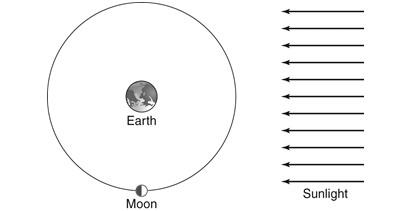 draw a picture of how the moon would appear to an observer located on Earth.
 (Essay)
4.8/5 (77)
(77) The meridian is half of an imaginary circle in the sky that passes through an observer's zenith and both celestial poles.
(True/False)
4.8/5 (74)
(74) At what latitude is the north celestial pole located at your zenith?
(Multiple Choice)
4.9/5 (77)
(77) 
Filters
- Essay(0)
- Multiple Choice(0)
- Short Answer(0)
- True False(0)
- Matching(0)