



 Chat with AI
Exam 12: Optical Images

Exam 1: The Electric Field I: Discrete Charge Distributions87 Questions
Exam 2: The Electric Field II: Continuous Charge Distributions75 Questions
Exam 3: Electric Potential108 Questions
Exam 4: Capacitance73 Questions
Exam 5: Electric Current and Direct-Current Circuits160 Questions
Exam 6: The Magnetic Field71 Questions
Exam 7: Sources of the Magnetic Field115 Questions
Exam 8: Magnetic Induction84 Questions
Exam 9: Alternating-Current Circuits119 Questions
Exam 10: Maxwells Equations and Electromagnetic Waves61 Questions
Exam 11: Properties of Light116 Questions
Exam 12: Optical Images143 Questions
Exam 13: Interference and Diffraction116 Questions
Exam 14: Wave Particle Duality and Quantum Physics153 Questions
Exam 15: Applications of the Schrodinger Equation54 Questions
Exam 16: Atoms128 Questions
Exam 17: Molecules44 Questions
Exam 18: Solids and the Theory of Conduction83 Questions
Exam 19: Relativity83 Questions
Exam 20: Nuclear Physics135 Questions
Exam 21: Elementary Particles and the Beginning of the Universe68 Questions
Select questions type


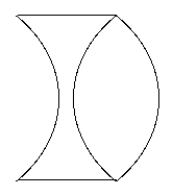 The figure shows a doublet lens in which the positive lens and the negative lens are both manufactured from flint glass and have the same radius of curvature. The focal length of the negative lens is -50.8 cm, and the focal length of the positive lens is 50.8 cm. The combined focal length of the doublet is
 (Multiple Choice)
4.9/5  (77)
(77) A 6-cm-high candle is placed in front of a converging lens with a focal length of magnitude 30 cm. If the image distance is +50 cm, then find the image height of the candle and whether it is upright or inverted.
(Multiple Choice)
4.7/5 (78)
(78) 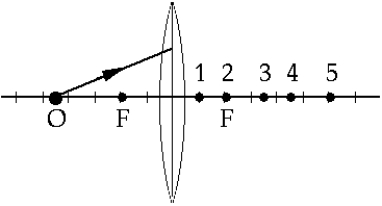 A ray of light leaves point O and passes through a thin positive lens. It crosses the principal axis at point
 (Multiple Choice)
4.8/5 (77)
(77) In order for a lens to produce a real image, the light rays from the object
(Multiple Choice)
4.8/5 (77)
(77) 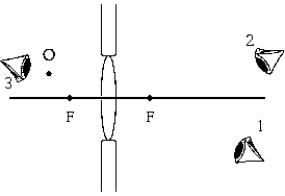 A point object O is placed in front of a thin converging lens. Observers are at 1, 2, and 3. The image of point O is seen by the
 (Multiple Choice)
4.7/5 (74)
(74)  The image of the encircled point on the object formed in the positive lens is at which circle?
 (Multiple Choice)
4.7/5 (84)
(84) An object is placed 5 m in front of a converging lens of focal length 11 cm. A diverging lens with focal length 11 cm is placed 6 cm behind the converging lens. Calculate the position of the final image produced by the two-lens system and state if this final image is real or virtual.
(Multiple Choice)
5.0/5 (83)
(83)  When a real object is placed just inside the focal point F of a diverging lens, the image is
 (Multiple Choice)
4.9/5 (85)
(85) Your hypermetropic eye cannot focus on objects that are more than 225 cm from it. The power in diopters of the lens you need for distinct distant vision is
(Multiple Choice)
4.9/5 (88)
(88)  When the ray in the diagram is continued through the diverging lens, it passes through point
 (Multiple Choice)
4.8/5 (88)
(88) When you look at the image reflected from two plane mirrors placed at 90 , the image
(Multiple Choice)
4.7/5 (81)
(81)  The parallel rays incident on the surface of the concave spherical mirror in the figure converge to a point at
 (Multiple Choice)
4.8/5 (82)
(82) A lens forms an erect image of a real object. The image is twice the size of the object and appears to be 40 cm from the lens. Determine the power of the lens in diopters (D).
(Multiple Choice)
4.8/5 (77)
(77)  An object is placed between two mirrors set at an angle to each other. The location of the image of the object in mirror 1 is shown in the figure. The location of the image of that image in mirror 2 is at
 (Multiple Choice)
4.9/5 (84)
(84) What is the minimum height of a plane mirror in which a standing woman can see her entire body reflected?
(Multiple Choice)
4.8/5 (69)
(69) Your myopic eye cannot focus on objects that are more than 16.5 cm away or closer than 4.5 cm. When you put on glasses for normal distant vision, your new near point is
(Multiple Choice)
4.9/5 (76)
(76) You construct a microscope with an objective of focal length 1.50 cm and an eyepiece of focal length 2.50 cm. You set the two lenses 20.0 cm apart. What is the overall magnification of your microscope for a person with a normal near point (25.0 cm)?
(Multiple Choice)
4.7/5 (90)
(90) An object is placed 10 inches in front of a concave mirror that has a radius of curvature of 8 inches. The image is located
(Multiple Choice)
4.8/5 (76)
(76) An object is placed to the left of a thin converging lens with a focal length of 8 cm. A real and inverted image is formed 13.3 cm to the right of the lens. What is the distance of the object from the lens?
(Multiple Choice)
5.0/5 (100)
(100)  An object is shown to the left of a converging lens of focal length f. A ray of light leaves the object and enters the lens. After this ray of light passes through the lens, it will go through point
 (Multiple Choice)
4.8/5 (71)
(71) 
Filters
- Essay(0)
- Multiple Choice(0)
- Short Answer(0)
- True False(0)
- Matching(0)