



 Chat with AI
Exam 12: Optical Images

Exam 1: The Electric Field I: Discrete Charge Distributions87 Questions
Exam 2: The Electric Field II: Continuous Charge Distributions75 Questions
Exam 3: Electric Potential108 Questions
Exam 4: Capacitance73 Questions
Exam 5: Electric Current and Direct-Current Circuits160 Questions
Exam 6: The Magnetic Field71 Questions
Exam 7: Sources of the Magnetic Field115 Questions
Exam 8: Magnetic Induction84 Questions
Exam 9: Alternating-Current Circuits119 Questions
Exam 10: Maxwells Equations and Electromagnetic Waves61 Questions
Exam 11: Properties of Light116 Questions
Exam 12: Optical Images143 Questions
Exam 13: Interference and Diffraction116 Questions
Exam 14: Wave Particle Duality and Quantum Physics153 Questions
Exam 15: Applications of the Schrodinger Equation54 Questions
Exam 16: Atoms128 Questions
Exam 17: Molecules44 Questions
Exam 18: Solids and the Theory of Conduction83 Questions
Exam 19: Relativity83 Questions
Exam 20: Nuclear Physics135 Questions
Exam 21: Elementary Particles and the Beginning of the Universe68 Questions
Select questions type


Your near point is 25.0 cm, and you're using a 50-diopter lens as a simple magnifier. What magnification do you obtain?
(Multiple Choice)
4.8/5  (79)
(79) 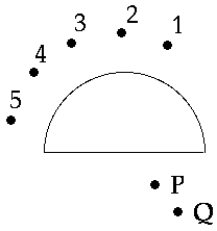 Half-round slabs of glass or plastic are often used to trace rays. Pins are placed at points P and Q. For an observer to see the images of the pins in line, she should place her eye at point
 (Multiple Choice)
4.9/5 (88)
(88) A stamp collector with a normal near point (25 cm) needs a magnifying power of 10 to examine her stamps. If one of the stamps is 2.0 cm wide, what is the angle (in degrees) subtended by the stamp when it is viewed through her magnifier?
(Multiple Choice)
4.8/5 (82)
(82) How much must the focal length of an eye change when an object, originally at 4.00 m, is brought to 40.0 cm from the eye?
(Multiple Choice)
4.7/5 (79)
(79) A cat is watching a goldfish in a spherical fishbowl of radius 15.0 cm. The goldfish is 5.00 cm from the side of the bowl nearest the cat. How far from the side of the bowl does the fish appear to be to the cat? (For water, n = 1.33.)
(Multiple Choice)
4.8/5 (76)
(76) Two plane mirrors are arranged so that the reflecting surfaces face each other and are parallel. The mirrors are located at x =  2 m and x = 2 m. An object is located at
X = 1 m. The second image from the left mirror is located at
2 m and x = 2 m. An object is located at
X = 1 m. The second image from the left mirror is located at (Multiple Choice)
4.9/5 (77)
(77) An object is located 3 cm in front of a converging lens of focal length 2 cm. A diverging lens of -6 cm focal length is placed 3 cm on the other side of the converging lens. What is the final image distance with respect to the diverging lens?
(Multiple Choice)
4.9/5 (93)
(93) An object is placed 20 cm to the left of a converging lens with a focal length of 8 cm. A second converging lens of focal length 12 cm is placed to the right of the first lens. If the final image of the combined lens system is virtual and 15 cm from the second lens, then calculate the distance between the two lenses.
(Multiple Choice)
4.9/5 (87)
(87) Your microscope has an objective lens of focal length 1.50 cm and an eyepiece of focal length 2.50 cm separated by 20.0 cm. What is the magnifying power if your near point is 25.0 cm?
(Multiple Choice)
4.9/5 (73)
(73) How much must the focal length of an eye change when an object, originally at 5.00 m, is brought to 30.0 cm from the eye?
(Multiple Choice)
4.7/5 (84)
(84) A circular coin is 33.3 cm from a concave spherical mirror. (Assume the coin is on the optical axis.) The image of the coin is produced 10.0 cm from the mirror and on the same side as its real position. If the coin is moved to a position 23.3 cm from the mirror, calculate how far from the mirror the new image is:
(Multiple Choice)
4.8/5 (79)
(79) Your nearsighted coach cannot focus clearly on objects more distant than 50 cm from his eye. What power lenses are required for him to follow the flight of a batted ball?
(Multiple Choice)
4.8/5 (75)
(75) A short sighted person's range of vision is between 12 cm and 35 cm from the eye. What focal length lens is needed to allow her to see distant objects clearly?
(Multiple Choice)
4.9/5 (73)
(73) An object placed 7.62 cm from a simple magnifying glass of focal length 10.2 cm is magnified
(Multiple Choice)
4.8/5 (85)
(85) An object 2 cm high is placed 20 cm from a thin convex lens that has a focal length of 10 cm. Which of the following statements describes the image formed?
(Multiple Choice)
4.8/5 (71)
(71) A real object is 42 cm from a negative lens with f = -21 cm. The image is
(Multiple Choice)
4.8/5 (82)
(82) 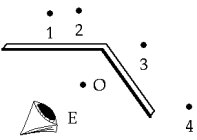 Two plane mirrors make an angle of 120° as shown. An object is placed at O. When the eye is placed at E, it will observe images formed at
 (Multiple Choice)
4.8/5 (84)
(84) The lens system used in a Galilean telescope or opera glasses consists of a positive lens and a negative lens on the same axis. In the following ray diagrams the focal points of the positive lens are marked F and F' and those of the negative lens are marked f and f'. The points F and f' coincide. A ray of light comes from a distant object, traverses the system, and enters an eye on the right side of the diagram. Which of the ray diagrams is correct?
(Multiple Choice)
4.7/5 (77)
(77) For a myopic eye that cannot focus on objects more than 25 cm in front of it, the power in diopters of the lens needed for distinct distant vision is
(Multiple Choice)
4.8/5 (68)
(68) 
Filters
- Essay(0)
- Multiple Choice(0)
- Short Answer(0)
- True False(0)
- Matching(0)