



 Chat with AI
Exam 12: Optical Images

Exam 1: The Electric Field I: Discrete Charge Distributions87 Questions
Exam 2: The Electric Field II: Continuous Charge Distributions75 Questions
Exam 3: Electric Potential108 Questions
Exam 4: Capacitance73 Questions
Exam 5: Electric Current and Direct-Current Circuits160 Questions
Exam 6: The Magnetic Field71 Questions
Exam 7: Sources of the Magnetic Field115 Questions
Exam 8: Magnetic Induction84 Questions
Exam 9: Alternating-Current Circuits119 Questions
Exam 10: Maxwells Equations and Electromagnetic Waves61 Questions
Exam 11: Properties of Light116 Questions
Exam 12: Optical Images143 Questions
Exam 13: Interference and Diffraction116 Questions
Exam 14: Wave Particle Duality and Quantum Physics153 Questions
Exam 15: Applications of the Schrodinger Equation54 Questions
Exam 16: Atoms128 Questions
Exam 17: Molecules44 Questions
Exam 18: Solids and the Theory of Conduction83 Questions
Exam 19: Relativity83 Questions
Exam 20: Nuclear Physics135 Questions
Exam 21: Elementary Particles and the Beginning of the Universe68 Questions
Select questions type


An object is placed 200 cm from a screen. When a converging lens is placed between the object and screen at a distance of 160 cm from the object, an image is formed on the screen. Without moving the object or screen, an image can also be formed on the screen when the distance from the object to the lens is
(Multiple Choice)
4.9/5  (68)
(68)  Which of the following statements about the figure is correct when the index of refraction n2 is greater than n1?
 (Multiple Choice)
4.8/5 (72)
(72) Your farsighted girlfriend requires lenses with a power of 1.67 diopters to read comfortably from a book that is 25.0 cm from her eyes. What is her near point without the lenses?
(Multiple Choice)
4.9/5 (75)
(75) A person uses two microscopes to view the same object. Microscope A is twice as long as microscope B and contains lenses with focal lengths that are one-half those of B. If microscope A provides a magnification of m, then what magnification does B provide?
(Multiple Choice)
4.9/5 (94)
(94) When an object is closer to a convex mirror than the mirror's focal point, the
(Multiple Choice)
4.9/5 (76)
(76)  Two parallel rays are incident on a concave spherical mirror whose center of curvature is at 3. After being reflected, the two rays cross at point
 (Multiple Choice)
4.8/5 (87)
(87) A diverging lens has a focal length of magnitude 20 cm. An object is placed 10 cm in front of the diverging lens. Calculate the magnitude of the distance of the image to the lens.
(Multiple Choice)
4.8/5 (79)
(79) A two lens magnifying system uses lenses of focal lengths 2.5 and 9.5 cm for the objective and eyepiece respectively. The two lenses are positioned 23 cm apart. An object for study is placed 3.0 cm in front of the objective lens. Find the position of the final image relative to the eyepiece lens.
(Multiple Choice)
4.9/5 (63)
(63) To provide large magnification, a telescope should have an objective with a _____ and an eyepiece with a _____.
(Multiple Choice)
4.8/5 (85)
(85) Your microscope has an objective lens of focal length 1.20 cm and an eyepiece of focal length 2.40 cm separated by 16.0 cm. What is the magnifying power if your near point is 25.0 cm?
(Multiple Choice)
4.9/5 (82)
(82) A person uses a simple magnifying glass to study faces on an old school photograph. If the person has a near point of 25 cm and the magnifying glass (which is held close to the eye) has a focal length of 6 cm, then calculate the distance the photograph must be held in front of the magnifying glass.
(Multiple Choice)
4.9/5 (65)
(65) When an object is farther from a concave mirror than twice the mirror's focal length, the
(Multiple Choice)
4.8/5 (85)
(85)  The image produced by the converging lens is at point
The resolving power of a telescope is a measure of the ability of the instrument to
(Multiple Choice)
4.9/5 (72)
(72) 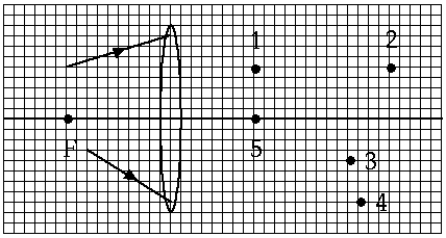 After passing through the thin converging lens, the two rays cross at point
 (Multiple Choice)
4.8/5 (76)
(76) A diverging lens has a focal length of magnitude 20 cm. An object is placed 10 cm in front of the diverging lens. Calculate the magnification of the image and whether it is upright or inverted.
(Multiple Choice)
4.9/5 (69)
(69) When a human eye that has a power of +60 D is fitted with a contact lens of -10 D, the equivalent lens combination is
(Multiple Choice)
4.9/5 (72)
(72) A simple magnifier gives a magnification of 8 times when it is used by a person with a normal near point (25 cm). What is the magnifying power when it is used by a person whose near point is 15 cm?
(Multiple Choice)
4.9/5 (75)
(75) Your nearsighted instructor cannot focus clearly on objects more distant than 150 cm from her eyes. What power lenses are required for her to see distant students clearly?
(Multiple Choice)
4.8/5 (61)
(61) 
Filters
- Essay(0)
- Multiple Choice(0)
- Short Answer(0)
- True False(0)
- Matching(0)