



 Chat with AI
Exam 12: Optical Images

Exam 1: The Electric Field I: Discrete Charge Distributions87 Questions
Exam 2: The Electric Field II: Continuous Charge Distributions75 Questions
Exam 3: Electric Potential108 Questions
Exam 4: Capacitance73 Questions
Exam 5: Electric Current and Direct-Current Circuits160 Questions
Exam 6: The Magnetic Field71 Questions
Exam 7: Sources of the Magnetic Field115 Questions
Exam 8: Magnetic Induction84 Questions
Exam 9: Alternating-Current Circuits119 Questions
Exam 10: Maxwells Equations and Electromagnetic Waves61 Questions
Exam 11: Properties of Light116 Questions
Exam 12: Optical Images143 Questions
Exam 13: Interference and Diffraction116 Questions
Exam 14: Wave Particle Duality and Quantum Physics153 Questions
Exam 15: Applications of the Schrodinger Equation54 Questions
Exam 16: Atoms128 Questions
Exam 17: Molecules44 Questions
Exam 18: Solids and the Theory of Conduction83 Questions
Exam 19: Relativity83 Questions
Exam 20: Nuclear Physics135 Questions
Exam 21: Elementary Particles and the Beginning of the Universe68 Questions
Select questions type


 A plano-concave lens has r1 = 15 cm and is constructed of a material with refractive index of 1.5. The focal length of the lens is
 (Multiple Choice)
5.0/5  (78)
(78) A jeweler's loupe (magnifying glass) has a focal length of 2.00 cm. Assuming that the loupe is held so that it forms an image at the normal near point of 25.0 cm, what magnification does it provide?
(Multiple Choice)
4.9/5 (88)
(88)  A double-convex lens is made of glass of index of refraction 1.60. If the radii of curvature of the two surfaces are 10 cm and 20 cm, the focal length of the lens in air is
 (Multiple Choice)
4.8/5 (74)
(74) 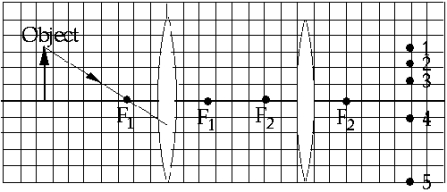 Thin converging lenses 1 and 2 have focal points F1 and F2, respectively. After passing through the two lenses, the ray passes through point
 (Multiple Choice)
4.8/5 (83)
(83) 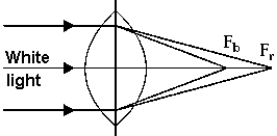 White light falls on a thick lens. The red wavelength and the blue wavelength fall at different focuses. The lens is said to exhibit
 (Multiple Choice)
4.8/5 (79)
(79) 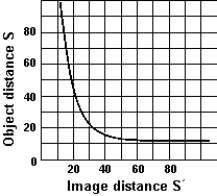 The data in the graph were obtained using a thin lens. The lens must have been a
 (Multiple Choice)
4.8/5 (84)
(84) A positive lens of focal length 40 cm is placed 20 cm behind a negative lens of focal length -80 cm. An object is placed 240 cm in front of the negative lens. The final image distance relative to the positive lens is
(Multiple Choice)
4.9/5 (70)
(70) Suppose your near point is 25.0 cm and you want to obtain a magnifying power of 20 with a simple magnifier. What focal-length lens should you choose?
(Multiple Choice)
4.8/5 (74)
(74) Two people look at the same object through the same microscope. Person A has a near point of xnp and person B has a near point of 2xnp. If person A sees the object magnified m times, with what magnification does person B see the object?
(Multiple Choice)
4.9/5 (69)
(69)  An object is located 3 cm from the surface of a silvered spherical glass Christmas tree ornament that is 3 cm in diameter. The image forms at
 (Multiple Choice)
4.8/5 (72)
(72) An object is 10 cm from a concave spherical mirror whose radius is 10 cm. The image is
(Multiple Choice)
4.8/5 (88)
(88) How far must a man's face be located in front of a concave spherical shaving mirror of radius 120 cm for him to see an erect image of his face four times its real size?
(Multiple Choice)
4.8/5 (76)
(76) A lens of focal length -45 cm is used to correct the vision of a nearsighted person. Where is this person's far point?
(Multiple Choice)
4.9/5 (84)
(84) A farsighted person uses glasses to read. The person then sees _____ print that appears _____ than is actually the case.
(Multiple Choice)
4.8/5 (83)
(83) When an object is farther from a convex mirror than the mirror's focal point, the
(Multiple Choice)
4.9/5 (95)
(95) Which type of aberration can be eliminated using mirrors instead of lenses?
(Multiple Choice)
4.8/5 (74)
(74) The theoretical limit to the sharpness of focus of a lens system is determined by
(Multiple Choice)
4.9/5 (87)
(87) Your near point is xnp, and you're using a lens of focal length xnp/5 as a simple magnifier. What magnification do you obtain?
(Multiple Choice)
4.9/5 (95)
(95) The eyes of some people wearing glasses appear smaller than normal. The glasses help the people to see
(Multiple Choice)
4.8/5 (90)
(90)  An object is placed in front of a plano-concave lens at r1/2. The image produced by the lens is
 (Multiple Choice)
4.9/5 (71)
(71) 
Filters
- Essay(0)
- Multiple Choice(0)
- Short Answer(0)
- True False(0)
- Matching(0)