



 Chat with AI
Exam 3: Electric Potential

Exam 1: The Electric Field I: Discrete Charge Distributions87 Questions
Exam 2: The Electric Field II: Continuous Charge Distributions75 Questions
Exam 3: Electric Potential108 Questions
Exam 4: Capacitance73 Questions
Exam 5: Electric Current and Direct-Current Circuits160 Questions
Exam 6: The Magnetic Field71 Questions
Exam 7: Sources of the Magnetic Field115 Questions
Exam 8: Magnetic Induction84 Questions
Exam 9: Alternating-Current Circuits119 Questions
Exam 10: Maxwells Equations and Electromagnetic Waves61 Questions
Exam 11: Properties of Light116 Questions
Exam 12: Optical Images143 Questions
Exam 13: Interference and Diffraction116 Questions
Exam 14: Wave Particle Duality and Quantum Physics153 Questions
Exam 15: Applications of the Schrodinger Equation54 Questions
Exam 16: Atoms128 Questions
Exam 17: Molecules44 Questions
Exam 18: Solids and the Theory of Conduction83 Questions
Exam 19: Relativity83 Questions
Exam 20: Nuclear Physics135 Questions
Exam 21: Elementary Particles and the Beginning of the Universe68 Questions
Select questions type


Use the following figure to answer the next four problems: 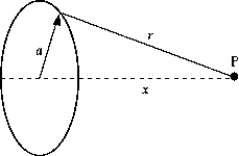 -A disk of radius 10 cm has a uniform charge density of 20 nC/cm2. A small particle of mass m = 10 mg and charge q0 = 5 nC is placed at x = 20 cm and released. The speed of the particle when it is a great distance from the disk is
 (Multiple Choice)
4.8/5  (83)
(83) The electrical potential 2.5 cm from a point charge of Q1 = +4.5 * 10-9 C and 2.0 cm from a second charge Q2 is 3.2 kV. Find Q2.
(Multiple Choice)
5.0/5 (82)
(82) The metal sphere at the top of a small Van de Graaf generator has a radius of 8.0 cm. How much charge can be accumulated on this sphere before dielectric breakdown of the air around it occurs? (The dielectric strength of air is 3.0 MV/m.)
(Multiple Choice)
4.7/5 (72)
(72) Dielectric breakdown occurs in the air at an electric field strength of Emax = 3.0*106 V/m. If the maximum charge that can be placed on a spherical conductor is 2.0 *10-3 C before breakdown, calculate the diameter of the sphere.
(Multiple Choice)
4.8/5 (90)
(90) The electric potential in a region of space is given by
V(x, y, z) = 50 V
The electric field in this region is
(Multiple Choice)
4.8/5 (91)
(91) Use the following figure to answer the next four problems: 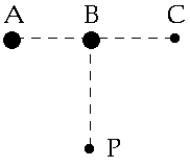 -ABC is a straight line with AB = BC = 0.60 nm. BP is perpendicular to ABC and
BP = 0.80 nm. Charges of +3.2 × 10⁻¹⁹ C are placed at A and C, and a charge of -3.2 × 10⁻¹⁹ C is placed at B. The electric potential at P is
-ABC is a straight line with AB = BC = 0.60 nm. BP is perpendicular to ABC and
BP = 0.80 nm. Charges of +3.2 × 10⁻¹⁹ C are placed at A and C, and a charge of -3.2 × 10⁻¹⁹ C is placed at B. The electric potential at P is (Multiple Choice)
4.9/5 (83)
(83) A solid spherical conductor of radius 20 cm has a charge Q = 25 nC on it. A second, initially uncharged, spherical conductor of radius 12 cm is moved toward the first until they touch and is then moved far away from it. How much charge is there on the second sphere after the two spheres have been separated?
(Multiple Choice)
4.9/5 (72)
(72) Use the following figure to answer the next problem. 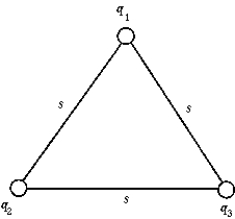 -The electrostatic potential energy of the system of point charges q1 = -1 µC, q2 = 2 µC, and q3 = 3 µC at the corners of the equilateral triangle whose side s = 50 cm is
 (Multiple Choice)
4.9/5 (76)
(76) 
Filters
- Essay(0)
- Multiple Choice(0)
- Short Answer(0)
- True False(0)
- Matching(0)