



 Chat with AI
Exam 3: Electric Potential

Exam 1: The Electric Field I: Discrete Charge Distributions87 Questions
Exam 2: The Electric Field II: Continuous Charge Distributions75 Questions
Exam 3: Electric Potential108 Questions
Exam 4: Capacitance73 Questions
Exam 5: Electric Current and Direct-Current Circuits160 Questions
Exam 6: The Magnetic Field71 Questions
Exam 7: Sources of the Magnetic Field115 Questions
Exam 8: Magnetic Induction84 Questions
Exam 9: Alternating-Current Circuits119 Questions
Exam 10: Maxwells Equations and Electromagnetic Waves61 Questions
Exam 11: Properties of Light116 Questions
Exam 12: Optical Images143 Questions
Exam 13: Interference and Diffraction116 Questions
Exam 14: Wave Particle Duality and Quantum Physics153 Questions
Exam 15: Applications of the Schrodinger Equation54 Questions
Exam 16: Atoms128 Questions
Exam 17: Molecules44 Questions
Exam 18: Solids and the Theory of Conduction83 Questions
Exam 19: Relativity83 Questions
Exam 20: Nuclear Physics135 Questions
Exam 21: Elementary Particles and the Beginning of the Universe68 Questions
Select questions type


The electric field in a region is given by  where the units are in V/m. What is the potential from the origin to (x, y) = (2, 0) m?
 (Multiple Choice)
4.9/5  (80)
(80) The concept of difference in electric potential is most closely associated with
(Multiple Choice)
4.8/5 (80)
(80) Two charges Q1 (= +6 C) and Q2 (= -2 C) are brought from infinity to positions on the x-axis of x = -4 cm and x = +4 cm, respectively. Is it possible to bring a third charge Q3 (= +3 C) from infinity to a point on the x-axis between the charges where the potential is zero, and if so, where would this position be?
(Multiple Choice)
4.8/5 (95)
(95) Use the following figure to answer the next problem.  -Four point charges q1 = -1 C, q2 = 2 C, q3 = 3 C, and q4 = 4 C are located at the corners of a square whose side s = 1 m. The electrostatic potential energy of this system of charges is
 (Multiple Choice)
4.8/5 (72)
(72) The electric potential at the surface of an infinite plane of charge is 100 V. If the charge density of the charge on the infinite plane is s = 1 nC/m2, the electric potential at a distance of 1 m from the infinite plane is
(Multiple Choice)
4.7/5 (93)
(93) A lithium nucleus with a charge of 3(1.6 × 10⁻¹⁹) C and a mass of 7(1.67 × 10⁻²⁷) kg, and an alpha particle with a charge of 2(1.6 × 10⁻¹⁹) C and a mass of 4(1.67 × 10⁻²⁷) kg, are at rest. They could be accelerated to the same kinetic energy by
(Multiple Choice)
4.8/5 (80)
(80)  A charge of 100 nC resides on the surface of a spherical shell of radius 20 cm. The electric potential at a distance of 50 cm from the center of the spherical shell is
 (Multiple Choice)
4.8/5 (73)
(73) Use the following figure to answer the next problem:  Two equal positive charges are placed x m apart. The equipotential lines are at 100 V interval.
-The work required to move a third charge, q = -e, from the+100 V line to b is
Two equal positive charges are placed x m apart. The equipotential lines are at 100 V interval.
-The work required to move a third charge, q = -e, from the+100 V line to b is (Multiple Choice)
4.8/5 (73)
(73) Which of the following statements regarding potential is true?
(Multiple Choice)
4.9/5 (70)
(70) Use the following to answer the next question.  -The electrostatic potential energy of a positively charged body is greatest at point _____.
 (Multiple Choice)
4.8/5 (83)
(83) Use the following figure to answer the next four problems:  -A disk of radius 10 cm has a uniform charge density of 20 nC/cm2. The electric potential at a distance x = 20 cm on its axis is
 (Multiple Choice)
4.8/5 (80)
(80) What is the approximate radius of an equipotential spherical surface of 100 V about a point charge of +45 nC if the potential at an infinite distance from the surface is zero?
(Multiple Choice)
4.8/5 (74)
(74) 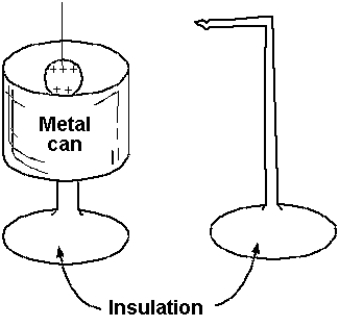 A charged metal ball is lowered into an insulated metal can and permitted to touch the inside of the can. If the ball is withdrawn and hung on a stand, an uncharged ball will be attracted to
 (Multiple Choice)
4.8/5 (81)
(81) Dielectric breakdown occurs in the air at an electric field strength of Emax = 3.0 *106 V/m. If the maximum potential at the surface of a spherical conductor is 5.0 *106 V, then calculate the radius of the sphere.
(Multiple Choice)
4.9/5 (82)
(82) Two charges Q1 (= +6 C) and Q2 (= -2 C) are brought from infinity to positions on the x-axis of x = -4 cm and x = +4 cm, respectively. How much work was done in bringing the charges together?
(Multiple Choice)
5.0/5 (81)
(81) 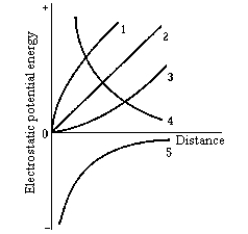 Which of the curves in the graph represents the electrostatic potential energy of a small negative charge plotted as a function of its distance from a positive point charge?
 (Multiple Choice)
4.8/5 (72)
(72) The electric field in a region is given by  where Q is the charge. What is the potential between r = a to r = b?
 (Multiple Choice)
4.9/5 (77)
(77)  Charges +Q and -Q are arranged at the corners of a square as shown. When the electric field
 and the electric potential V are determined at P, the center of the square, we find that
Charges +Q and -Q are arranged at the corners of a square as shown. When the electric field and the electric potential V are determined at P, the center of the square, we find that (Multiple Choice)
4.9/5 (78)
(78) Use the following figure to answer the next four problems:  -ABC is a straight line with AB = BC = 0.60 nm. BP is perpendicular to ABC and
BP = 0.80 nm. Charges of +3.2 × 10⁻¹⁹ C are placed at A and B. The magnitude of the electric field at P is
-ABC is a straight line with AB = BC = 0.60 nm. BP is perpendicular to ABC and
BP = 0.80 nm. Charges of +3.2 × 10⁻¹⁹ C are placed at A and B. The magnitude of the electric field at P is (Multiple Choice)
4.9/5 (89)
(89) 
Filters
- Essay(0)
- Multiple Choice(0)
- Short Answer(0)
- True False(0)
- Matching(0)