



 Chat with AI
Exam 3: Electric Potential

Exam 1: The Electric Field I: Discrete Charge Distributions87 Questions
Exam 2: The Electric Field II: Continuous Charge Distributions75 Questions
Exam 3: Electric Potential108 Questions
Exam 4: Capacitance73 Questions
Exam 5: Electric Current and Direct-Current Circuits160 Questions
Exam 6: The Magnetic Field71 Questions
Exam 7: Sources of the Magnetic Field115 Questions
Exam 8: Magnetic Induction84 Questions
Exam 9: Alternating-Current Circuits119 Questions
Exam 10: Maxwells Equations and Electromagnetic Waves61 Questions
Exam 11: Properties of Light116 Questions
Exam 12: Optical Images143 Questions
Exam 13: Interference and Diffraction116 Questions
Exam 14: Wave Particle Duality and Quantum Physics153 Questions
Exam 15: Applications of the Schrodinger Equation54 Questions
Exam 16: Atoms128 Questions
Exam 17: Molecules44 Questions
Exam 18: Solids and the Theory of Conduction83 Questions
Exam 19: Relativity83 Questions
Exam 20: Nuclear Physics135 Questions
Exam 21: Elementary Particles and the Beginning of the Universe68 Questions
Select questions type


A charge of 2.0 mC is located in a uniform electric field of intensity 4.0 × 10⁵ N/C. How much work is required to move this charge 20 cm along a path making an angle of 60° with the electric field?
(Multiple Choice)
4.7/5  (91)
(91) Calculate the change in electrostatic potential energy of a charge, Q = 1 C, when it is moved from a distance x = 4 m to 2 m from an infinite plane of uniform surface charge density = 10 C/m2.
(Multiple Choice)
4.8/5 (73)
(73)  Two charged metal spheres are connected by a wire. Sphere A is larger than sphere B, as shown. The magnitude of the electric potential of sphere A
 (Multiple Choice)
4.8/5 (77)
(77) Two parallel metal plates 0.35 cm apart have a potential difference between them of
175 V. The electric force on a positive charge of 6.4 × 10⁻¹⁹ C at a point midway between the plates is approximately
(Multiple Choice)
4.9/5 (81)
(81) An electric dipole that has a positive charge of 4.80 × 10⁻¹⁹ C is separated from a negative charge of the same magnitude by 6.40 × 10⁻¹⁰ m. The magnitude of the electric field at the midpoint of the dipole is
(Multiple Choice)
4.7/5 (67)
(67) Two parallel horizontal plates are spaced 0.40 cm apart in air. You introduce an oil droplet of mass 4.9 × 10⁻¹⁷ kg between the plates. If the droplet carries two electronic charges and if there were no air buoyancy, you could hold the droplet motionless between the plates if you kept the potential difference between them at
(Multiple Choice)
4.8/5 (87)
(87) Use the following to answer the next question.  -The electrostatic potential energy of a negatively charged body is greatest at point _____.
 (Multiple Choice)
5.0/5 (78)
(78)  The figure shows portions of four equipotential surfaces whose potentials are related as follows: V1 > V2 > V3 > V4. The lines represent four paths (A A', B B', C C', D D') along which equal test charges are moved. The work involved can be said to be
 (Multiple Choice)
4.7/5 (70)
(70) A positive point charge of 10-4 C is located 3 m from another positive point charge of 10-5 C. Their mutual electric potential energy is
(Multiple Choice)
4.8/5 (75)
(75) The charge density of an infinite line of charge is = 100 nC/m. If zero of potential is chosen to be at a point having a perpendicular distance of 1 m from the line, the electric potential at a perpendicular distance of 50 cm from this line is
(Multiple Choice)
4.9/5 (75)
(75) The electric potential in a region of space is given by
V(x, y, z) = (10 V/m) x + (20 V/m) y + (30 V/m) z
The y-component of the electric field in this region is
(Multiple Choice)
4.8/5 (86)
(86) 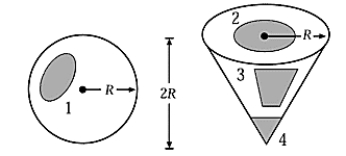 We give the same charge to a metal sphere of radius R and a metal cone of radius R and height 2R. The shaded regions in the figure are of equal area. Which region has the greatest surface charge density?
 (Multiple Choice)
4.8/5 (92)
(92)  The figure shows two plates A and B. Plate A has a potential of 0 V and plate B a potential of 100 V. The dotted lines represent equipotential lines of 25, 50, and 75 V. A positive test charge of 1.6 × 10⁻¹⁹ C at point x is transferred to point z. The energy gained or expended by the test charge is
 (Multiple Choice)
4.8/5 (79)
(79) Use the following to answer the next question:  -Which of the points shown in the diagram are at the same potential?
 (Multiple Choice)
4.7/5 (95)
(95) When 2.0 C of charge moves at constant speed along a path between two points differing in potential by 6.0 V, the amount of work done is
(Multiple Choice)
4.9/5 (91)
(91) An electric dipole that has a positive charge of 4.8 × 10⁻¹⁹ C is separated from a negative charge of the same magnitude by 6.4 × 10⁻¹⁰ m. The electric potential at a point 9.2 × 10⁻¹⁰ m from each of the two charges is
(Multiple Choice)
4.8/5 (76)
(76)  The figure depicts a uniform electric field. The direction in which there is no change in the electric potential is
 (Multiple Choice)
5.0/5 (92)
(92)  The graph that represents the electric potential near an infinite plane of charge is
 (Multiple Choice)
4.8/5 (86)
(86) Use the following figure to answer the next four problems:  -ABC is a straight line with AB = BC = 0.60 nm. BP is perpendicular to ABC and
BP = 0.80 nm. Charges of +3.2 × 10⁻¹⁹ C are placed at A and C, and a charge of -3.2 × 10⁻¹⁹ C is placed at B. The magnitude of the electric field at P is approximately
-ABC is a straight line with AB = BC = 0.60 nm. BP is perpendicular to ABC and
BP = 0.80 nm. Charges of +3.2 × 10⁻¹⁹ C are placed at A and C, and a charge of -3.2 × 10⁻¹⁹ C is placed at B. The magnitude of the electric field at P is approximately (Multiple Choice)
4.8/5 (81)
(81) An electric charge q is placed on an isolated metal sphere of radius r1. If an uncharged sphere of radius r2 (with r2 > r1) is then connected to the first sphere, the spheres will have equal
(Multiple Choice)
4.9/5 (58)
(58) 
Filters
- Essay(0)
- Multiple Choice(0)
- Short Answer(0)
- True False(0)
- Matching(0)