



 Chat with AI
Exam 3: Electric Potential

Exam 1: The Electric Field I: Discrete Charge Distributions87 Questions
Exam 2: The Electric Field II: Continuous Charge Distributions75 Questions
Exam 3: Electric Potential108 Questions
Exam 4: Capacitance73 Questions
Exam 5: Electric Current and Direct-Current Circuits160 Questions
Exam 6: The Magnetic Field71 Questions
Exam 7: Sources of the Magnetic Field115 Questions
Exam 8: Magnetic Induction84 Questions
Exam 9: Alternating-Current Circuits119 Questions
Exam 10: Maxwells Equations and Electromagnetic Waves61 Questions
Exam 11: Properties of Light116 Questions
Exam 12: Optical Images143 Questions
Exam 13: Interference and Diffraction116 Questions
Exam 14: Wave Particle Duality and Quantum Physics153 Questions
Exam 15: Applications of the Schrodinger Equation54 Questions
Exam 16: Atoms128 Questions
Exam 17: Molecules44 Questions
Exam 18: Solids and the Theory of Conduction83 Questions
Exam 19: Relativity83 Questions
Exam 20: Nuclear Physics135 Questions
Exam 21: Elementary Particles and the Beginning of the Universe68 Questions
Select questions type


The potential of a spherical shell carrying 6.0 C of charge is 540 kV. What is the radius of the shell?
(Multiple Choice)
4.8/5  (82)
(82) Use the following figure to answer the next problem.  -Which of the following statements is false?
 (Multiple Choice)
4.8/5 (84)
(84) Use the following figure to answer the next four problems:  -A ring of radius 5 cm is the yz plane with its center at the origin. The ring carries a uniform charge of 10 nC. A small particle of mass m = 10 mg and charge q0 = 5 nC is placed at x = 12 cm and released. The speed of the particle when it is a great distance from the ring is
 (Multiple Choice)
4.9/5 (75)
(75) When a small, positively charged metal ball comes in contact with the interior of a positively charged metal shell,
(Multiple Choice)
4.9/5 (82)
(82) 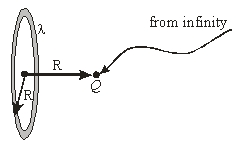 Calculate the work done to bring a charge, Q = 1 mC, from infinity and place it at a distance R = 10 cm along the axis of a thin uniformly charged ring with linear charge density = 10 C/m and radius R.
 (Multiple Choice)
4.8/5 (76)
(76)  The vector that best represents the direction of the electric field intensity at point x on the 20-V equipotential line is
 (Multiple Choice)
4.9/5 (90)
(90) A uniform electric field exists between two parallel plates separated by 2.0 cm. The intensity of the field is 15 kN/C. What is the potential difference between the plates?
(Multiple Choice)
4.9/5 (79)
(79)  The electrostatic potential as a function of distance along a certain line in space is shown in graph (1). Which of the curves in graph (2) is most likely to represent the electric field as a function of distance along the same line?
 (Multiple Choice)
4.8/5 (83)
(83)  Charges Q and q (Q q), separated by a distance d, produce a potential VP = 0 at point P. This means that
 (Multiple Choice)
5.0/5 (79)
(79) When 5.0 C of charge moves at constant speed along a path between two points differing in potential by 12 V, the amount of work done is
(Multiple Choice)
4.8/5 (71)
(71) A proton (charge = e, mass = 1.67 *10-27 kg) with initial kinetic energy 3 MeV is fired head-on towards a fixed stationary uranium nucleus (charge 92e, mass = 3.95 * 10-25 kg). Calculate how close to the uranium the proton gets before it comes to rest. (Assume the uranium nucleus does not move.)
(Multiple Choice)
4.8/5 (75)
(75) Dielectric breakdown occurs in the air at an electric field strength of Emax = 3.0 *106 V/m. What is the maximum surface charge density that can be placed on a spherical conductor of radius 1.5 m before breakdown?
(Multiple Choice)
4.8/5 (77)
(77) Use the following figure to answer the next problem:  The electric field versus distance for a charge is plotted above. Use the reference point
V = 0 at r infinity.
-The work required to move a charge, q = +e from infinity to r = 2 m is
The electric field versus distance for a charge is plotted above. Use the reference point
V = 0 at r infinity.
-The work required to move a charge, q = +e from infinity to r = 2 m is (Multiple Choice)
4.8/5 (79)
(79) A conducting sphere of radius r1 = 10 cm and charge q1 = 2 C is placed far apart from a second conducting sphere of radius r2 = 30 cm and charge q2 = 3 C. The two spheres are then connected by a thin conducting wire. What is the charge on the first sphere after the two spheres are connected by the wire?
(Multiple Choice)
4.9/5 (70)
(70) A solid conducting sphere of radius ra is placed concentrically inside a conducting spherical shell of inner radius rb1 and outer radius rb2. The inner sphere carries a charge Q while the outer sphere does not carry any net charge. The potential for rb1 r rb2 is
(Multiple Choice)
4.7/5 (59)
(59) The electric potential is known to be a function of x only; i.e., v = V(x). The electric field at a position x1 is given by
(Multiple Choice)
4.8/5 (75)
(75) Use the following to answer the next question:  -Which point in the electric field in the diagram is at the lowest potential?
 (Multiple Choice)
4.9/5 (72)
(72) The electric potential in a region of space is given by
V(x, y, z) = (10 V/m) x + (20 V/m) y + (30 V/m) z
The x-component of the electric field in this region is
(Multiple Choice)
4.8/5 (86)
(86)  The vector that best represents the direction of the electric field intensity at point x on the 200-V equipotential line is
 (Multiple Choice)
4.9/5 (84)
(84) 
Filters
- Essay(0)
- Multiple Choice(0)
- Short Answer(0)
- True False(0)
- Matching(0)