



 Chat with AI
Exam 43: Animal Nervous Systems

Exam 1: Biology and the Tree of Life37 Questions
Exam 2: Water and Carbon: the Chemical Basis of Life59 Questions
Exam 3: Protein Structure and Function59 Questions
Exam 4: Nucleic Acids and the Rna World43 Questions
Exam 5: An Introduction to Carbohydrates44 Questions
Exam 53: Ecosystems and Global Ecology57 Questions
Exam 6: Lipids, Membranes, and the First Cells59 Questions
Exam 7: Inside the Cell60 Questions
Exam 8: Energy and Enzymes: an Introduction to Metabolism60 Questions
Exam 9: Cellular Respiration and Fermentation61 Questions
Exam 10: Photosynthesis58 Questions
Exam 11: Cellcell Interactions52 Questions
Exam 12: The Cell Cycle59 Questions
Exam 13: Meiosis63 Questions
Exam 14: Mendel and the Gene60 Questions
Exam 15: Dna and the Gene: Synthesis and Repair51 Questions
Exam 16: How Genes Work48 Questions
Exam 17: Transcription, Rna Processing, and Translation58 Questions
Exam 18: Control of Gene Expression in Bacteria29 Questions
Exam 19: Control of Gene Expression in Eukaryotes56 Questions
Exam 20: The Molecular Revolution: Biotechnology and Beyond70 Questions
Exam 21: Genes, Development, and Evolution38 Questions
Exam 22: Evolution by Natural Selection38 Questions
Exam 23: Evolutionary Processes37 Questions
Exam 24: Speciation56 Questions
Exam 25: Phylogenies and the History of Life63 Questions
Exam 26: Bacteria and Archaea38 Questions
Exam 27: Protists37 Questions
Exam 28: Green Algae and Land Plants59 Questions
Exam 29: Fungi47 Questions
Exam 30: An Introduction to Animals48 Questions
Exam 31: Protostome Animals54 Questions
Exam 32: Deuterostome Animals60 Questions
Exam 33: Viruses44 Questions
Exam 34: Plant Form and Function46 Questions
Exam 35: Water and Sugar Transport in Plants47 Questions
Exam 36: Plant Nutrition54 Questions
Exam 37: Plant Sensory Systems, Signals, and Responses48 Questions
Exam 38: Plant Reproduction and Development51 Questions
Exam 39: Animal Form and Function53 Questions
Exam 40: Water and Electrolyte Balance in Animals60 Questions
Exam 41: Animal Nutrition94 Questions
Exam 42: Gas Exchange and Circulation93 Questions
Exam 43: Animal Nervous Systems100 Questions
Exam 44: Animal Sensory Systems50 Questions
Exam 45: Animal Movement40 Questions
Exam 46: Chemical Signals in Animals59 Questions
Exam 47: Animal Reproduction and Development104 Questions
Exam 48: The Immune System in Animals77 Questions
Exam 49: An Introduction to Ecology40 Questions
Exam 50: Behavioral Ecology40 Questions
Exam 51: Population Ecology57 Questions
Exam 52: Community Ecology55 Questions
Exam 54: Biodiversity and Conservation Biology43 Questions
Select questions type


Acetylcholine released into the junction between a motor neuron and a skeletal muscle binds to a sodium channel and opens it. This is an example of ________.
(Multiple Choice)
5.0/5  (82)
(82) Two fundamental concepts about the ion channels of a "resting" neuron are that the channels ________.
(Multiple Choice)
5.0/5 (76)
(76) Damage to the frontal lobe, such as experienced by Phineas Gage, leads to ________.
(Multiple Choice)
4.9/5 (86)
(86) Which of the following ions is most likely to cross the plasma membrane of a resting neuron?
(Multiple Choice)
4.7/5 (73)
(73) A common feature of action potentials is that they ________.
(Multiple Choice)
4.7/5 (94)
(94) In a synapse, what initiates the release of neurotransmitter?
(Multiple Choice)
4.9/5 (81)
(81) Refer to the following graph of an action potential to answer the question(s) below. 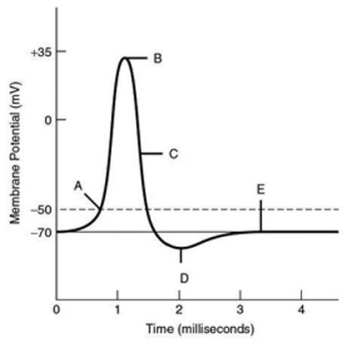 -The cell is not hyperpolarized; however, repolarization is in progress, as the sodium channels are closing or closed, and many potassium channels have opened at label ________.
 (Multiple Choice)
4.8/5 (84)
(84) An inhibitory postsynaptic potential (IPSP) occurs in a membrane made more permeable to ________.
(Multiple Choice)
4.9/5 (78)
(78) Although an exact count is not available, it is likely that the human brain has as many as ________.
(Multiple Choice)
4.8/5 (78)
(78) Why are action potentials usually conducted in one direction?
(Multiple Choice)
4.9/5 (85)
(85) In a simple synapse, neurotransmitter chemicals are received by ________.
(Multiple Choice)
4.9/5 (83)
(83) If you experimentally increase the concentration of K+ inside a cell while maintaining other ion concentrations as they were, what would happen to the cell's membrane potential?
(Multiple Choice)
5.0/5 (98)
(98) Forming new long-term memories is strikingly disrupted after damage to the ________.
(Multiple Choice)
4.7/5 (77)
(77) Immediately after an action potential passes along an axon, it is not possible to generate a second action potential. Thus, we state that the membrane is briefly ________.
(Multiple Choice)
4.8/5 (80)
(80) The activation of the parasympathetic branch of the autonomic nervous system is associated with ________.
(Multiple Choice)
4.8/5 (72)
(72) After the depolarization phase of an action potential, the resting potential is restored by ________.
(Multiple Choice)
4.8/5 (79)
(79) In multiple sclerosis the myelin sheaths around the axons of the brain and spinal cord are damaged and demyelination results. How does this disease manifest at the level of the action potential?
I. Action potentials move in the opposite direction on the axon.
II. Action potentials move more slowly along the axon.
III. No action potentials are transmitted.
(Multiple Choice)
4.7/5 (67)
(67) Neurotransmitters categorized as inhibitory are expected to ________.
(Multiple Choice)
4.7/5 (86)
(86) Preparation for the fight-or-flight response includes activation of the ________ nervous system.
(Multiple Choice)
4.9/5 (79)
(79) 
Filters
- Essay(0)
- Multiple Choice(0)
- Short Answer(0)
- True False(0)
- Matching(0)