



 Chat with AI
Exam 43: Animal Nervous Systems

Exam 1: Biology and the Tree of Life37 Questions
Exam 2: Water and Carbon: the Chemical Basis of Life59 Questions
Exam 3: Protein Structure and Function59 Questions
Exam 4: Nucleic Acids and the Rna World43 Questions
Exam 5: An Introduction to Carbohydrates44 Questions
Exam 53: Ecosystems and Global Ecology57 Questions
Exam 6: Lipids, Membranes, and the First Cells59 Questions
Exam 7: Inside the Cell60 Questions
Exam 8: Energy and Enzymes: an Introduction to Metabolism60 Questions
Exam 9: Cellular Respiration and Fermentation61 Questions
Exam 10: Photosynthesis58 Questions
Exam 11: Cellcell Interactions52 Questions
Exam 12: The Cell Cycle59 Questions
Exam 13: Meiosis63 Questions
Exam 14: Mendel and the Gene60 Questions
Exam 15: Dna and the Gene: Synthesis and Repair51 Questions
Exam 16: How Genes Work48 Questions
Exam 17: Transcription, Rna Processing, and Translation58 Questions
Exam 18: Control of Gene Expression in Bacteria29 Questions
Exam 19: Control of Gene Expression in Eukaryotes56 Questions
Exam 20: The Molecular Revolution: Biotechnology and Beyond70 Questions
Exam 21: Genes, Development, and Evolution38 Questions
Exam 22: Evolution by Natural Selection38 Questions
Exam 23: Evolutionary Processes37 Questions
Exam 24: Speciation56 Questions
Exam 25: Phylogenies and the History of Life63 Questions
Exam 26: Bacteria and Archaea38 Questions
Exam 27: Protists37 Questions
Exam 28: Green Algae and Land Plants59 Questions
Exam 29: Fungi47 Questions
Exam 30: An Introduction to Animals48 Questions
Exam 31: Protostome Animals54 Questions
Exam 32: Deuterostome Animals60 Questions
Exam 33: Viruses44 Questions
Exam 34: Plant Form and Function46 Questions
Exam 35: Water and Sugar Transport in Plants47 Questions
Exam 36: Plant Nutrition54 Questions
Exam 37: Plant Sensory Systems, Signals, and Responses48 Questions
Exam 38: Plant Reproduction and Development51 Questions
Exam 39: Animal Form and Function53 Questions
Exam 40: Water and Electrolyte Balance in Animals60 Questions
Exam 41: Animal Nutrition94 Questions
Exam 42: Gas Exchange and Circulation93 Questions
Exam 43: Animal Nervous Systems100 Questions
Exam 44: Animal Sensory Systems50 Questions
Exam 45: Animal Movement40 Questions
Exam 46: Chemical Signals in Animals59 Questions
Exam 47: Animal Reproduction and Development104 Questions
Exam 48: The Immune System in Animals77 Questions
Exam 49: An Introduction to Ecology40 Questions
Exam 50: Behavioral Ecology40 Questions
Exam 51: Population Ecology57 Questions
Exam 52: Community Ecology55 Questions
Exam 54: Biodiversity and Conservation Biology43 Questions
Select questions type


Imagine you are resting comfortably on a sofa after dinner. This could be described as a state with ________.
(Multiple Choice)
4.8/5  (82)
(82) Which neurotransmitter is involved in reducing perceptions of pain?
(Multiple Choice)
4.9/5 (84)
(84) A toxin that binds specifically to voltage-gated sodium channels in axons would be expected to ________.
(Multiple Choice)
4.8/5 (78)
(78) The point of connection between two communicating neurons is called the ________.
(Multiple Choice)
4.8/5 (91)
(91) In a simple synapse, neurotransmitter chemicals are released by ________.
(Multiple Choice)
4.7/5 (78)
(78) Calculation, contemplation, and cognition are human activities associated with increased activity in the ________.
(Multiple Choice)
4.8/5 (82)
(82) Excitatory postsynaptic potentials (EPSPs) produced nearly simultaneously by different synapses on the same postsynaptic neuron can also add together, creating ________.
(Multiple Choice)
5.0/5 (88)
(88) A neurophysiologist is investigating nerve reflexes in two different animals: a crab and a fish. Action potentials are found to pass more rapidly along the fish's neurons. What is the most likely explanation?
(Multiple Choice)
4.8/5 (82)
(82) The surface on a neuron that discharges the contents of synaptic vesicles is the ________.
(Multiple Choice)
5.0/5 (80)
(80) Self-propagation and refractory periods (or refractory states) are typical of ________.
(Multiple Choice)
4.8/5 (76)
(76) What is the space between the presynaptic and postsynaptic membranes?
(Multiple Choice)
4.9/5 (82)
(82) Functionally, which cellular location is the neuron's "decision-making site" as to whether or not an action potential will be initiated?
(Multiple Choice)
4.9/5 (91)
(91) Refer to the following graph of an action potential to answer the question(s) below. 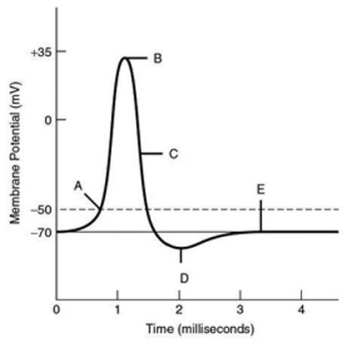 -The neuronal membrane is at its resting potential at label ________.
 (Multiple Choice)
4.8/5 (86)
(86) Muscle cells are stimulated by neurotransmitters released from the synaptic terminals of ________.
(Multiple Choice)
4.8/5 (84)
(84) Neurotransmitters can affect postsynaptic cells by ________.
I. initiating signal transduction pathways in the cells
II. causing molecular changes in the cells
III. affecting ion-channel proteins
IV. altering the permeability of the cells
(Multiple Choice)
4.9/5 (83)
(83) Studies employing Aplysia suggest that memory formation requires ________.
(Multiple Choice)
4.8/5 (76)
(76) 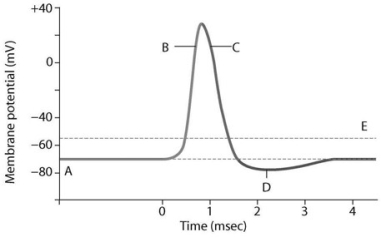 -Which letter in the accompanying figure corresponds to a large influx of Na+ ions into the cell?
 (Multiple Choice)
4.9/5 (83)
(83)
-Which letter in the accompanying figure corresponds to a large efflux of K+ ions from the cell?
-Which letter in the accompanying figure corresponds to a large efflux of K+ ions from the cell? (Multiple Choice)
4.9/5 (83)
(83) How do myelin sheaths increase the speed with which action potentials are propagated along an axon?
(Multiple Choice)
4.8/5 (82)
(82) 
Filters
- Essay(0)
- Multiple Choice(0)
- Short Answer(0)
- True False(0)
- Matching(0)