



 Chat with AI
Exam 43: Animal Nervous Systems

Exam 1: Biology and the Tree of Life37 Questions
Exam 2: Water and Carbon: the Chemical Basis of Life59 Questions
Exam 3: Protein Structure and Function59 Questions
Exam 4: Nucleic Acids and the Rna World43 Questions
Exam 5: An Introduction to Carbohydrates44 Questions
Exam 53: Ecosystems and Global Ecology57 Questions
Exam 6: Lipids, Membranes, and the First Cells59 Questions
Exam 7: Inside the Cell60 Questions
Exam 8: Energy and Enzymes: an Introduction to Metabolism60 Questions
Exam 9: Cellular Respiration and Fermentation61 Questions
Exam 10: Photosynthesis58 Questions
Exam 11: Cellcell Interactions52 Questions
Exam 12: The Cell Cycle59 Questions
Exam 13: Meiosis63 Questions
Exam 14: Mendel and the Gene60 Questions
Exam 15: Dna and the Gene: Synthesis and Repair51 Questions
Exam 16: How Genes Work48 Questions
Exam 17: Transcription, Rna Processing, and Translation58 Questions
Exam 18: Control of Gene Expression in Bacteria29 Questions
Exam 19: Control of Gene Expression in Eukaryotes56 Questions
Exam 20: The Molecular Revolution: Biotechnology and Beyond70 Questions
Exam 21: Genes, Development, and Evolution38 Questions
Exam 22: Evolution by Natural Selection38 Questions
Exam 23: Evolutionary Processes37 Questions
Exam 24: Speciation56 Questions
Exam 25: Phylogenies and the History of Life63 Questions
Exam 26: Bacteria and Archaea38 Questions
Exam 27: Protists37 Questions
Exam 28: Green Algae and Land Plants59 Questions
Exam 29: Fungi47 Questions
Exam 30: An Introduction to Animals48 Questions
Exam 31: Protostome Animals54 Questions
Exam 32: Deuterostome Animals60 Questions
Exam 33: Viruses44 Questions
Exam 34: Plant Form and Function46 Questions
Exam 35: Water and Sugar Transport in Plants47 Questions
Exam 36: Plant Nutrition54 Questions
Exam 37: Plant Sensory Systems, Signals, and Responses48 Questions
Exam 38: Plant Reproduction and Development51 Questions
Exam 39: Animal Form and Function53 Questions
Exam 40: Water and Electrolyte Balance in Animals60 Questions
Exam 41: Animal Nutrition94 Questions
Exam 42: Gas Exchange and Circulation93 Questions
Exam 43: Animal Nervous Systems100 Questions
Exam 44: Animal Sensory Systems50 Questions
Exam 45: Animal Movement40 Questions
Exam 46: Chemical Signals in Animals59 Questions
Exam 47: Animal Reproduction and Development104 Questions
Exam 48: The Immune System in Animals77 Questions
Exam 49: An Introduction to Ecology40 Questions
Exam 50: Behavioral Ecology40 Questions
Exam 51: Population Ecology57 Questions
Exam 52: Community Ecology55 Questions
Exam 54: Biodiversity and Conservation Biology43 Questions
Select questions type


In a resting potential, an example of a cation that is more abundant as a solute inside a neuron than it is in the interstitial fluid outside the neuron is ________.
(Multiple Choice)
4.8/5  (92)
(92) The divisions of the nervous system that have antagonistic, or opposing, actions are the ________.
(Multiple Choice)
4.9/5 (83)
(83) One of the complications of Alzheimer's disease is an interference with learning and memory. This disease would most likely involve ________.
(Multiple Choice)
4.8/5 (85)
(85) Which is NOT an element of the efferent division of the peripheral nervous system?
(Multiple Choice)
4.7/5 (87)
(87) In the sequence of permeability changes for a complete action potential, the first of these events that occurs is the ________.
(Multiple Choice)
4.9/5 (97)
(97) What would be a consequence of a person having Na+ levels in the blood and interstitial fluids that are well below normal?
(Multiple Choice)
4.9/5 (71)
(71) The release of acetylcholine from the terminal of a motor neuron is most directly linked to the ________.
(Multiple Choice)
4.9/5 (89)
(89) What would probably happen if a long neuron had one continuous myelin sheath down the length of the axon with no nodes of Ranvier?
(Multiple Choice)
4.9/5 (81)
(81) How could you increase the magnitude of inhibitory postsynaptic potentials (IPSPs) generated at a synapse?
(Multiple Choice)
4.8/5 (75)
(75) What happens if twice as many inhibitory postsynaptic potentials (IPSPs) as excitatory postsynaptic potentials (EPSPs) arrive at a postsynaptic neuron in close proximity?
(Multiple Choice)
4.8/5 (81)
(81) The activity of acetylcholine in a synapse is terminated by its ________.
(Multiple Choice)
4.9/5 (82)
(82) Motor neurons release the neurotransmitter acetylcholine (ACh), and acetylcholinesterase degrades ACh in the synapse. If a neurophysiologist applies onchidal (a naturally occurring acetylcholinesterase inhibitor produced by the mollusk Onchidella binneyi) to a synapse, what would you expect to happen?
(Multiple Choice)
4.9/5 (82)
(82) If the activity of the sodium-potassium pump was completely stopped, what would happen to the neuron's membrane potential?
(Multiple Choice)
4.9/5 (82)
(82) Action potentials are normally carried in only one direction: from the axon hillock toward the axon terminals. If you experimentally depolarize the middle of the axon to threshold, using an electronic probe, then ________.
(Multiple Choice)
4.9/5 (87)
(87) An important excitatory neurotransmitter in the central nervous system (CNS) is ________.
(Multiple Choice)
4.9/5 (82)
(82) Refer to the following graph of an action potential to answer the question(s) below. 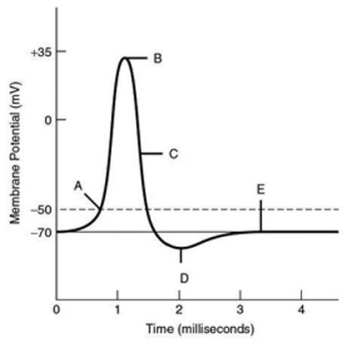 -The membrane potential is hyperpolarized at label ________.
 (Multiple Choice)
4.8/5 (80)
(80) The "undershoot" phase of after-hyperpolarization is due to ________.
(Multiple Choice)
4.8/5 (88)
(88) For a neuron at rest with a membrane potential of −65 mV, an increase in the movement of potassium ions out of that neuron's cytoplasm would result in the ________.
(Multiple Choice)
4.8/5 (74)
(74) 
Filters
- Essay(0)
- Multiple Choice(0)
- Short Answer(0)
- True False(0)
- Matching(0)