



 Chat with AI
Exam 10: Differential Equations

Exam 1: The Derivative189 Questions
Exam 2: Applications of the Derivative93 Questions
Exam 3: Techniques of Differentiation69 Questions
Exam 4: Logarithm Functions135 Questions
Exam 5: Applications of the Exponential and Natural Logarithm Functions73 Questions
Exam 6: The Definite Integral135 Questions
Exam 7: Functions of Several Variables119 Questions
Exam 8: The Trigonometric Functions128 Questions
Exam 9: Techniques of Integration178 Questions
Exam 10: Differential Equations126 Questions
Exam 11: Taylor Polynomials and Infinite Series132 Questions
Exam 12: Probability and Calculus92 Questions
Select questions type


Use Euler's method with n = 5 on the interval 0 ≤ t ≤ to approximate the solution Is the following the correct answer? =0; =-1 =0.1; =-0.9 =0.2; =-0.82 =0.3; =-0.758 =0.4; =-0.7122 =0.5; =-0.68098
(True/False)
4.8/5  (76)
(76) Consider the differential equation = g(y) where g(y) is the function whose graph is shown below: 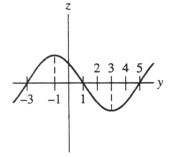 Indicate whether the following statements are true or false.
-Let = . Which of the following properties hold for the solution y = f(t) determined by the initial condition y(0) = -2? (I) It is always increasing.
(II) It has an inflection point.
(III) It is always concave down.
Indicate whether the following statements are true or false.
-Let = . Which of the following properties hold for the solution y = f(t) determined by the initial condition y(0) = -2? (I) It is always increasing.
(II) It has an inflection point.
(III) It is always concave down. (Multiple Choice)
4.8/5 (80)
(80) Use Euler's method with n = 4 to approximate the solution f(t) to = t + y - 1, for . Estimate f(2).
Enter just a reduced fraction of form .
(Short Answer)
4.9/5 (79)
(79) Let f(t) be the solution of = ty + 0.2, y(0) = 3. Use Euler's method on with n = 2 to estimate f(1). Is the correct answer?
(True/False)
5.0/5 (69)
(69) A certain chemical vaporizes when exposed to the air. Suppose f(t) is the amount of chemical present. It is found that the rate of vaporization of the chemical is proportional to the amount of chemical present squared. Write a differential equation satisfied by f(t) . Does this equation accurately represent this situation:
(True/False)
4.9/5 (73)
(73) Suppose that an epidemic is spreading at a rate proportional to the square of the infected population. Let f(t) be the number of infected people at time t, and suppose y = f(t) satisfies a differential equation . Which of the following sets of curves could represent solutions of [Hint: First determine the differential equation = g(y) .]
(Multiple Choice)
4.9/5 (88)
(88) 
Filters
- Essay(0)
- Multiple Choice(0)
- Short Answer(0)
- True False(0)
- Matching(0)