



 Chat with AI
Exam 10: Differential Equations

Exam 1: The Derivative189 Questions
Exam 2: Applications of the Derivative93 Questions
Exam 3: Techniques of Differentiation69 Questions
Exam 4: Logarithm Functions135 Questions
Exam 5: Applications of the Exponential and Natural Logarithm Functions73 Questions
Exam 6: The Definite Integral135 Questions
Exam 7: Functions of Several Variables119 Questions
Exam 8: The Trigonometric Functions128 Questions
Exam 9: Techniques of Integration178 Questions
Exam 10: Differential Equations126 Questions
Exam 11: Taylor Polynomials and Infinite Series132 Questions
Exam 12: Probability and Calculus92 Questions
Select questions type


Let f(t) be the solution to of = t - y, y(0) = 1. Which of the following statements is true?
(Multiple Choice)
4.9/5  (79)
(79) Given the differential equation with the given initial condition: is this the solution
(True/False)
4.8/5 (77)
(77) Solve the differential equation with the given initial condition.
-
(Multiple Choice)
4.9/5 (67)
(67) Use Euler's method with n = 4 on the interval to approximate the solution f(t) to , Is the following graph accurate? 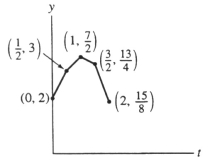
(True/False)
4.9/5 (80)
(80) Find a constant solution of Enter just a reduced fraction of form .
(Short Answer)
4.9/5 (89)
(89) One or more initial conditions are given for the differential equation. Use the qualitative theory of autonomous differential equations to sketch the graphs of the corresponding solution. Include a yz-graph as well as a ty-graph. Do these graphs represent the situation? 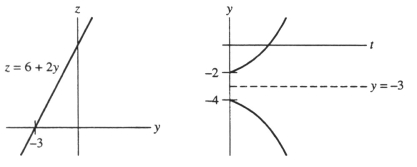
(True/False)
4.8/5 (78)
(78) How much would you need to invest per month - in effect, continuously - in an investment account that pays an annual interest rate of 9%, compounded continuously, in order for the account to be worth $100,000 after 20 years? Enter just an integer representing dollars to the nearest dollar (no units)
(Short Answer)
4.8/5 (75)
(75) Consider the differential equation = g(y) where g(y) is the function whose graph is shown below: 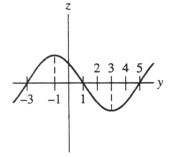 Indicate whether the following statements are true or false.
-Let = 2 - y. Which of the following properties hold for the solution y = f(t) determined by the initial condition y(0) = 1? (I) It is always concave down.
(II) It is a constant solution.
(III) It is always decreasing.
Indicate whether the following statements are true or false.
-Let = 2 - y. Which of the following properties hold for the solution y = f(t) determined by the initial condition y(0) = 1? (I) It is always concave down.
(II) It is a constant solution.
(III) It is always decreasing. (Multiple Choice)
4.8/5 (91)
(91) Find the integrating factor, the general solution, and the particular solution satisfying the initial condition. 2t - y = ; y(1) = -1, t > 0
(Multiple Choice)
5.0/5 (80)
(80) Solve the differential equation with the given initial condition.
-
(Multiple Choice)
4.8/5 (76)
(76) The following is a polygonal path obtained from Euler's method with n = 4 to approximate a solution f(t) of a differential equation. Indicate whether the following statements are true or false: 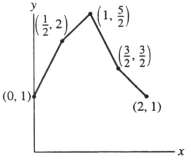 - ≈
- ≈ (True/False)
4.8/5 (89)
(89) Find f'(1) if f(t) is a solution to the initial value problem: Enter just an integer.
(Short Answer)
4.8/5 (79)
(79) One or more initial conditions are given for the differential equation. Use the qualitative theory of autonomous differential equations to sketch the graphs of the corresponding solution. Include a yz-graph as well as a ty-graph.. Do these graphs represent the situation? 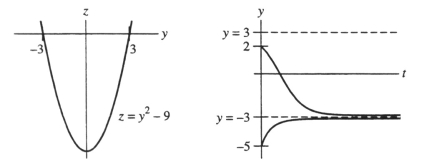
(True/False)
4.8/5 (72)
(72) The following is a polygonal path obtained from Euler's method with n = 4 to approximate a solution f(t) of a differential equation. Indicate whether the following statements are true or false:
-f(0) = 1
-f(0) = 1 (True/False)
4.9/5 (71)
(71) Solve the differential equation with the given initial condition.
-
(Multiple Choice)
4.7/5 (82)
(82) A millionaire wants to set up a trust for her grandchild. She wants to put a lump sum of money into an account earning 10% interest. She'd like her grandchild to be able to withdraw $100 every month for the rest of the child's life. Write a differential equation satisfied by f(t), the amount of money in the account at time Does the equation, , accurately describe this situation?
(True/False)
4.8/5 (78)
(78) The following could be graphs of solutions to which of the following differential equations? 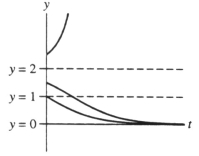
(Multiple Choice)
4.9/5 (82)
(82) 
Filters
- Essay(0)
- Multiple Choice(0)
- Short Answer(0)
- True False(0)
- Matching(0)