



 Chat with AI
Exam 10: Differential Equations

Exam 1: The Derivative189 Questions
Exam 2: Applications of the Derivative93 Questions
Exam 3: Techniques of Differentiation69 Questions
Exam 4: Logarithm Functions135 Questions
Exam 5: Applications of the Exponential and Natural Logarithm Functions73 Questions
Exam 6: The Definite Integral135 Questions
Exam 7: Functions of Several Variables119 Questions
Exam 8: The Trigonometric Functions128 Questions
Exam 9: Techniques of Integration178 Questions
Exam 10: Differential Equations126 Questions
Exam 11: Taylor Polynomials and Infinite Series132 Questions
Exam 12: Probability and Calculus92 Questions
Select questions type


Combine the terms y and into the derivative of a product: .
Is this derivative correct: ?
(True/False)
4.7/5  (77)
(77) Given the differential equation with the given initial condition: is this the solution
(True/False)
4.8/5 (82)
(82) Depending on the type of soil there is a constant M that represents the maximum amount of water the soil can absorb per cubic ft. If the rate of absorption is proportional to the difference between the maximum amount of water that could be absorbed and the amount of water that has been absorbed, write a differential equation satisfied by y = f(t), the amount of water in the soil at time t. Does this equation accurately describe this situation:
(True/False)
4.9/5 (86)
(86) Given = y - 3. On a ty-coordinate system sketch the solutions corresponding to the initial conditions and Does this graph represent the situation? 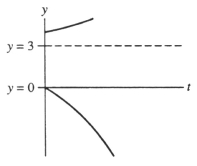
(True/False)
4.9/5 (78)
(78) The annual sales y (in millions of dollars) of a company satisfy the differential equation . Which of the following is a verbal description of the rate of change of annual sales ?
(Multiple Choice)
4.8/5 (70)
(70) Which of the following functions solves the differential equation:
(Multiple Choice)
4.7/5 (77)
(77) Consider the differential equation = (y + 3). Which of the following statements is/are true?
(I) f(t) = -3 is a constant solution to this differential equation.
(II) f(t) = 0 is a constant solution to this differential equation.
(III) If f(t) is a solution to the differential equation with initial conditions y(1) = 0, then (1) = 3.
(Multiple Choice)
4.7/5 (82)
(82) The annual sales y (in millions of dollars) of a company satisfy the differential equation . Which of the following is a verbal description of the rate of change of annual sales.
(Multiple Choice)
4.9/5 (74)
(74) One or more initial conditions are given for the differential equation. Use the qualitative theory of autonomous differential equations to sketch the graphs of the corresponding solution. Include a yz-graph as well as a ty-graph. Do these graphs represent the situation? 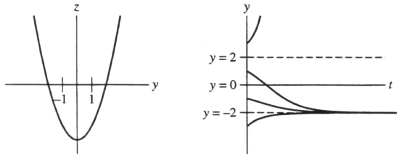
(True/False)
4.8/5 (82)
(82) Suppose water is seeping from an underground storage facility at a rate that is proportional to the square amount of water present. If f(t) = y is the amount of water present at time t, find a differential equation describing the situation.
(Multiple Choice)
4.9/5 (89)
(89) A tank contains 2000 L of a solution consisting of 50 kg of salt dissolved in water. Pure water is pumped into the tank at the rate of 10L/s, and the mixture (kept uniform by stirring) is pumped out at the same rate. How long will it be until only 5 kg of salt remain in the tank?
(Multiple Choice)
4.8/5 (70)
(70) A fly population increases at a rate proportional to the amount present. After two years the population has doubled. After three years it is 20,000. Find the number of flies initially present. Enter just an integer.
(Short Answer)
5.0/5 (85)
(85) Use Euler's method with n = 5 to approximate the solution f(t) to = 5 - y, for . Estimate f(1).
Enter just a real number rounded off to two decimal places.
(Short Answer)
4.9/5 (75)
(75) There is a differential equation that is a mathematical model of the situation in which the time rate of change in the population of a certain organism is proportional to the product of the current population and the difference between the current population and the limiting factor of 100,000. Is this the equation
(True/False)
4.7/5 (69)
(69) Combine the terms y and into the derivative of a product, then solve the equation. Is this the solution:
(True/False)
4.7/5 (86)
(86) A certain developing country has a population of 500,000. The yearly rate of increase of literacy among the people is proportional to the number of illiterate people in the population. Letting f(t) represent the number of literate people, determine the differential equation that f(t) satisfies. (Let k represent a positive constant.)
(Multiple Choice)
4.7/5 (80)
(80) Which of the following functions solves the differential equation: ?
(Multiple Choice)
4.8/5 (71)
(71) 
Filters
- Essay(0)
- Multiple Choice(0)
- Short Answer(0)
- True False(0)
- Matching(0)