



 Chat with AI
Exam 6: Risk and return

Exam 1: An overview of financial management and the financial environment46 Questions
Exam 2: Financial statements, cash flow, and taxes77 Questions
Exam 3: Analysis of financial statements104 Questions
Exam 4: Time value of money168 Questions
Exam 5: Bonds, bond valuation, and interest rates100 Questions
Exam 6: Risk and return146 Questions
Exam 7: Valuation of stocks and corporations80 Questions
Exam 8: Financial options and applications in corporate finance28 Questions
Exam 9: The cost of capital92 Questions
Exam 10: The basics of capital budgeting: evaluating cash flows108 Questions
Exam 11: Cash flow estimation and risk analysis78 Questions
Exam 12: Corporate valuation and financial planning41 Questions
Exam 13: Agency conflicts and corporate governance6 Questions
Exam 14: Distributions to shareholders: dividends and repurchases58 Questions
Exam 15: Capital structure decisions72 Questions
Exam 16: Supply chains and working capital management138 Questions
Exam 17: Multinational financial management49 Questions
Select questions type


If investors become less averse to risk, the slope of the Security Market Line (SML)will increase.
(True/False)
4.7/5  (77)
(77) The Y-axis intercept of the SML represents the required return of a portfolio with a beta of zero, which is the risk-free rate.
(True/False)
4.9/5 (79)
(79) The realized return on a stock portfolio is the weighted average of the expected returns on the stocks in the portfolio.
(True/False)
4.9/5 (84)
(84) Assume that the risk-free rate remains constant, but the market risk premium declines.Which of the following is most likely to occur?
(Multiple Choice)
4.9/5 (83)
(83) If you randomly select stocks and add them to your portfolio, which of the following statements best describes what you should expect?
(Multiple Choice)
4.9/5 (77)
(77) Since the market return represents the expected return on an average stock, the market return reflects a certain amount of risk.As a result, there exists a market risk premium, which is the amount over and above the risk-free rate, that is required to compensate stock investors for assuming an average amount of risk.
(True/False)
4.9/5 (86)
(86) Risk-averse investors require higher rates of return on investments whose returns are highly uncertain, and most investors are risk averse.
(True/False)
4.9/5 (66)
(66) Martin Ortner holds a $200, 000 portfolio consisting of the following stocks:
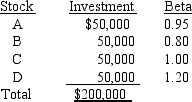 What is the portfolio's beta?
 (Multiple Choice)
4.8/5 (75)
(75) Stock A has a beta of 0.7, whereas Stock B has a beta of 1.3.Portfolio P has 50% invested in both A and B.Which of the following would occur if the market risk premium increased by 1% but the risk-free rate remained constant?
(Multiple Choice)
4.7/5 (67)
(67) You are considering investing in one of the these three stocks:
 If you are a strict risk minimizer, you would choose Stock ____ if it is to be held in isolation and Stock ____ if it is to be held as part of a well-diversified portfolio.
 (Multiple Choice)
4.8/5 (79)
(79) Suppose Stan holds a portfolio consisting of a $10, 000 investment in each of 8 different common stocks.The portfolio's beta is 1.25.Now suppose Stan decided to sell one of his stocks that has a beta of 1.00 and to use the proceeds to buy a replacement stock with a beta of 1.35.What would the portfolio's new beta be?
(Multiple Choice)
4.9/5 (70)
(70) The CAPM is built on historic conditions, although in most cases we use expected future data in applying it.Because betas used in the CAPM are calculated using expected future data, they are not subject to changes in future volatility.This is one of the strengths of the CAPM.
(True/False)
4.8/5 (73)
(73) Assume that the market is in equilibrium and that Portfolio AB has 50% invested in Stock A and 50% invested in Stock B.Stock A has an expected return of 10% and a standard deviation of 20%.Stock B has an expected return of 13% and a standard deviation of 30%.The risk-free rate is 5% and the market risk premium, rM - rRF, is 6%.The returns of Stock A and Stock B are independent of one another, i.e., the correlation coefficient between them is zero.Which of the following statements is CORRECT?
(Multiple Choice)
4.9/5 (68)
(68) "Risk aversion" implies that investors require higher expected returns on riskier than on less risky securities.
(True/False)
5.0/5 (79)
(79) When adding a randomly chosen new stock to an existing portfolio, the higher (or more positive)the degree of correlation between the new stock and stocks already in the portfolio, the less the additional stock will reduce the portfolio's risk.
(True/False)
4.8/5 (84)
(84) Brodkey Shoes has a beta of 1.30, the T-bill rate is 3.00%, and the T-bond rate is 6.5%.The annual return on the stock market during the past 3 years was 15.00%, but investors expect the annual future stock market return to be 13.00%.Based on the SML, what is the firm's required return?
(Multiple Choice)
4.8/5 (80)
(80) 
Filters
- Essay(0)
- Multiple Choice(0)
- Short Answer(0)
- True False(0)
- Matching(0)