



 Chat with AI
Exam 5: Bonds, bond valuation, and interest rates

Exam 1: An overview of financial management and the financial environment46 Questions
Exam 2: Financial statements, cash flow, and taxes77 Questions
Exam 3: Analysis of financial statements104 Questions
Exam 4: Time value of money168 Questions
Exam 5: Bonds, bond valuation, and interest rates100 Questions
Exam 6: Risk and return146 Questions
Exam 7: Valuation of stocks and corporations80 Questions
Exam 8: Financial options and applications in corporate finance28 Questions
Exam 9: The cost of capital92 Questions
Exam 10: The basics of capital budgeting: evaluating cash flows108 Questions
Exam 11: Cash flow estimation and risk analysis78 Questions
Exam 12: Corporate valuation and financial planning41 Questions
Exam 13: Agency conflicts and corporate governance6 Questions
Exam 14: Distributions to shareholders: dividends and repurchases58 Questions
Exam 15: Capital structure decisions72 Questions
Exam 16: Supply chains and working capital management138 Questions
Exam 17: Multinational financial management49 Questions
Select questions type


Which of the following statements is CORRECT?

Free
(Multiple Choice)
4.9/5  (79)
(79) Correct Answer: Verified
B
Haswell Enterprises' bonds have a 10-year maturity, a 6.25% semiannual coupon, and a par value of $1, 000.The going interest rate (rd)is 4.75%, based on semiannual compounding.What is the bond's price?
Free
(Multiple Choice)
4.9/5 (87)
(87) Correct Answer:Verified
VerifiedC
CMS Corporation's balance sheet as of today is as follows:
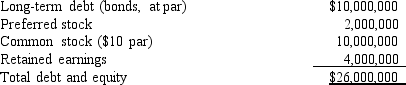 The bonds have a 4.0% coupon rate, payable semiannually, and a par value of $1, 000.They mature exactly 10 years from today.The yield to maturity is 12%, so the bonds now sell below par.What is the current market value of the firm's debt?
Free
(Multiple Choice)
4.8/5 (71)
(71) Correct Answer:Verified
VerifiedC
The Gergen Group's 5-year bonds yield 6.85%, and 5-year T-bonds yield 4.75%.The real risk-free rate is r* = 2.80%, the default risk premium for Gergen's bonds is DRP = 0.85% versus zero for T-bonds, the liquidity premium on Gergen's bonds is LP = 1.25%, and the maturity risk premium for all bonds is found with the formula MRP = (t - 1)´ 0.1%, where t = number of years to maturity.What is the inflation premium (IP)on 5-year bonds?
(Multiple Choice)
4.9/5 (76)
(76) You are considering three different bonds for your portfolio.Each bond has a 10-year maturity and a yield to maturity of 10%.Bond X has an 8% annual coupon, Bond Y has a 10% annual coupon, and Bond Z has a 12% annual coupon.Which of the following statements is CORRECT?
(Multiple Choice)
5.0/5 (67)
(67) Floating-rate debt is advantageous to investors because the interest rate moves up if market rates rise.Since floating-rate debt shifts interest rate risk to companies, it offers no advantages to issuers.
(True/False)
4.9/5 (78)
(78) A bond has a $1, 000 par value, makes annual interest payments of $100, has 5 years to maturity, cannot be called, and is not expected to default.The bond should sell at a premium if interest rates are below 10% and at a discount if interest rates are greater than 10%.
(True/False)
4.8/5 (84)
(84) Which of the following bonds would have the greatest percentage increase in value if all interest rates fall by 1%?
(Multiple Choice)
4.7/5 (81)
(81) Which of the following events would make it more likely that a company would choose to call its outstanding callable bonds?
(Multiple Choice)
4.9/5 (88)
(88) The prices of high-coupon bonds tend to be less sensitive to a given change in interest rates than low-coupon bonds, other things held constant.
(True/False)
4.9/5 (76)
(76) Sinking funds are devices used to force companies to retire bonds on a scheduled basis prior to their maturity.Many bond indentures allow the company to acquire bonds for a sinking fund by either purchasing bonds in the market or selecting the bonds to be acquired by a lottery administered by the trustee through a call at face value.
(True/False)
4.9/5 (79)
(79) "Restrictive covenants" are designed primarily to protect bondholders by constraining the actions of managers.Such covenants are spelled out in bond indentures.
(True/False)
4.9/5 (91)
(91) If 10-year T-bonds have a yield of 6.2%, 10-year corporate bonds yield 8.5%, the maturity risk premium on all 10-year bonds is 1.3%, and corporate bonds have a 0.4% liquidity premium versus a zero liquidity premium for T-bonds, what is the default risk premium on the corporate bond?
(Multiple Choice)
4.7/5 (81)
(81) Under normal conditions, which of the following would be most likely to increase the coupon rate required to enable a bond to be issued at par?
(Multiple Choice)
4.9/5 (79)
(79) Chandler Co.'s 5-year bonds yield 7.00%, and 5-year T-bonds yield 5.15%.The real risk-free rate is r* = 3.0%, the inflation premium for 5-year bonds is IP = 1.75%, the liquidity premium for Chandler's bonds is LP = 0.75% versus zero for T-bonds, and the maturity risk premium for all bonds is found with the formula MRP = (t - 1)´ 0.1%, where t = number of years to maturity.What is the default risk premium (DRP)on Chandler's bonds?
(Multiple Choice)
4.8/5 (78)
(78) 
Filters
- Essay(0)
- Multiple Choice(0)
- Short Answer(0)
- True False(0)
- Matching(0)