



 Chat with AI
Exam 6: Risk and return

Exam 1: An overview of financial management and the financial environment46 Questions
Exam 2: Financial statements, cash flow, and taxes77 Questions
Exam 3: Analysis of financial statements104 Questions
Exam 4: Time value of money168 Questions
Exam 5: Bonds, bond valuation, and interest rates100 Questions
Exam 6: Risk and return146 Questions
Exam 7: Valuation of stocks and corporations80 Questions
Exam 8: Financial options and applications in corporate finance28 Questions
Exam 9: The cost of capital92 Questions
Exam 10: The basics of capital budgeting: evaluating cash flows108 Questions
Exam 11: Cash flow estimation and risk analysis78 Questions
Exam 12: Corporate valuation and financial planning41 Questions
Exam 13: Agency conflicts and corporate governance6 Questions
Exam 14: Distributions to shareholders: dividends and repurchases58 Questions
Exam 15: Capital structure decisions72 Questions
Exam 16: Supply chains and working capital management138 Questions
Exam 17: Multinational financial management49 Questions
Select questions type


The CAPM is a multi-period model that takes account of differences in securities' maturities, and it can be used to determine the required rate of return for any given level of systematic risk.

Free
(True/False)
4.8/5  (78)
(78) Correct Answer: Verified
False
Gretta's portfolio consists of $700, 000 invested in a stock that has a beta of 1.2 and $300, 000 invested in a stock that has a beta of 0.8.The risk-free rate is 6% and the market risk premium is 5%.Which of the following statements is CORRECT?
Free
(Multiple Choice)
4.7/5 (92)
(92) Correct Answer:Verified
VerifiedC
The slope of the SML is determined by investors' aversion to risk.The greater the average investor's risk aversion, the steeper the SML.
Free
(True/False)
5.0/5 (83)
(83) Correct Answer:Verified
VerifiedTrue
Stuart Company's manager believes that economic conditions during the next year will be strong, normal, or weak, and she thinks that the firm's returns will have the probability distribution shown below.What's the standard deviation of the estimated returns? (Hint: Use the formula for the standard deviation of a population, not a sample.)
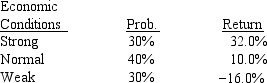
(Multiple Choice)
4.9/5 (89)
(89) Recession, inflation, and high interest rates are economic events that are best characterized as being
(Multiple Choice)
4.8/5 (77)
(77) Megan Ross holds the following portfolio:
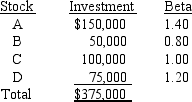 What is the portfolio's beta?
 (Multiple Choice)
4.8/5 (73)
(73) Jenna holds a diversified $100, 000 portfolio consisting of 20 stocks with $5, 000 invested in each.The portfolio's beta is 1.12.Jenna plans to sell a stock with b = 0.90 and use the proceeds to buy a new stock with b = 1.80.What will the portfolio's new beta be?
(Multiple Choice)
4.8/5 (74)
(74) The tighter the probability distribution of its expected future returns, the greater the risk of a given investment as measured by its standard deviation.
(True/False)
5.0/5 (87)
(87) Which of the following is NOT a potential problem when estimating and using betas, i.e., which statement is FALSE?
(Multiple Choice)
5.0/5 (97)
(97) Porter Plumbing's stock had a required return of 11.75% last year, when the risk-free rate was 5.50% and the market risk premium was 4.75%.Then an increase in investor risk aversion caused the market risk premium to rise by 2%.The risk-free rate and the firm's beta remain unchanged.What is the company's new required rate of return? (Hint: First calculate the beta, then find the required return.)
(Multiple Choice)
4.8/5 (85)
(85) Assume that the risk-free rate is 5%.Which of the following statements is CORRECT?
(Multiple Choice)
4.9/5 (91)
(91) Stocks A and B both have an expected return of 10% and a standard deviation of returns of 25%.Stock A has a beta of 0.8 and Stock B has a beta of 1.2.The correlation coefficient, r, between the two stocks is 0.6.Portfolio P has 50% invested in Stock A and 50% invested in B.Which of the following statements is CORRECT?
(Multiple Choice)
4.8/5 (90)
(90) Assume that in recent years both expected inflation and the market risk premium (rM - rRF)have declined.Assume also that all stocks have positive betas.Which of the following would be most likely to have occurred as a result of these changes?
(Multiple Choice)
4.9/5 (84)
(84) Hazel Morrison, a mutual fund manager, has a $40 million portfolio with a beta of 1.00.The risk-free rate is 4.25%, and the market risk premium is 6.00%.Hazel expects to receive an additional $60 million, which she plans to invest in additional stocks.After investing the additional funds, she wants the fund's required and expected return to be 13.00%.What must the average beta of the new stocks be to achieve the target required rate of return?
(Multiple Choice)
4.9/5 (68)
(68) Stock X has a beta of 0.7 and Stock Y has a beta of 1.7.Which of the following statements must be true, according to the CAPM?
(Multiple Choice)
4.9/5 (85)
(85) Portfolio A has but one security, while Portfolio B has 100 securities.Because of diversification effects, we would expect Portfolio B to have the lower risk.However, it is possible for Portfolio A to be less risky.
(True/False)
4.8/5 (83)
(83) If an investor buys enough stocks, he or she can, through diversification, eliminate all of the market risk inherent in owning stocks, but as a general rule it will not be possible to eliminate all diversifiable risk.
(True/False)
4.7/5 (81)
(81) Stocks A and B each have an expected return of 15%, a standard deviation of 20%, and a beta of 1.2.The returns on the two stocks have a correlation coefficient of +0.6.Your portfolio consists of 50% A and 50% B.Which of the following statements is CORRECT?
(Multiple Choice)
4.8/5 (67)
(67) 
Filters
- Essay(0)
- Multiple Choice(0)
- Short Answer(0)
- True False(0)
- Matching(0)