



 Chat with AI
Exam 2: Basic Financial Statements

Exam 1: Accounting: Information for Decision Making135 Questions
Exam 2: Basic Financial Statements158 Questions
Exam 3: The Accounting Cycle: Capturing Economic Events161 Questions
Exam 4: The Accounting Cycle: Accruals and Deferrals160 Questions
Exam 5: The Accounting Cycle: Reporting Financial Results136 Questions
Exam 6: Merchandising Activities144 Questions
Exam 7: Financial Assets233 Questions
Exam 8: Inventories and the Cost of Goods Sold169 Questions
Exam 9: Plant and Intangible Assets154 Questions
Exam 10: Liabilities221 Questions
Exam 11: Stockholders Equity: Paid-In Capital166 Questions
Exam 12: Income and Changes in Retained Earnings153 Questions
Exam 13: Statement of Cash Flows181 Questions
Exam 14: Financial Statement Analysis165 Questions
Exam 15: Global Business and Accounting95 Questions
Exam 16: Management Accounting: a Business Partner124 Questions
Exam 17: Job Order Cost Systems and Overhead Allocations116 Questions
Exam 18: Process Costing103 Questions
Exam 19: Costing and the Value Chain89 Questions
Exam 20: Cost-Volume-Profit Analysis147 Questions
Exam 21: Incremental Analysis119 Questions
Exam 22: Responsibility Accounting and Transfer Pricing108 Questions
Exam 23: Operational Budgeting115 Questions
Exam 24: Standard Cost Systems130 Questions
Exam 25: Rewarding Business Performance71 Questions
Exam 26: Capital Budgeting125 Questions
Exam 28: Forms of Business Organization52 Questions
Exam 27: The Time Value of Money: Future Amounts and Present Values Answer Key49 Questions
Select questions type


A balance sheet is designed to show the financial position of an entity:
(Multiple Choice)
4.8/5  (82)
(82) Which of the following statements relating to the role of professional judgment in the financial reporting process are valid?
(Multiple Choice)
4.8/5 (71)
(71) If total assets equal $270,000 and total liabilities equal $202,500, the total owners' equity must equal:
(Multiple Choice)
5.0/5 (77)
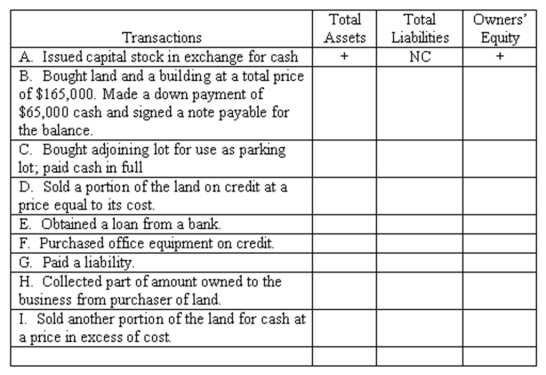
(77) Effects of transactions on elements of the accounting equation. Some of the transactions carried out by Tudor Wholesale during the first month of the company's operations are listed below. You are to determine the effect of each transaction on the total assets, the total liabilities, and the owners' equity. Prepare your answer in columnar form, identifying each transaction by letter and using the symbols (+) for increase, (-) for decrease, and (NC) for no change. An answer is provided for the first transaction to serve as an example.
(Essay)
4.8/5 (94)
(94) The accounting equation may be stated as "assets minus liabilities equals owners' equity."
(True/False)
4.8/5 (74)
(74) In a business organized as a corporation, it is not necessary to list the equity of each stockholder on the balance sheet.
(True/False)
4.8/5 (69)
(69) Which of the following statements regarding liquidity and profitability is not true?
(Multiple Choice)
4.9/5 (71)
(71) If a company purchases equipment for $65,000 by issuing a note payable:
(Multiple Choice)
4.8/5 (77)
(77) The amount of owners' equity in a business is not affected by:
(Multiple Choice)
4.9/5 (72)
(72) If a company purchases equipment by issuing a note payable, its total assets will not change.
(True/False)
4.9/5 (68)
(68) A net profit results from having more revenues than liabilities.
(True/False)
4.9/5 (81)
(81) Valuation of assets under generally accepted accounting principles. Under generally accepted accounting principles, the assets owned by a business are reported in the balance sheet at their historical cost. Identify and briefly explain two accounting principles other than the cost principle that support the valuation of assets at cost in the balance sheet.
(Essay)
4.9/5 (83)
(83) Total assets must always equal total liabilities plus total owners' equity.
(True/False)
4.8/5 (88)
(88) Which of the following is the primary objective of financial statements?
(Multiple Choice)
4.9/5 (96)
(96) 
Filters
- Essay(0)
- Multiple Choice(0)
- Short Answer(0)
- True False(0)
- Matching(0)