



 Chat with AI
Exam 11: Stockholders Equity: Paid-In Capital

Exam 1: Accounting: Information for Decision Making135 Questions
Exam 2: Basic Financial Statements158 Questions
Exam 3: The Accounting Cycle: Capturing Economic Events161 Questions
Exam 4: The Accounting Cycle: Accruals and Deferrals160 Questions
Exam 5: The Accounting Cycle: Reporting Financial Results136 Questions
Exam 6: Merchandising Activities144 Questions
Exam 7: Financial Assets233 Questions
Exam 8: Inventories and the Cost of Goods Sold169 Questions
Exam 9: Plant and Intangible Assets154 Questions
Exam 10: Liabilities221 Questions
Exam 11: Stockholders Equity: Paid-In Capital166 Questions
Exam 12: Income and Changes in Retained Earnings153 Questions
Exam 13: Statement of Cash Flows181 Questions
Exam 14: Financial Statement Analysis165 Questions
Exam 15: Global Business and Accounting95 Questions
Exam 16: Management Accounting: a Business Partner124 Questions
Exam 17: Job Order Cost Systems and Overhead Allocations116 Questions
Exam 18: Process Costing103 Questions
Exam 19: Costing and the Value Chain89 Questions
Exam 20: Cost-Volume-Profit Analysis147 Questions
Exam 21: Incremental Analysis119 Questions
Exam 22: Responsibility Accounting and Transfer Pricing108 Questions
Exam 23: Operational Budgeting115 Questions
Exam 24: Standard Cost Systems130 Questions
Exam 25: Rewarding Business Performance71 Questions
Exam 26: Capital Budgeting125 Questions
Exam 28: Forms of Business Organization52 Questions
Exam 27: The Time Value of Money: Future Amounts and Present Values Answer Key49 Questions
Select questions type


Refer to the information above. The average issue price per share of the preferred stock was:
(Multiple Choice)
4.9/5  (88)
(88) What's so "preferred" about preferred stocks?
Most preferred stocks do not have voting power, a basic right of common stock. Identify at least two features of most preferred stocks that justify or support use of the term preferred in describing these types of stock issues.
(Essay)
4.8/5 (89)
(89) Preferred stockholders are owners of the corporation and have rights upon liquidation and to receive dividends.
(True/False)
4.9/5 (75)
(75) Preferred stockholders generally do not have the same voting rights as do common stockholders in a corporation.
(True/False)
4.8/5 (70)
(70) Most preferred stocks have the following characteristics, except:
(Multiple Choice)
4.7/5 (81)
(81) Which of the following is not an addition to total paid-in-capital?
(Multiple Choice)
4.9/5 (68)
(68) On September 1, 2009, Maryland Corporation's common stock was selling at a market price of $200 per share. On that date, Maryland announced a 3 for 2 stock split. At what price would you expect the stock to trade immediately after the split goes into effect?
(Multiple Choice)
4.8/5 (69)
(69) Stockholders' Equity
Blake Corporation has the following accounts on December 31, 2010
Common Stock $.25 par, 1,000,000 authorized, 400,000 issued.
Preferred stock 6%, $100 par, cumulative, 5,000 shares authorized, 3,000 issued.
Treasury stock, 1,500 shares purchased at market value of $6 per share
Paid-in capital - Preferred \ 190,000 Paid-in capital - Common \ 2,400,000 Dividends Payable \ 415,000 Retained Earnings \ 2,335,000
Required:
(1) Prepare the stockholders' equity section of the balance sheet.
(2) Prepare the journal entry for the purchase of the treasury stock.
(3) Blake paid the liability for dividends on March 1. Prepare the journal entry for the payment.
(Essay)
4.9/5 (79)
(79) When a stockholder sends in a proxy statement to a corporation he or she owns stock in, they relinquish their voting rights to the officers of the corporation.
(True/False)
4.8/5 (86)
(86) Stockholders of a corporation are personally liable for the debts of the corporation if all shares of stock are owned by the officers of the corporation.
(True/False)
4.9/5 (78)
(78) It is illegal for the government to double tax corporate earnings.
(True/False)
4.9/5 (70)
(70) Accounting terminology
Listed below are nine technical accounting terms introduced in this chapter:
 Each of the following statements may (or may not) describe one of these technical terms. In the space provided beside each statement, indicate the accounting term described, or answer "None" if the statement does not correctly describe any of the terms.
____ (a) The type of stock whose owners have little say in management of the corporation and whose annual dividend is limited to a preset amount.
____ (b) Distribution of cash or other company assets to the owners of a corporation.
____ (c) An investment banking firm that guarantees an issuing corporation a specific price for a stock issue and then makes a profit by selling the shares to the investing public at a higher price.
____ (d) Shares of a corporation's stock that have been issued and then reacquired, but not cancelled.
____ (e) An element of stockholders' equity arising from the profitable operations of a business.
____ (f) The type of stock most likely to increase dramatically in value if the issuing corporation is extremely successful.
____ (g) Amounts invested in a corporation by its stockholders.
Each of the following statements may (or may not) describe one of these technical terms. In the space provided beside each statement, indicate the accounting term described, or answer "None" if the statement does not correctly describe any of the terms.
____ (a) The type of stock whose owners have little say in management of the corporation and whose annual dividend is limited to a preset amount.
____ (b) Distribution of cash or other company assets to the owners of a corporation.
____ (c) An investment banking firm that guarantees an issuing corporation a specific price for a stock issue and then makes a profit by selling the shares to the investing public at a higher price.
____ (d) Shares of a corporation's stock that have been issued and then reacquired, but not cancelled.
____ (e) An element of stockholders' equity arising from the profitable operations of a business.
____ (f) The type of stock most likely to increase dramatically in value if the issuing corporation is extremely successful.
____ (g) Amounts invested in a corporation by its stockholders. (Essay)
4.8/5 (79)
(79) The purchase of treasury stock creates an asset for the corporation and is recorded at the cost of the shares purchased, not par value.
(True/False)
4.7/5 (71)
(71) A corporation continues in existence even if a stockholder dies or withdraws from the organization.
(True/False)
4.8/5 (85)
(85) Treasury stock transactions.
Jackson Corporation engaged in the following treasury stock transactions during the current year:
 Complete the following three general journal entries to record these treasury stock transactions.
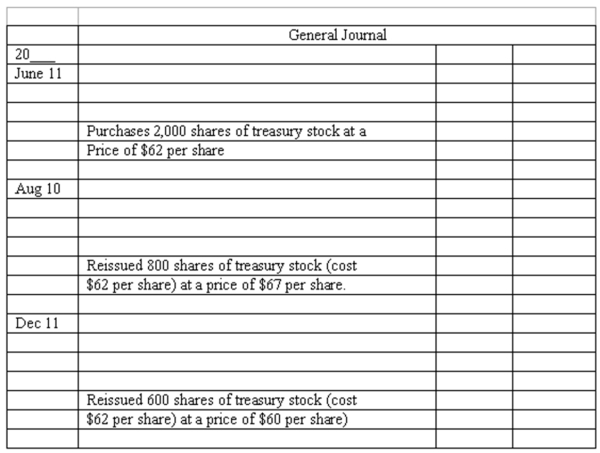
Complete the following three general journal entries to record these treasury stock transactions.
(Essay)
4.9/5 (73)
(73) The advantages of corporations going public include all of the following except:
(Multiple Choice)
4.8/5 (77)
(77) The average issue price per share of Grant's preferred stock was:
(Multiple Choice)
4.8/5 (71)
(71) 
Filters
- Essay(0)
- Multiple Choice(0)
- Short Answer(0)
- True False(0)
- Matching(0)