



 Chat with AI
Exam 15: Global Business and Accounting

Exam 1: Accounting: Information for Decision Making135 Questions
Exam 2: Basic Financial Statements158 Questions
Exam 3: The Accounting Cycle: Capturing Economic Events161 Questions
Exam 4: The Accounting Cycle: Accruals and Deferrals160 Questions
Exam 5: The Accounting Cycle: Reporting Financial Results136 Questions
Exam 6: Merchandising Activities144 Questions
Exam 7: Financial Assets233 Questions
Exam 8: Inventories and the Cost of Goods Sold169 Questions
Exam 9: Plant and Intangible Assets154 Questions
Exam 10: Liabilities221 Questions
Exam 11: Stockholders Equity: Paid-In Capital166 Questions
Exam 12: Income and Changes in Retained Earnings153 Questions
Exam 13: Statement of Cash Flows181 Questions
Exam 14: Financial Statement Analysis165 Questions
Exam 15: Global Business and Accounting95 Questions
Exam 16: Management Accounting: a Business Partner124 Questions
Exam 17: Job Order Cost Systems and Overhead Allocations116 Questions
Exam 18: Process Costing103 Questions
Exam 19: Costing and the Value Chain89 Questions
Exam 20: Cost-Volume-Profit Analysis147 Questions
Exam 21: Incremental Analysis119 Questions
Exam 22: Responsibility Accounting and Transfer Pricing108 Questions
Exam 23: Operational Budgeting115 Questions
Exam 24: Standard Cost Systems130 Questions
Exam 25: Rewarding Business Performance71 Questions
Exam 26: Capital Budgeting125 Questions
Exam 28: Forms of Business Organization52 Questions
Exam 27: The Time Value of Money: Future Amounts and Present Values Answer Key49 Questions
Select questions type


Listed below are nine global business terms introduced in this chapter:
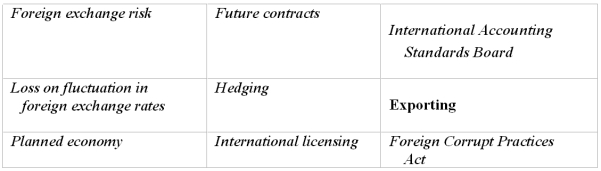 Each of the following statements may (or may not) describe one of these terms. In the space provided below each statement, indicate the accounting term described, or answer "None" if the statement does not correctly describe any of the terms.
a. The strategy of creating offsetting positions so that losses from currency fluctuations will be offset by gains resulting from the same fluctuations.______________________________
b. Selling a good or service to a foreign customer.______________________________
c. Government allocates resources and determines output through central planning.______________________________
d. The organization responsible for developing uniform worldwide accounting standards.______________________________
e. Distinguishes between illegal influence peddling and legal facilitating payments.______________________________
f. A cross-border contractual agreement allowing one company to use trademarks, patents, or technology of another company.______________________________
g. The impact on the value of a company of unexpected fluctuations in the exchange rate.______________________________
Each of the following statements may (or may not) describe one of these terms. In the space provided below each statement, indicate the accounting term described, or answer "None" if the statement does not correctly describe any of the terms.
a. The strategy of creating offsetting positions so that losses from currency fluctuations will be offset by gains resulting from the same fluctuations.______________________________
b. Selling a good or service to a foreign customer.______________________________
c. Government allocates resources and determines output through central planning.______________________________
d. The organization responsible for developing uniform worldwide accounting standards.______________________________
e. Distinguishes between illegal influence peddling and legal facilitating payments.______________________________
f. A cross-border contractual agreement allowing one company to use trademarks, patents, or technology of another company.______________________________
g. The impact on the value of a company of unexpected fluctuations in the exchange rate.______________________________ (Essay)
4.8/5  (85)
(85) Trente Switch and Signal sold equipment to a Canadian transportation company at a price of 300,000 Canadian dollars with payment due in 60 days. On the date of sale, the exchange rate was 1.50 Canadian dollars per U.S. dollar. Trente decided to hedge the risk of currency fluctuations by purchasing 300,000 Canadian dollars with payment due in 60 days. If the exchange rate in 60 days is 1.25 Canadian dollars per U.S. dollar, Trente Switch and Signal will:
(Multiple Choice)
5.0/5 (79)
(79) An international joint venture is a company owned by two or more companies from different countries.
(True/False)
4.9/5 (68)
(68) One of the most important requirements of the Foreign Corrupt Practices Act is the maintenance of an adequate system of international reporting.
(True/False)
4.9/5 (69)
(69) If the exchange rate for a foreign currency (stated in dollars) has risen, a dollar will purchase:
(Multiple Choice)
4.9/5 (74)
(74) Which of the following does not affect the cost associated with producing and selling goods and services in global markets?
(Multiple Choice)
4.8/5 (82)
(82) Which of the following organizations is responsible for developing uniform worldwide accounting standards?
(Multiple Choice)
4.8/5 (78)
(78) Having a liability that is fixed in terms of a foreign currency results in a loss for the debtor if the exchange rate falls between the transaction date and the payment date.
(True/False)
4.8/5 (83)
(83) An international joint venture involves the creation of a new company that is owned by two or more firms from different countries.
(True/False)
4.9/5 (85)
(85) China, Japan, and Australia have amended their current standards to converge with International Financial Reporting Standards, but the United States has chosen not to adopt the International Financial Reporting Standards.
(True/False)
4.9/5 (91)
(91) Hedging refers to the strategy of taking offsetting positions so that gains in one currency offset losses in another currency.
(True/False)
4.8/5 (92)
(92) Multicountry tax laws do not affect the cost of doing business in global markets.
(True/False)
4.9/5 (74)
(74) Explain the major provisions of the Foreign Corrupt Practices Act as amended in 1986.
(Essay)
4.7/5 (76)
(76) The standards issued by the International Accounting Standards Board must be followed by all multinational companies.
(True/False)
4.9/5 (78)
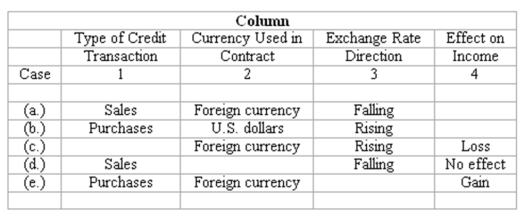
(78) The following table summarizes the facts of five independent cases (labeled a through e) of American companies engaging in credit transactions with foreign corporations while the foreign exchange rate is fluctuating:
 Instructions
After evaluating the information about each case, fill the blank space that has been left in one of the four columns denoted by a yellow color. The content of each column and the word or words that you should enter in the blank spaces are described below:
Column 1 indicates the type of credit transaction in which the American company engaged with the foreign corporations. The answer entered in this column should be either "Sales" or "Purchases."
Column 2 indicates the currency in which the invoice price is stated. The answer may be either "U.S. dollars" or "Foreign currency."
Column 3 indicates the direction in which the foreign currency exchange rate has moved between the date of the credit transaction and the date of settlement. The answer in this column may be either "Rising" or "Falling."
Column 4 indicates the effect of the exchange rate fluctuation upon the income of the American company. The answers entered in this column are to be selected from the following: "Gain," "Loss," or "No effect."
Instructions
After evaluating the information about each case, fill the blank space that has been left in one of the four columns denoted by a yellow color. The content of each column and the word or words that you should enter in the blank spaces are described below:
Column 1 indicates the type of credit transaction in which the American company engaged with the foreign corporations. The answer entered in this column should be either "Sales" or "Purchases."
Column 2 indicates the currency in which the invoice price is stated. The answer may be either "U.S. dollars" or "Foreign currency."
Column 3 indicates the direction in which the foreign currency exchange rate has moved between the date of the credit transaction and the date of settlement. The answer in this column may be either "Rising" or "Falling."
Column 4 indicates the effect of the exchange rate fluctuation upon the income of the American company. The answers entered in this column are to be selected from the following: "Gain," "Loss," or "No effect." (Essay)
4.7/5 (81)
(81) 
Filters
- Essay(0)
- Multiple Choice(0)
- Short Answer(0)
- True False(0)
- Matching(0)