



 Chat with AI
Exam 22: Accounting for Changes and Errors

Exam 1: The Demand for and Supply of Financial Accounting Information89 Questions
Exam 2: Financial Reporting: Its Conceptual Framework87 Questions
Exam 3: Review of a Companys Accounting System146 Questions
Exam 4: The Balance Sheet and the Statement of Shareholders Equity112 Questions
Exam 5: The Income Statement and the Statement of Cash Flows151 Questions
Exam 6: Cash and Receivables149 Questions
Exam 7: Inventories: Cost Measurement and Flow Assumptions123 Questions
Exam 8: Inventories: Special Valuation Issues148 Questions
Exam 9: Current Liabilities and Contingencies128 Questions
Exam 10: Property, Plant, and Equipment: Acquisition and Subsequent Investments105 Questions
Exam 11: Depreciation, Depletion, Impairment, and Disposal143 Questions
Exam 12: Intangibles105 Questions
Exam 13: Investments and Long-Term Receivables140 Questions
Exam 14: Financing Liabilities: Bonds and Notes Payable171 Questions
Exam 15: Contributed Capital154 Questions
Exam 16: Retained Earnings and Earnings Per Share111 Questions
Exam 17: Advanced Issues in Revenue Recognition113 Questions
Exam 18: Accounting for Income Taxes108 Questions
Exam 19: Accounting for Postretirement Benefits98 Questions
Exam 20: Accounting for Leases149 Questions
Exam 21: The Statement of Cash Flows107 Questions
Exam 22: Accounting for Changes and Errors130 Questions
Exam 23: Time Value of Money Module121 Questions
Select questions type


All of the following would be reported retrospectively by restating prior period's financial results except for a
(Multiple Choice)
4.7/5  (92)
(92) Which of the following should be reported as a change in accounting estimate?
(Multiple Choice)
4.8/5 (75)
(75) A change in unit depletion rate would be accounted for as a
(Multiple Choice)
4.9/5 (77)
(77) On January 1, 2014, Suzanne Company purchased equipment for $48,000. The estimated life was five years and the salvage value was estimated at $5,000. On January 1, 2016, it was determined that the equipment's total useful life should have been estimated at seven years and the salvage value should have been estimated at only $4,000. The company used straight-line depreciation.
Required:
a.What type of change did Suzanne Company make on January 1, 2016, and how should Suzanne account for the change?
b.If an adjusting entry is necessary on January 1, 2016, prepare it.
c.Compute the amount of depreciation expense on the equipment for 2016.
(Essay)
4.8/5 (78)
(78) An advantage of retrospective adjustment method is that it achieves comparability and consistency between accounting periods.
(True/False)
4.8/5 (89)
(89) Disadvantages of using the retrospective application method do not include which of the following?
(Multiple Choice)
4.9/5 (79)
(79) Which of the following changes would normally require some footnote disclosure?
(Multiple Choice)
4.9/5 (83)
(83) During 2016, Dragon Company determined, based on new information, that equipment previously depreciated using a ten-year life and a salvage value of $100,000 had a total estimated life of only six years and a salvage value of $50,000. The equipment was acquired on January 1, 2014 at a cost of $600,000, and was depreciated using the straight-line method. Dragon made an accounting change in 2016 to reflect this additional information, and the change was approved by the IRS. Dragon has an income tax rate of 30%. Assuming Dragon's income before depreciation, before income taxes, and before any retroactive effect of the accounting change (if any) for the year ended December 31, 2016, was $180,000, Dragon's net income for 2016 should be
(Multiple Choice)
5.0/5 (86)
(86) In Western reviewed their estimated warranty costs which at that time was 5% of sales. This estimated was based upon the warranty accrual method. In 2014 net sales were $3,250,000 they recorded warranty expense of $162,500. Due to some pending changes in product improvement and certain economic factors the company saw a drastic drop in their warranty claims for 2015. The company decided for 2015 to reduce the estimate to 3% of sales. In 2015 Western reported net sales of $3,500,000.
Required:
1) How should the company report the change and why?
2) Prepare any necessary journal entries for 2014 or 2015 to account for the change.
(Essay)
4.8/5 (89)
(89) Exhibit 22-4 Barbara Company's year-end December 31, 2014, financial statements contained the following errors:
Ending inventory on December 31, 2014, was overstated by $75,000.
Depreciation expense was understated by $7,000.
A two-year insurance policy for 2014 and 2015 in the amount of $14,000 was entirely expensed in 2014.
Investments in common stock of other companies were sold in 2014 at a gain of $10,000, but the sale was not recorded until 2015.
-Refer to Exhibit 22-4. The effect of the above errors on the December 31, 2014, reported assets of Barbara is that assets are
(Multiple Choice)
4.8/5 (78)
(78) On January 1, 2014, Tessa loaned $12,000 to another company on a three-year, 4% note. No interest was accrued in 2014. Cash will not be received for the interest until the end of the three-year period. The error was discovered before adjusting and closing entries were posted on December 31, 2015. Ignoring income taxes, the correct entry on December 31, 2015, should be
(Multiple Choice)
4.9/5 (81)
(81) Explain the direct and indirect effects of a change in accounting principles.
(Essay)
4.9/5 (73)
(73) Shelley Construction began operations in 2014 and appropriately used the completed-contract method in accounting for its long-term construction contracts. The prepared the following information:
 Effective January 1, 2016, Shelley changed to the percentage-of-completion method tax reporting and can justify the change; the company's tax rate is 35%. It determines the construction and revenue expense amounts under the percentage of completion method to be:
 Required:
1) How would the company account for the change?
2) Prepare the journal entries to reflect the changes.
Effective January 1, 2016, Shelley changed to the percentage-of-completion method tax reporting and can justify the change; the company's tax rate is 35%. It determines the construction and revenue expense amounts under the percentage of completion method to be:
Required:
1) How would the company account for the change?
2) Prepare the journal entries to reflect the changes. (Essay)
4.7/5 (87)
(87) The December 31, 2014, ending inventory failed to include $25,000 of inventory that was received on December 27, 2014. The purchase on account was, however, properly recorded on the date of delivery. What effect will this error have on the December 31, 2014, assets, liabilities, and net income for the year then ended?

(Multiple Choice)
4.8/5 (73)
(73) A change in accounting estimate does not result in a retrospective adjustment to previously issued financial statements.
(True/False)
4.9/5 (86)
(86) On January 1, Year 1, the Dole Company purchased an asset that cost $154,000. The asset had an expected useful life of seven years and no estimated residual value. The company initially decided to use sum-of-the-years'-digits (SYD) depreciation for both financial accounting and income tax purposes. Depreciation expense for the straight-line method and the sum-of-the-years'-digits method is as follows: 
(Essay)
4.9/5 (80)
(80) The Jack Company began its operations on January 1, 2014, and used the LIFO method of accounting for its inventory. On January 1, 2016, Jack Company adopted FIFO in accounting for its inventory. The following information is available regarding cost of goods sold for each method:
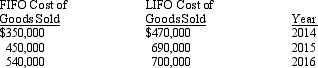 Assuming a tax rate of 35% and the same accounting change adopted for tax purposes, how would the effect of the accounting change be reported in opening retained earnings on the 2016 financial statements?
 (Multiple Choice)
5.0/5 (85)
(85) When a change in method is inseparable from a change in estimate, the change is accounted for
(Multiple Choice)
4.9/5 (82)
(82) What are the two methods for reporting changes as approved by GAAP provide a brief explanation of each?
(Essay)
4.7/5 (88)
(88) 
Filters
- Essay(0)
- Multiple Choice(0)
- Short Answer(0)
- True False(0)
- Matching(0)