



 Chat with AI
Exam 5: Consolidated Financial Statements - Intercompany Asset Transactions

Exam 1: The Equity Method of Accounting for Investments119 Questions
Exam 2: Consolidation of Financial Information118 Questions
Exam 3: Consolidations - Subsequent to the Date of Acquisition121 Questions
Exam 4: Consolidated Financial Statements and Outside Ownership116 Questions
Exam 5: Consolidated Financial Statements - Intercompany Asset Transactions127 Questions
Exam 6: Intercompany Debt, Consolidated Statement of Cash Flows, and Other Issues114 Questions
Exam 7: Consolidated Financial Statements - Ownership Patterns and Income Taxes117 Questions
Exam 8: Segment and Interim Reporting113 Questions
Exam 9: Foreign Currency Transactions and Hedging Foreign Exchange Risk93 Questions
Exam 10: Translation of Foreign Currency Financial Statements97 Questions
Exam 11: Worldwide Accounting Diversity and International Accounting Standards60 Questions
Exam 12: Financial Reporting and the Securities and Exchange Commission76 Questions
Exam 13: Accounting for Legal Reorganizations and Liquidations83 Questions
Exam 14: Partnerships: Formation and Operation88 Questions
Exam 15: Partnerships: Termination and Liquidation70 Questions
Exam 16: Accounting for State and Local Governments78 Questions
Exam 17: Accounting for State and Local Governments51 Questions
Exam 18: Accounting for Not-For-Profit Organizations64 Questions
Exam 19: Accounting for Estates and Trusts80 Questions
Select questions type


Wilson owned equipment with an estimated life of 10 years when it was acquired for an original cost of $80,000. The equipment had a book value of $50,000 at January 1, 2010. On January 1, 2010, Wilson realized that the useful life of the equipment was longer than originally anticipated, at ten remaining years. On April 1, 2010 Simon Company, a 90% owned subsidiary of Wilson Company, bought the equipment from Wilson for $68,250 and for depreciation purposes used the estimated remaining life as of that date. The following data are available pertaining to Simon's income and dividends:  Compute the amortization of gain through a depreciation adjustment for 2012 for consolidation purposes.
 (Multiple Choice)
4.8/5  (75)
(75) On April 7, 2011, Pate Corp. sold land to Shannahan Co., its subsidiary. From a consolidated point of view, when will the gain on this transfer actually be earned?
(Essay)
5.0/5 (74)
(74) Stark Company, a 90% owned subsidiary of Parker, Inc., sold land to Parker on May 1, 2010, for $80,000. The land originally cost Stark $85,000. Stark reported net income of $200,000, $180,000, and $220,000 for 2010, 2011, and 2012, respectively. Parker sold the land purchased from Stark in 2010 for $92,000 in 2012. Compute Stark's reported gain or loss relating to the land for 2012.
(Multiple Choice)
4.9/5 (91)
(91) Patti Company owns 80% of the common stock of Shannon, Inc. In the current year, Patti reports sales of $10,000,000 and cost of goods sold of $7,500,000. For the same period, Shannon has sales of $200,000 and cost of goods sold of $160,000. During the year, Patti sold merchandise to Shannon for $60,000 at a price based on the normal markup. At the end of the year, Shannon still possesses 30 percent of this inventory. Compute consolidated cost of goods sold.
(Multiple Choice)
4.9/5 (92)
(92) On January 1, 2011, Pride, Inc. acquired 80% of the outstanding voting common stock of Strong Corp. for $364,000. There is no active market for Strong's stock. Of this payment, $28,000 was allocated to equipment (with a five-year life) that had been undervalued on Strong's books by $35,000. Any remaining excess was attributable to goodwill which has not been impaired. As of December 31, 2011, before preparing the consolidated worksheet, the financial statements appeared as follows: 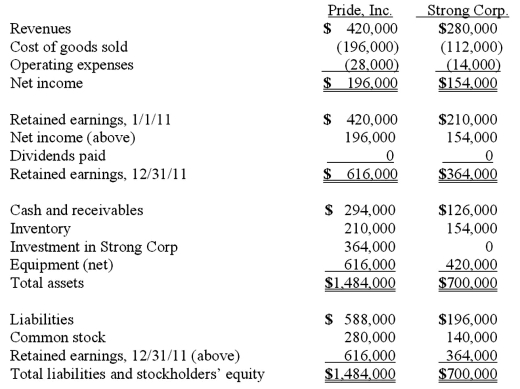 During 2011, Pride bought inventory for $112,000 and sold it to Strong for $140,000. Only half of this purchase had been paid for by Strong by the end of the year. 60% of these goods were still in the company's possession on December 31.
What is the total of consolidated cost of goods sold?
During 2011, Pride bought inventory for $112,000 and sold it to Strong for $140,000. Only half of this purchase had been paid for by Strong by the end of the year. 60% of these goods were still in the company's possession on December 31.
What is the total of consolidated cost of goods sold? (Multiple Choice)
5.0/5 (71)
(71) During 2010, Von Co. sold inventory to its wholly-owned subsidiary, Lord Co. The inventory cost $30,000 and was sold to Lord for $44,000. From the perspective of the combination, when is the $14,000 gain realized?
(Multiple Choice)
4.8/5 (68)
(68) On January 1, 2010, Smeder Company, an 80% owned subsidiary of Collins, Inc., transferred equipment with a 10-year life (six of which remain with no salvage value) to Collins in exchange for $84,000 cash. At the date of transfer, Smeder's records carried the equipment at a cost of $120,000 less accumulated depreciation of $48,000. Straight-line depreciation is used. Smeder reported net income of $28,000 and $32,000 for 2010 and 2011, respectively. All net income effects of the intra-entity transfer are attributed to the seller for consolidation purposes. Compute Collins' share of Smeder's net income for 2010.
(Multiple Choice)
4.9/5 (83)
(83) How do upstream and downstream inventory transfers differ in their effect in a year-end consolidation?
(Essay)
4.8/5 (79)
(79) Walsh Company sells inventory to its subsidiary, Fisher Company, at a profit during 2010. One-third of the inventory is sold by Walsh uses the equity method to account for its investment in Fisher. In the consolidation worksheet for 2010, which of the following choices would be a debit entry to eliminate unrealized intra-entity gross profit with regard to the 2010 intra-entity sales?
(Multiple Choice)
4.8/5 (81)
(81) Several years ago Polar Inc. acquired an 80% interest in Icecap Co. The book values of Icecap's asset and liability accounts at that time were considered to be equal to their fair values. Polar's acquisition value corresponded to the underlying book value of Icecap so that no allocations or goodwill resulted from the transaction.
The following selected account balances were from the individual financial records of these two companies as of December 31, 2011: 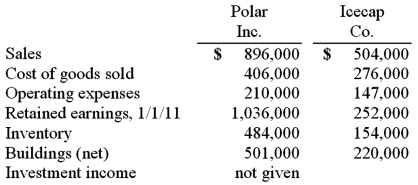 Assume that Polar sold inventory to Icecap at a markup equal to 25% of cost. Intra-entity transfers were $130,000 in 2010 and $165,000 in 2011. Of this inventory, $39,000 of the 2010 transfers were retained and then sold by Icecap in 2011, while $55,000 of the 2011 transfers were held until 2012.
Required:
For the consolidated financial statements for 2011, determine the balances that would appear for the following accounts: (1) Cost of Goods Sold, (2) Inventory, and (3) Non-controlling Interest in Subsidiary's Net Income.
Assume that Polar sold inventory to Icecap at a markup equal to 25% of cost. Intra-entity transfers were $130,000 in 2010 and $165,000 in 2011. Of this inventory, $39,000 of the 2010 transfers were retained and then sold by Icecap in 2011, while $55,000 of the 2011 transfers were held until 2012.
Required:
For the consolidated financial statements for 2011, determine the balances that would appear for the following accounts: (1) Cost of Goods Sold, (2) Inventory, and (3) Non-controlling Interest in Subsidiary's Net Income. (Essay)
4.8/5 (82)
(82) Stiller Company, an 80% owned subsidiary of Leo Company, purchased land from Leo on March 1, 2010, for $75,000. The land originally cost Leo $60,000. Stiller reported net income of $125,000 and $140,000 for 2010 and 2011, respectively. Leo uses the equity method to account for its investment. On a consolidation worksheet, what adjustment would be made for 2010 regarding the land transfer?
(Multiple Choice)
4.9/5 (81)
(81) On January 1, 2011, Pride, Inc. acquired 80% of the outstanding voting common stock of Strong Corp. for $364,000. There is no active market for Strong's stock. Of this payment, $28,000 was allocated to equipment (with a five-year life) that had been undervalued on Strong's books by $35,000. Any remaining excess was attributable to goodwill which has not been impaired. As of December 31, 2011, before preparing the consolidated worksheet, the financial statements appeared as follows: 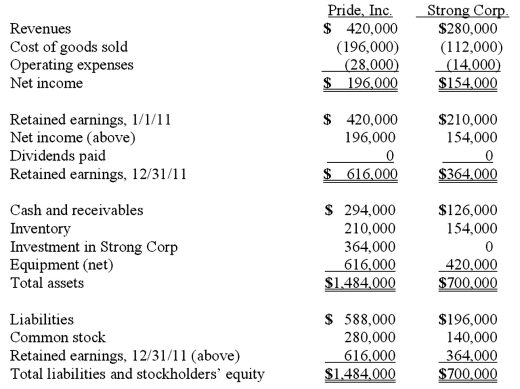 During 2011, Pride bought inventory for $112,000 and sold it to Strong for $140,000. Only half of this purchase had been paid for by Strong by the end of the year. 60% of these goods were still in the company's possession on December 31.
What is the consolidated total for inventory at December 31, 2011?
During 2011, Pride bought inventory for $112,000 and sold it to Strong for $140,000. Only half of this purchase had been paid for by Strong by the end of the year. 60% of these goods were still in the company's possession on December 31.
What is the consolidated total for inventory at December 31, 2011? (Multiple Choice)
4.7/5 (84)
(84) What is meant by unrealized inventory gains, and how are they treated on a consolidation worksheet?
(Essay)
4.8/5 (82)
(82) Pot Co. holds 90% of the common stock of Skillet Co. During 2011, Pot reported sales of $1,120,000 and cost of goods sold of $840,000. For this same period, Skillet had sales of $420,000 and cost of goods sold of $252,000. The reported sales did not include any intra-entity sales. In addition to the reported amounts, there were intra-entity sales from Pot to Skillet in the amount of $140,000. There were no sales from Skillet to Pot. Intra-entity sales had the same markup as sales to outsiders. Skillet still had 40% of the intra-entity sales as inventory at the end of 2011. What are consolidated sales and cost of goods sold for 2011?
(Multiple Choice)
4.8/5 (76)
(76) Wilson owned equipment with an estimated life of 10 years when it was acquired for an original cost of $80,000. The equipment had a book value of $50,000 at January 1, 2010. On January 1, 2010, Wilson realized that the useful life of the equipment was longer than originally anticipated, at ten remaining years. On April 1, 2010 Simon Company, a 90% owned subsidiary of Wilson Company, bought the equipment from Wilson for $68,250 and for depreciation purposes used the estimated remaining life as of that date. The following data are available pertaining to Simon's income and dividends:  Compute the gain on transfer of equipment reported by Wilson for 2010.
 (Multiple Choice)
4.8/5 (76)
(76) Parent sold land to its subsidiary for a gain in 2008. The subsidiary sold the land externally for a gain in 2011. Which of the following statements is true?
(Multiple Choice)
4.8/5 (79)
(79) What is the impact on the non-controlling interest of a subsidiary when there are downstream transfers of inventory between the parent and subsidiary companies?
(Short Answer)
4.8/5 (73)
(73) Stiller Company, an 80% owned subsidiary of Leo Company, purchased land from Leo on March 1, 2010, for $75,000. The land originally cost Leo $60,000. Stiller reported net income of $125,000 and $140,000 for 2010 and 2011, respectively. Leo uses the equity method to account for its investment. Compute income from Stiller on Leo's books for 2010.
(Multiple Choice)
4.8/5 (78)
(78) On January 1, 2011, Musial Corp. sold equipment to Matin Inc. (a wholly-owned subsidiary) for $168,000 in cash. The equipment originally cost $140,000 but had a book value of only $98,000 when transferred. On that date, the equipment had a five-year remaining life. Depreciation expense was calculated using the straight-line method.
Musial earned $308,000 in net income in 2011 (not including any investment income) while Matin reported $126,000. Assume there is no amortization related to the original investment.
Prepare a schedule of consolidated net income and the share to controlling and non-controlling interests for 2011, assuming that Musial owned only 90% of Matin and the equipment transfer had been upstream
(Essay)
4.9/5 (71)
(71) Gargiulo Company, a 90% owned subsidiary of Posito Corporation, sells inventory to Posito at a 25% profit on selling price. The following data are available pertaining to intra-entity purchases. Gargiulo was acquired on January 1, 2010.  Assume the equity method is used. The following data are available pertaining to Gargiulo's income and dividends.
 Compute the non-controlling interest in Gargiulo's net income for 2010.
Assume the equity method is used. The following data are available pertaining to Gargiulo's income and dividends. Compute the non-controlling interest in Gargiulo's net income for 2010. (Multiple Choice)
4.8/5 (78)
(78) 
Filters
- Essay(0)
- Multiple Choice(0)
- Short Answer(0)
- True False(0)
- Matching(0)