



 Chat with AI
Exam 13: Accounting for Legal Reorganizations and Liquidations

Exam 1: The Equity Method of Accounting for Investments119 Questions
Exam 2: Consolidation of Financial Information118 Questions
Exam 3: Consolidations - Subsequent to the Date of Acquisition121 Questions
Exam 4: Consolidated Financial Statements and Outside Ownership116 Questions
Exam 5: Consolidated Financial Statements - Intercompany Asset Transactions127 Questions
Exam 6: Intercompany Debt, Consolidated Statement of Cash Flows, and Other Issues114 Questions
Exam 7: Consolidated Financial Statements - Ownership Patterns and Income Taxes117 Questions
Exam 8: Segment and Interim Reporting113 Questions
Exam 9: Foreign Currency Transactions and Hedging Foreign Exchange Risk93 Questions
Exam 10: Translation of Foreign Currency Financial Statements97 Questions
Exam 11: Worldwide Accounting Diversity and International Accounting Standards60 Questions
Exam 12: Financial Reporting and the Securities and Exchange Commission76 Questions
Exam 13: Accounting for Legal Reorganizations and Liquidations83 Questions
Exam 14: Partnerships: Formation and Operation88 Questions
Exam 15: Partnerships: Termination and Liquidation70 Questions
Exam 16: Accounting for State and Local Governments78 Questions
Exam 17: Accounting for State and Local Governments51 Questions
Exam 18: Accounting for Not-For-Profit Organizations64 Questions
Exam 19: Accounting for Estates and Trusts80 Questions
Select questions type


Mount Inc. was a hardware store that operated in Boise, Idaho. Management made some poor inventory acquisitions that loaded the store with unsalable merchandise. Due to the decline in revenues, the company became insolvent. Following is a trial balance as of March 15, 2011, the day the company filed for Chapter 7 liquidation. 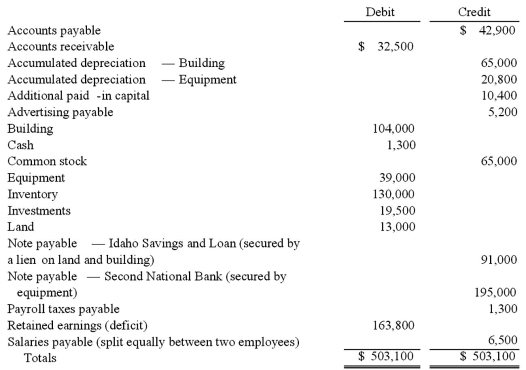 Company officials believed that sixty percent of the accounts receivable could be collected if the company was liquidated. The building and land had a fair value of $97,500, while the equipment was worth $24,700. The investments represented shares of a publicly traded company that could be sold at the time for $27,300. The entire inventory could be sold for only $42,900. Administrative expenses necessary to carry out a liquidation would have approximated $20,800.
Assume that the company was being liquidated and that the following transactions occurred:
• Accounts receivable of $23,400 were collected.
• All of the company's inventory was sold for $52,000.
• Additional accounts payable of $13,000 incurred for various expenses such as utilities and maintenance were discovered.
• The land and building were sold for $92,300.
• The note payable due to the Idaho Savings and Loan was paid.
• The equipment was sold at auction for only $14,300 with the proceeds applied to the note owed to the Second National Bank.
• The investments were sold for $27,300.
• Administrative expenses totaled $26,000 as of July 26, 2011, but no payment had yet been made.
Required:
Prepare a statement of realization and liquidation for the period from March 15 through July 26, 2011.
Company officials believed that sixty percent of the accounts receivable could be collected if the company was liquidated. The building and land had a fair value of $97,500, while the equipment was worth $24,700. The investments represented shares of a publicly traded company that could be sold at the time for $27,300. The entire inventory could be sold for only $42,900. Administrative expenses necessary to carry out a liquidation would have approximated $20,800.
Assume that the company was being liquidated and that the following transactions occurred:
• Accounts receivable of $23,400 were collected.
• All of the company's inventory was sold for $52,000.
• Additional accounts payable of $13,000 incurred for various expenses such as utilities and maintenance were discovered.
• The land and building were sold for $92,300.
• The note payable due to the Idaho Savings and Loan was paid.
• The equipment was sold at auction for only $14,300 with the proceeds applied to the note owed to the Second National Bank.
• The investments were sold for $27,300.
• Administrative expenses totaled $26,000 as of July 26, 2011, but no payment had yet been made.
Required:
Prepare a statement of realization and liquidation for the period from March 15 through July 26, 2011.
Free
(Essay)
4.9/5  (76)
(76) Correct Answer: Verified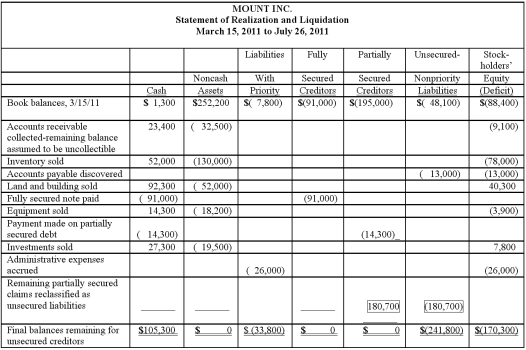
A company that was to be liquidated had the following liabilities: 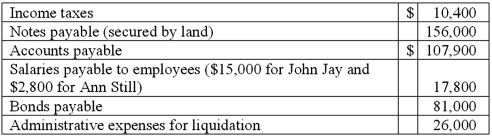 The company had the following assets:
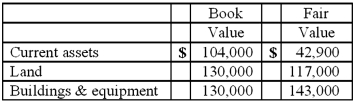 Total unsecured non-priority liabilities are calculated to be what amount?
The company had the following assets: Total unsecured non-priority liabilities are calculated to be what amount?Free
(Essay)
4.9/5 (69)
(69) Correct Answer:Verified
Verified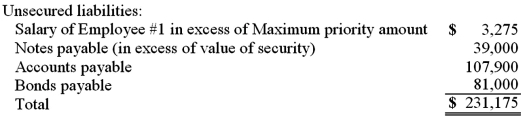
Which one of the following is a requirement that must be met before an involuntary bankruptcy petition can be filed when there are at least 12 unsecured creditors?
Free
(Multiple Choice)
4.8/5 (79)
(79) Correct Answer:Verified
VerifiedE
How should the fresh start reorganization value normally be determined?
(Multiple Choice)
4.9/5 (87)
(87) Which statement is false regarding a plan for reorganization?
(Multiple Choice)
4.9/5 (74)
(74) Hampton Company is trying to decide whether to seek liquidation or reorganization. Hampton has provided the following balance sheet: 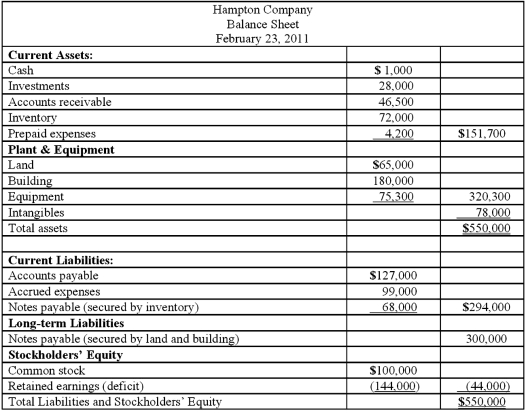 Additional information is as follows:
● The investments are currently worth $13,000.
● It is estimated that $32,000 of the accounts receivable are collectible.
● The inventory can be sold for $74,000.
● The prepaid expenses and the intangible assets have no net realizable value.
● The land and building are currently valued at $250,000.
● The equipment can be sold for $60,000.
● Administrative expenses (not yet recorded) are estimated to be $12,500.
● Accrued expenses include $17,000 of salaries payable ($11,000 to one employee and $3,000 each to two other employees).
● Accrued expenses include $7,000 of unpaid payroll taxes.
How much will Hampton's creditor of an unsecured accounts payable of $4,000 receive?
Additional information is as follows:
● The investments are currently worth $13,000.
● It is estimated that $32,000 of the accounts receivable are collectible.
● The inventory can be sold for $74,000.
● The prepaid expenses and the intangible assets have no net realizable value.
● The land and building are currently valued at $250,000.
● The equipment can be sold for $60,000.
● Administrative expenses (not yet recorded) are estimated to be $12,500.
● Accrued expenses include $17,000 of salaries payable ($11,000 to one employee and $3,000 each to two other employees).
● Accrued expenses include $7,000 of unpaid payroll taxes.
How much will Hampton's creditor of an unsecured accounts payable of $4,000 receive? (Essay)
5.0/5 (65)
(65) A company that was to be liquidated had the following liabilities: 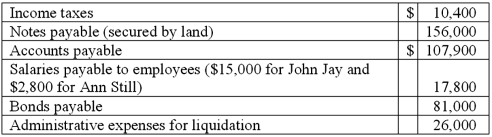 The company had the following assets:
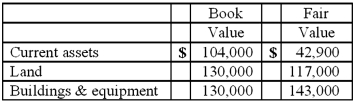 Total payment on notes payable is calculated to be what amount? (Round the payout percentage to one decimal place.)
The company had the following assets: Total payment on notes payable is calculated to be what amount? (Round the payout percentage to one decimal place.) (Essay)
4.9/5 (85)
(85) Lucky Co. had cash of $65,000, inventory worth $117,000, and a building worth $169,000. Unfortunately, the company also had accounts payable of $234,000, a note payable of $104,000 (secured by the inventory), liabilities with priority of $26,000, and a bond payable of $195,000 (secured by the building).
Total unsecured liabilities are calculated to be what amount?
(Essay)
4.9/5 (67)
(67) Gongman Corp. owned the following assets when it came out of a Chapter 11 bankruptcy: 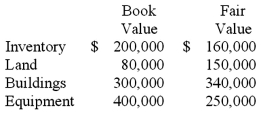 Gongman Corp. had a fresh start reorganization value of $1,000,000. What amount of goodwill should have been recognized in recording the reorganization?
 (Multiple Choice)
4.8/5 (65)
(65) What term is used for a bankruptcy forced upon a debtor by its creditors?
(Essay)
4.9/5 (83)
(83) Hampton Company is trying to decide whether to seek liquidation or reorganization. Hampton has provided the following balance sheet: 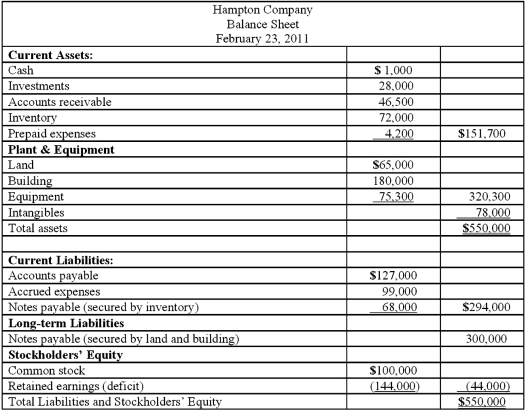 Additional information is as follows:
● The investments are currently worth $13,000.
● It is estimated that $32,000 of the accounts receivable are collectible.
● The inventory can be sold for $74,000.
● The prepaid expenses and the intangible assets have no net realizable value.
● The land and building are currently valued at $250,000.
● The equipment can be sold for $60,000.
● Administrative expenses (not yet recorded) are estimated to be $12,500.
● Accrued expenses include $17,000 of salaries payable ($11,000 to one employee and $3,000 each to two other employees).
● Accrued expenses include $7,000 of unpaid payroll taxes.
Compute the amount of total assets available to pay liabilities with priority and unsecured creditors.
Additional information is as follows:
● The investments are currently worth $13,000.
● It is estimated that $32,000 of the accounts receivable are collectible.
● The inventory can be sold for $74,000.
● The prepaid expenses and the intangible assets have no net realizable value.
● The land and building are currently valued at $250,000.
● The equipment can be sold for $60,000.
● Administrative expenses (not yet recorded) are estimated to be $12,500.
● Accrued expenses include $17,000 of salaries payable ($11,000 to one employee and $3,000 each to two other employees).
● Accrued expenses include $7,000 of unpaid payroll taxes.
Compute the amount of total assets available to pay liabilities with priority and unsecured creditors. (Essay)
4.9/5 (71)
(71) What are the four categories of debts in a Statement of Financial Affairs?
(Essay)
4.8/5 (74)
(74) On a statement of financial affairs, a specific liability may be classified as
(Multiple Choice)
4.7/5 (80)
(80) A company that was to be liquidated had the following liabilities: 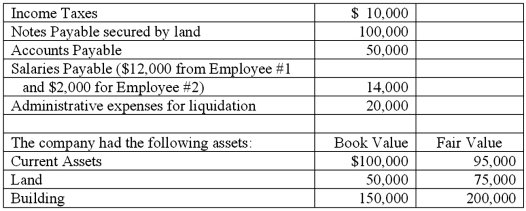 Total unsecured non-priority liabilities are calculated to be what amount?
 (Multiple Choice)
4.9/5 (91)
(91) What are the three categories of assets in a Statement of Financial Affairs?
(Essay)
4.7/5 (70)
(70) A company that was to be liquidated had the following liabilities: 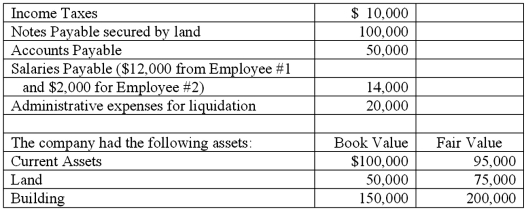 Total liabilities with priority are calculated to be what amount?
 (Multiple Choice)
4.8/5 (88)
(88) A company that was to be liquidated had the following liabilities: 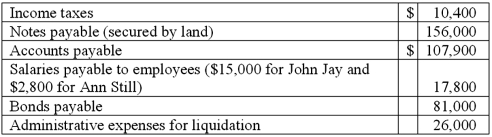 The company had the following assets:
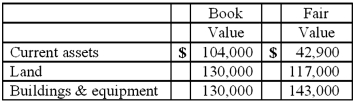 Total liabilities with priority are calculated to be what amount?
The company had the following assets: Total liabilities with priority are calculated to be what amount? (Essay)
4.9/5 (98)
(98) Quincy Corp., about to be liquidated, has the following amounts for its assets and liabilities: 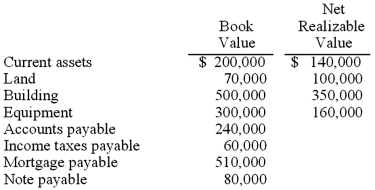 The mortgage is secured by the land and building, and the note payable is secured by the equipment. Quincy expects that the expenses of administering the liquidation will total $40,000. How much should Quincy expect to pay on the accounts payable?
 (Multiple Choice)
4.7/5 (84)
(84) 
Filters
- Essay(0)
- Multiple Choice(0)
- Short Answer(0)
- True False(0)
- Matching(0)