



 Chat with AI
Exam 3: Consolidations - Subsequent to the Date of Acquisition

Exam 1: The Equity Method of Accounting for Investments119 Questions
Exam 2: Consolidation of Financial Information118 Questions
Exam 3: Consolidations - Subsequent to the Date of Acquisition121 Questions
Exam 4: Consolidated Financial Statements and Outside Ownership116 Questions
Exam 5: Consolidated Financial Statements - Intercompany Asset Transactions127 Questions
Exam 6: Intercompany Debt, Consolidated Statement of Cash Flows, and Other Issues114 Questions
Exam 7: Consolidated Financial Statements - Ownership Patterns and Income Taxes117 Questions
Exam 8: Segment and Interim Reporting113 Questions
Exam 9: Foreign Currency Transactions and Hedging Foreign Exchange Risk93 Questions
Exam 10: Translation of Foreign Currency Financial Statements97 Questions
Exam 11: Worldwide Accounting Diversity and International Accounting Standards60 Questions
Exam 12: Financial Reporting and the Securities and Exchange Commission76 Questions
Exam 13: Accounting for Legal Reorganizations and Liquidations83 Questions
Exam 14: Partnerships: Formation and Operation88 Questions
Exam 15: Partnerships: Termination and Liquidation70 Questions
Exam 16: Accounting for State and Local Governments78 Questions
Exam 17: Accounting for State and Local Governments51 Questions
Exam 18: Accounting for Not-For-Profit Organizations64 Questions
Exam 19: Accounting for Estates and Trusts80 Questions
Select questions type


Prince Company acquires Duchess, Inc. on January 1, 2009. The consideration transferred exceeds the fair value of Duchess' net assets. On that date, Prince has a building with a book value of $1,200,000 and a fair value of $1,500,000. Duchess has a building with a book value of $400,000 and fair value of $500,000. If push-down accounting is used, what amounts in the Building account appear in Duchess' separate balance sheet and in the consolidated balance sheet immediately after acquisition?

Free
(Multiple Choice)
4.8/5  (79)
(79) Correct Answer: Verified
B
An acquisition transaction results in $90,000 of goodwill. Several years later a worksheet is being produced to consolidate the two companies. Describe in words at what amount goodwill will be reported at this date.
Free
(Essay)
4.9/5 (92)
(92) Correct Answer:Verified
VerifiedThe $90,000 attributed to goodwill is reported at its original amount unless a portion of goodwill is impaired or a unit of the business where goodwill resides is sold.
Following are selected accounts for Green Corporation and Vega Company as of December 31, 2013. Several of Green's accounts have been omitted.  Green acquired 100% of Vega on January 1, 2009, by issuing 10,500 shares of its $10 par value common stock with a fair value of $95 per share. On January 1, 2009, Vega's land was undervalued by $40,000, its buildings were overvalued by $30,000, and equipment was undervalued by $80,000. The buildings have a 20-year life and the equipment has a 10-year life. $50,000 was attributed to an unrecorded trademark with a 16-year remaining life. There was no goodwill associated with this investment. Compute the December 31, 2013, consolidated land.
Free
(Multiple Choice)
4.8/5 (84)
(84) Correct Answer:Verified
VerifiedC
Parrett Corp. acquired one hundred percent of Jones Inc. on January 1, 2009, at a price in excess of the subsidiary's fair value. On that date, Parrett's equipment (ten-year life) had a book value of $360,000 but a fair value of $480,000. Jones had equipment (ten-year life) with a book value of $240,000 and a fair value of $350,000. Parrett used the partial equity method to record its investment in Jones. On December 31, 2011, Parrett had equipment with a book value of $250,000 and a fair value of $400,000. Jones had equipment with a book value of $170,000 and a fair value of $320,000. What is the consolidated balance for the Equipment account as of December 31, 2011?
(Multiple Choice)
4.9/5 (81)
(81) Hoyt Corporation agreed to the following terms in order to acquire the net assets of Brown Company on January 1, 2011: (1.) To issue 400 shares of common stock ($10 par) with a fair value of $45 per share.
(2)) To assume Brown's liabilities which have a fair value of $1,500.
On the date of acquisition, the consideration transferred for Hoyt's acquisition of Brown would be
(Multiple Choice)
4.8/5 (78)
(78) When consolidating a subsidiary under the equity method, which of the following statements is true?
(Multiple Choice)
4.8/5 (63)
(63) Paperless Co. acquired Sheetless Co. and in effecting this business combination, there was a cash-flow performance contingency to be paid in cash, and a market-price performance contingency to be paid in additional shares of stock. In what accounts and in what section(s) of a consolidated balance sheet are these contingent consideration items shown?
(Essay)
4.8/5 (78)
(78) For an acquisition when the subsidiary retains its incorporation, which method of internal recordkeeping is the easiest for the parent to use?
(Essay)
4.9/5 (66)
(66) Fesler Inc. acquired all of the outstanding common stock of Pickett Company on January 1, 2010. Annual amortization of $22,000 resulted from this transaction. On the date of the acquisition, Fesler reported retained earnings of $520,000 while Pickett reported a $240,000 balance for retained earnings. Fesler reported net income of $100,000 in 2010 and $68,000 in 2011, and paid dividends of $25,000 in dividends each year. Pickett reported net income of $24,000 in 2010 and $36,000 in 2011, and paid dividends of $10,000 in dividends each year.
Assume that Fesler's reported net income includes Equity in Subsidiary Income.
If the parent's net income reflected use of the equity method, what were the consolidated retained earnings on December 31, 2011?
(Essay)
4.7/5 (80)
(80) One company acquires another company in a combination accounted for as an acquisition. The acquiring company decides to apply the equity method in accounting for the combination. What is one reason the acquiring company might have made this decision?
(Multiple Choice)
4.8/5 (82)
(82) Factors that should be considered in determining the useful life of an intangible asset include
(Multiple Choice)
4.8/5 (67)
(67) Beatty, Inc. acquires 100% of the voting stock of Gataux Company on January 1, 2010 for $500,000 cash. A contingent payment of $12,000 will be paid on April 1, 2011 if Gataux generates cash flows from operations of $26,500 or more in the next year. Beatty estimates that there is a 30% probability that Gataux will generate at least $26,500 next year, and uses an interest rate of 4% to incorporate the time value of money. The fair value of $12,000 at 4%, using a probability weighted approach, is $3,461. Assuming Gataux generates cash flow from operations of $27,200 in 2010, how will Beatty record the $12,000 payment of cash on April 1, 2011 in satisfaction of its contingent obligation?
(Multiple Choice)
4.9/5 (73)
(73) Under the partial equity method of accounting for an investment,
(Multiple Choice)
4.8/5 (74)
(74) Jaynes Inc. acquired all of Aaron Co.'s common stock on January 1, 2010, by issuing 11,000 shares of $1 par value common stock. Jaynes' shares had a $17 per share fair value. On that date, Aaron reported a net book value of $120,000. However, its equipment (with a five-year remaining life) was undervalued by $6,000 in the company's accounting records. Any excess of consideration transferred over fair value of assets and liabilities is assigned to an unrecorded patent to be amortized over ten years. 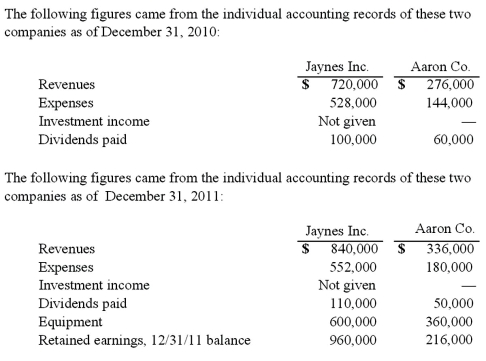 What was consolidated net income for the year ended December 31, 2011?
 (Essay)
4.9/5 (65)
(65) Watkins, Inc. acquires all of the outstanding stock of Glen Corporation on January 1, 2010. At that date, Glen owns only three assets and has no liabilities: 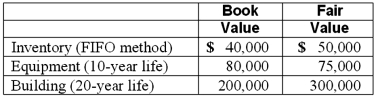 If Watkins pays $450,000 in cash for Glen, at what amount would Glen's Inventory acquired be represented in a December 31, 2010 consolidated balance sheet?
 (Multiple Choice)
4.7/5 (77)
(77) Avery Company acquires Billings Company in a combination accounted for as an acquisition and adopts the equity method to account for Investment in Billings. At the end of four years, the Investment in Billings account on Avery's books is $198,984. What items constitute this balance?
(Essay)
4.7/5 (76)
(76) Which one of the following accounts would not appear in the consolidated financial statements at the end of the first fiscal period of the combination?
(Multiple Choice)
4.9/5 (92)
(92) Goehler, Inc. acquires all of the voting stock of Kenneth, Inc. on January 4, 2010, at an amount in excess of Kenneth's fair value. On that date, Kenneth has equipment with a book value of $90,000 and a fair value of $120,000 (10-year remaining life). Goehler has equipment with a book value of $800,000 and a fair value of $1,200,000 (10-year remaining life). On December 31, 2011, Goehler has equipment with a book value of $975,000 but a fair value of $1,350,000 and Kenneth has equipment with a book value of $105,000 but a fair value of $125,000. If Goehler applies the partial equity method in accounting for Kenneth, what is the consolidated balance for the Equipment account as of December 31, 2011?
(Multiple Choice)
4.9/5 (89)
(89) On January 1, 2010, Franel Co. acquired all of the common stock of Hurlem Corp. For 2010, Hurlem earned net income of $360,000 and paid dividends of $190,000. Amortization of the patent allocation that was included in the acquisition was $6,000. How much difference would there have been in Franel's income with regard to the effect of the investment, between using the equity method or using the partial equity method of internal recordkeeping?
(Multiple Choice)
4.8/5 (78)
(78) According to the FASB ASC regarding the testing procedures for Goodwill Impairment, the proper procedure for conducting impairment testing is:
(Multiple Choice)
4.9/5 (86)
(86) 
Filters
- Essay(0)
- Multiple Choice(0)
- Short Answer(0)
- True False(0)
- Matching(0)