



 Chat with AI
Exam 3: Consolidations - Subsequent to the Date of Acquisition

Exam 1: The Equity Method of Accounting for Investments119 Questions
Exam 2: Consolidation of Financial Information118 Questions
Exam 3: Consolidations - Subsequent to the Date of Acquisition121 Questions
Exam 4: Consolidated Financial Statements and Outside Ownership116 Questions
Exam 5: Consolidated Financial Statements - Intercompany Asset Transactions127 Questions
Exam 6: Intercompany Debt, Consolidated Statement of Cash Flows, and Other Issues114 Questions
Exam 7: Consolidated Financial Statements - Ownership Patterns and Income Taxes117 Questions
Exam 8: Segment and Interim Reporting113 Questions
Exam 9: Foreign Currency Transactions and Hedging Foreign Exchange Risk93 Questions
Exam 10: Translation of Foreign Currency Financial Statements97 Questions
Exam 11: Worldwide Accounting Diversity and International Accounting Standards60 Questions
Exam 12: Financial Reporting and the Securities and Exchange Commission76 Questions
Exam 13: Accounting for Legal Reorganizations and Liquidations83 Questions
Exam 14: Partnerships: Formation and Operation88 Questions
Exam 15: Partnerships: Termination and Liquidation70 Questions
Exam 16: Accounting for State and Local Governments78 Questions
Exam 17: Accounting for State and Local Governments51 Questions
Exam 18: Accounting for Not-For-Profit Organizations64 Questions
Exam 19: Accounting for Estates and Trusts80 Questions
Select questions type


Perry Company acquires 100% of the stock of Hurley Corporation on January 1, 2010, for $3,800 cash. As of that date Hurley has the following trial balance;  Any excess of consideration transferred over fair value of net assets acquired is considered goodwill with an indefinite life. FIFO inventory valuation method is used. Compute the amount of Hurley's inventory that would be reported in a January 1, 2010, consolidated balance sheet.
 (Multiple Choice)
4.8/5  (81)
(81) Perry Company acquires 100% of the stock of Hurley Corporation on January 1, 2010, for $3,800 cash. As of that date Hurley has the following trial balance;  Any excess of consideration transferred over fair value of net assets acquired is considered goodwill with an indefinite life. FIFO inventory valuation method is used. Compute the amount of Hurley's buildings that would be reported in a December 31, 2010, consolidated balance sheet.
 (Multiple Choice)
4.8/5 (88)
(88) Perry Company acquires 100% of the stock of Hurley Corporation on January 1, 2010, for $3,800 cash. As of that date Hurley has the following trial balance;  Any excess of consideration transferred over fair value of net assets acquired is considered goodwill with an indefinite life. FIFO inventory valuation method is used. Compute the amount of Hurley's equipment that would be reported in a December 31, 2010, consolidated balance sheet.
 (Multiple Choice)
4.9/5 (97)
(97) On January 1, 2010, Cale Corp. paid $1,020,000 to acquire Kaltop Co. Kaltop maintained separate incorporation. Cale used the equity method to account for the investment. The following information is available for Kaltop's assets, liabilities, and stockholders' equity accounts:  Kaltop earned net income for 2010 of $126,000 and paid dividends of $48,000 during the year. What is the balance in Cale's investment in subsidiary account at the end of 2010?
 (Multiple Choice)
4.9/5 (78)
(78) How does the partial equity method differ from the equity method?
(Multiple Choice)
4.7/5 (86)
(86) Hanson Co. acquired all of the common stock of Roberts Inc. on January 1, 2010, transferring consideration in an amount slightly more than the fair value of Roberts' net assets. At that time, Roberts had buildings with a twenty-year useful life, a book value of $600,000, and a fair value of $696,000. On December 31, 2011, Roberts had buildings with a book value of $570,000 and a fair value of $648,000. On that date, Hanson had buildings with a book value of $1,878,000 and a fair value of $2,160,000.
Required:
What amount should be shown for buildings on the consolidated balance sheet dated December 31, 2011?
(Essay)
4.8/5 (78)
(78) For an acquisition when the subsidiary maintains its incorporation, under the partial equity method, what adjustments are made to the balance of the investment account?
(Essay)
4.7/5 (88)
(88) Watkins, Inc. acquires all of the outstanding stock of Glen Corporation on January 1, 2010. At that date, Glen owns only three assets and has no liabilities:  If Watkins pays $450,000 in cash for Glen, what amount would be represented as the subsidiary's Building in a consolidation at December 31, 2012, assuming the book value of the building at that date is still $200,000?
 (Multiple Choice)
4.8/5 (79)
(79) Kaye Company acquired 100% of Fiore Company on January 1, 2011. Kaye paid $1,000 excess consideration over book value which is being amortized at $20 per year. Fiore reported net income of $400 in 2011 and paid dividends of $100. Assume the equity method is applied. How much will Kaye's income increase or decrease as a result of Fiore's operations?
(Multiple Choice)
5.0/5 (91)
(91) When a company applies the initial method in accounting for its investment in a subsidiary and the subsidiary reports income in excess of dividends paid, what entry would be made for a consolidation worksheet? 
(Multiple Choice)
4.9/5 (82)
(82) Dutch Co. has loaned $90,000 to its subsidiary, Hans Corp., which retains separate incorporation. How would this loan be treated on a consolidated balance sheet?
(Essay)
4.7/5 (70)
(70) Jans Inc. acquired all of the outstanding common stock of Tysk Corp. on January 1, 2009, for $372,000. Equipment with a ten-year life was undervalued on Tysk's financial records by $46,000. Tysk also owned an unrecorded customer list with an assessed fair value of $67,000 and an estimated remaining life of five years. Tysk earned reported net income of $180,000 in 2009 and $216,000 in 2010. Dividends of $70,000 were paid in each of these two years. Selected account balances as of December 31, 2011, for the two companies follow.  If the partial equity method had been applied, what was 2011 consolidated net income?
 (Multiple Choice)
4.8/5 (85)
(85) Perry Company acquires 100% of the stock of Hurley Corporation on January 1, 2010, for $3,800 cash. As of that date Hurley has the following trial balance;  Any excess of consideration transferred over fair value of net assets acquired is considered goodwill with an indefinite life. FIFO inventory valuation method is used. Compute the amount of total expenses reported in an income statement for the year ended December 31, 2010, in order to recognize acquisition-date allocations of fair value and book value differences,
 (Multiple Choice)
4.8/5 (80)
(80) Fesler Inc. acquired all of the outstanding common stock of Pickett Company on January 1, 2010. Annual amortization of $22,000 resulted from this transaction. On the date of the acquisition, Fesler reported retained earnings of $520,000 while Pickett reported a $240,000 balance for retained earnings. Fesler reported net income of $100,000 in 2010 and $68,000 in 2011, and paid dividends of $25,000 in dividends each year. Pickett reported net income of $24,000 in 2010 and $36,000 in 2011, and paid dividends of $10,000 in dividends each year.
Assume that Fesler's reported net income includes Equity in Subsidiary Income.
If the parent's net income reflected use of the initial value method, what were the consolidated retained earnings on December 31, 2011?
(Essay)
4.7/5 (73)
(73) Red Co. acquired 100% of Green, Inc. on January 1, 2010. On that date, Green had inventory with a book value of $42,000 and a fair value of $52,000. This inventory had not yet been sold at December 31, 2010. Also, on the date of acquisition, Green had a building with a book value of $200,000 and a fair value of $390,000. Green had equipment with a book value of $350,000 and a fair value of $280,000. The building had a 10-year remaining useful life and the equipment had a 5-year remaining useful life. How much total expense will be in the consolidated financial statements for the year ended December 31, 2010 related to the acquisition allocations of Green?
(Multiple Choice)
4.9/5 (84)
(84) Following are selected accounts for Green Corporation and Vega Company as of December 31, 2013. Several of Green's accounts have been omitted.  Green acquired 100% of Vega on January 1, 2009, by issuing 10,500 shares of its $10 par value common stock with a fair value of $95 per share. On January 1, 2009, Vega's land was undervalued by $40,000, its buildings were overvalued by $30,000, and equipment was undervalued by $80,000. The buildings have a 20-year life and the equipment has a 10-year life. $50,000 was attributed to an unrecorded trademark with a 16-year remaining life. There was no goodwill associated with this investment. Compute the December 31, 2013 consolidated retained earnings.
 (Multiple Choice)
4.9/5 (71)
(71) Utah Inc. acquired all of the outstanding common stock of Trimmer Corp. on January 1, 2009. At that date, Trimmer owned only three assets and had no liabilities: 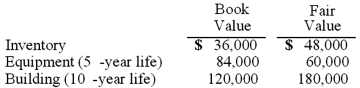 If Utah paid $300,000 in cash for Trimmer, what allocation should have been assigned to the subsidiary's Building account and its Equipment account in a December 31, 2011 consolidation?
 (Essay)
4.7/5 (83)
(83) On January 1, 2009, Rand Corp. issued shares of its common stock to acquire all of the outstanding common stock of Spaulding Inc. Spaulding's book value was only $140,000 at the time, but Rand issued 12,000 shares having a par value of $1 per share and a fair value of $20 per share. Rand was willing to convey these shares because it felt that buildings (ten-year life) were undervalued on Spaulding's records by $60,000 while equipment (five-year life) was undervalued by $25,000. Any consideration transferred over fair value of identified net assets acquired is assigned to goodwill.
Following are the individual financial records for these two companies for the year ended December 31, 2012. 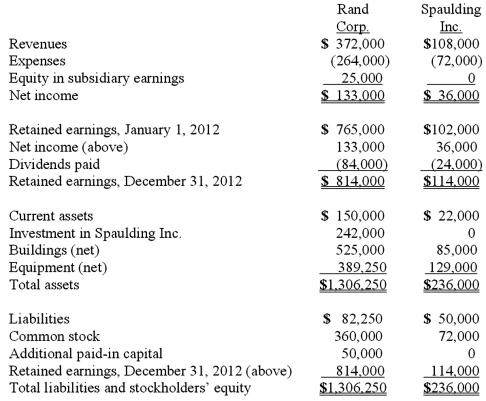 Required:
Prepare a consolidation worksheet for this business combination.
Required:
Prepare a consolidation worksheet for this business combination. (Essay)
5.0/5 (90)
(90) On January 1, 2010, Cale Corp. paid $1,020,000 to acquire Kaltop Co. Kaltop maintained separate incorporation. Cale used the equity method to account for the investment. The following information is available for Kaltop's assets, liabilities, and stockholders' equity accounts:  Kaltop earned net income for 2010 of $126,000 and paid dividends of $48,000 during the year. In Cale's accounting records, what amount would appear on December 31, 2010 for equity in subsidiary earnings?
 (Multiple Choice)
4.9/5 (71)
(71) Harrison, Inc. acquires 100% of the voting stock of Rhine Company on January 1, 2010 for $400,000 cash. A contingent payment of $16,500 will be paid on April 15, 2011 if Rhine generates cash flows from operations of $27,000 or more in the next year. Harrison estimates that there is a 20% probability that Rhine will generate at least $27,000 next year, and uses an interest rate of 5% to incorporate the time value of money. The fair value of $16,500 at 5%, using a probability weighted approach, is $3,142. What will Harrison record as its Investment in Rhine on January 1, 2010?
(Multiple Choice)
4.8/5 (74)
(74) 
Filters
- Essay(0)
- Multiple Choice(0)
- Short Answer(0)
- True False(0)
- Matching(0)