



 Chat with AI
Exam 6: Intercompany Debt, Consolidated Statement of Cash Flows, and Other Issues

Exam 1: The Equity Method of Accounting for Investments119 Questions
Exam 2: Consolidation of Financial Information118 Questions
Exam 3: Consolidations - Subsequent to the Date of Acquisition121 Questions
Exam 4: Consolidated Financial Statements and Outside Ownership116 Questions
Exam 5: Consolidated Financial Statements - Intercompany Asset Transactions127 Questions
Exam 6: Intercompany Debt, Consolidated Statement of Cash Flows, and Other Issues114 Questions
Exam 7: Consolidated Financial Statements - Ownership Patterns and Income Taxes117 Questions
Exam 8: Segment and Interim Reporting113 Questions
Exam 9: Foreign Currency Transactions and Hedging Foreign Exchange Risk93 Questions
Exam 10: Translation of Foreign Currency Financial Statements97 Questions
Exam 11: Worldwide Accounting Diversity and International Accounting Standards60 Questions
Exam 12: Financial Reporting and the Securities and Exchange Commission76 Questions
Exam 13: Accounting for Legal Reorganizations and Liquidations83 Questions
Exam 14: Partnerships: Formation and Operation88 Questions
Exam 15: Partnerships: Termination and Liquidation70 Questions
Exam 16: Accounting for State and Local Governments78 Questions
Exam 17: Accounting for State and Local Governments51 Questions
Exam 18: Accounting for Not-For-Profit Organizations64 Questions
Exam 19: Accounting for Estates and Trusts80 Questions
Select questions type


Ryan Company owns 80% of Chase Company. The original balances presented for Ryan and Chase as of January 1, 2011 are as follows: 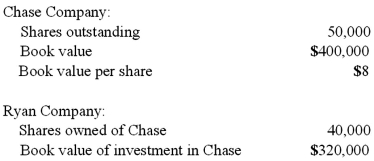 Assume Chase reacquired 8,000 shares of its common stock from outsiders at $10 per share. What should the adjusted book value of Chase be after the treasury shares were purchased?
 (Multiple Choice)
4.8/5  (86)
(86) Parent Corporation loaned money to its subsidiary with a five-year note at the market interest rate. How would the note be accounted for in the consolidation process?
(Essay)
4.9/5 (64)
(64) Which of the following characteristics is not indicative of an enterprise qualifying as a primary beneficiary with a controlling financial interest in a variable interest entity?
(Multiple Choice)
4.8/5 (81)
(81) On January 1, 2009, Nichols Company acquired 80% of Smith Company's common stock and 40% of its non-voting, cumulative preferred stock. The consideration transferred by Nichols was $1,200,000 for the common and $124,000 for the preferred. Any excess acquisition-date fair value over book value is considered goodwill. The capital structure of Smith immediately prior to the acquisition is: 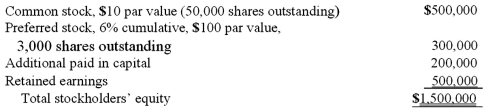 Determine the amount and account to be recorded for Nichols' investment in Smith.
 (Multiple Choice)
4.7/5 (76)
(76) The following information has been taken from the consolidation worksheet of Graham Company and its 80% owned subsidiary, Stage Company. (1.) Graham reports a loss on sale of land of $5,000. The land cost Graham $20,000.
(2)) Non-controlling interest in Stage's net income was $30,000.
(3)) Graham paid dividends of $15,000.
(4)) Stage paid dividends of $10,000.
(5)) Excess acquisition-date fair value over book value was expensed by $6,000.
(6)) Consolidated accounts receivable decreased by $8,000.
(7)) Consolidated accounts payable decreased by $7,000.
Where does the non-controlling interest in Stage's net income appear on a consolidated statement of cash flows?
(Multiple Choice)
4.8/5 (82)
(82) The following information has been taken from the consolidation worksheet of Graham Company and its 80% owned subsidiary, Stage Company. (1.) Graham reports a loss on sale of land of $5,000. The land cost Graham $20,000.
(2)) Non-controlling interest in Stage's net income was $30,000.
(3)) Graham paid dividends of $15,000.
(4)) Stage paid dividends of $10,000.
(5)) Excess acquisition-date fair value over book value was expensed by $6,000.
(6)) Consolidated accounts receivable decreased by $8,000.
(7)) Consolidated accounts payable decreased by $7,000.
Using the indirect method, where does the decrease in accounts payable appear in a consolidated statement of cash flows?
(Multiple Choice)
4.9/5 (70)
(70) When a company has preferred stock in its capital structure, what amount should be used to calculate non-controlling interest in the preferred stock of the subsidiary when the company is acquired as a subsidiary of another company?
(Essay)
4.9/5 (80)
(80) Fargus Corporation owned 51% of the voting common stock of Sanatee, Inc. The parent's interest was acquired several years ago on the date that the subsidiary was formed. Consequently, no goodwill or other allocation was recorded in connection with the acquisition price.
On January 1, 2010, Sanatee sold $1,400,000 in ten-year bonds to the public at 108. The bonds pay a 10% interest rate every December 31. Fargus acquired 40% of these bonds on January 1, 2012, for 95% of the face value. Both companies utilized the straight-line method of amortization.
What balances would need to be considered in order to prepare the consolidation entry in connection with these intra-entity bonds at December 31, 2012, the end of the first year of the intra-entity investment? Prepare schedules to show numerical answers for balances that would be needed for the entry.
(Essay)
4.9/5 (82)
(82) Anderson, Inc. has owned 70% of its subsidiary, Arthur Corp., for several years. The consolidated balance sheets of Anderson, Inc. and Arthur Corp. are presented below: 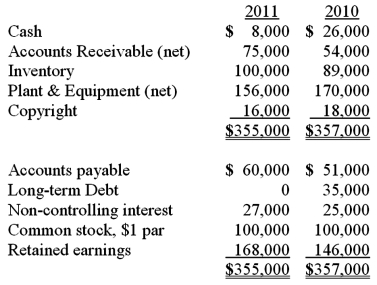 Additional information for 2011:
 Net cash flow from operating activities was:
Additional information for 2011: Net cash flow from operating activities was: (Multiple Choice)
4.8/5 (70)
(70) On January 1, 2009, Nichols Company acquired 80% of Smith Company's common stock and 40% of its non-voting, cumulative preferred stock. The consideration transferred by Nichols was $1,200,000 for the common and $124,000 for the preferred. Any excess acquisition-date fair value over book value is considered goodwill. The capital structure of Smith immediately prior to the acquisition is: 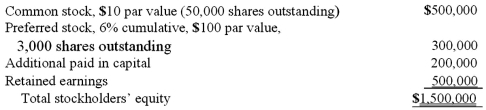 Compute the goodwill recognized in consolidation.
 (Multiple Choice)
4.8/5 (72)
(72) Where do dividends paid by a subsidiary to the parent company appear in a consolidated statement of cash flows?
(Multiple Choice)
5.0/5 (78)
(78) Knight Co. owned 80% of the common stock of Stoop Co. Stoop had 50,000 shares of $5 par value common stock and 2,000 shares of preferred stock outstanding. Each preferred share received an annual per share dividend of $10 and is convertible into four shares of common stock. Knight did not own any of Stoop's preferred stock. Stoop also had 600 bonds outstanding, each of which is convertible into ten shares of common stock. Stoop's annual after-tax interest expense for the bonds was $22,000. Knight did not own any of Stoop's bonds. Stoop reported income of $300,000 for 2011. Stoop's diluted earnings per share (rounded) is calculated to be
(Multiple Choice)
4.9/5 (89)
(89) Keenan Company has had bonds payable of $20,000 outstanding for several years. On January 1, 2011, there was an unamortized premium of $2,000 with a remaining life of 10 years, Keenan's parent, Ross, Inc., purchased the bonds in the open market for $19,000. Keenan is a 90% owned subsidiary of Ross. The bonds pay 8% interest annually on December 31. The companies use the straight-line method to amortize interest revenue and expense. Compute the consolidated gain or loss on a consolidated income statement for 2011.
(Multiple Choice)
4.7/5 (81)
(81) Where do intra-entity sales of inventory appear in a consolidated statement of cash flows?
(Multiple Choice)
4.9/5 (83)
(83) 
Filters
- Essay(0)
- Multiple Choice(0)
- Short Answer(0)
- True False(0)
- Matching(0)