



 Chat with AI
Exam 6: Intercompany Debt, Consolidated Statement of Cash Flows, and Other Issues

Exam 1: The Equity Method of Accounting for Investments119 Questions
Exam 2: Consolidation of Financial Information118 Questions
Exam 3: Consolidations - Subsequent to the Date of Acquisition121 Questions
Exam 4: Consolidated Financial Statements and Outside Ownership116 Questions
Exam 5: Consolidated Financial Statements - Intercompany Asset Transactions127 Questions
Exam 6: Intercompany Debt, Consolidated Statement of Cash Flows, and Other Issues114 Questions
Exam 7: Consolidated Financial Statements - Ownership Patterns and Income Taxes117 Questions
Exam 8: Segment and Interim Reporting113 Questions
Exam 9: Foreign Currency Transactions and Hedging Foreign Exchange Risk93 Questions
Exam 10: Translation of Foreign Currency Financial Statements97 Questions
Exam 11: Worldwide Accounting Diversity and International Accounting Standards60 Questions
Exam 12: Financial Reporting and the Securities and Exchange Commission76 Questions
Exam 13: Accounting for Legal Reorganizations and Liquidations83 Questions
Exam 14: Partnerships: Formation and Operation88 Questions
Exam 15: Partnerships: Termination and Liquidation70 Questions
Exam 16: Accounting for State and Local Governments78 Questions
Exam 17: Accounting for State and Local Governments51 Questions
Exam 18: Accounting for Not-For-Profit Organizations64 Questions
Exam 19: Accounting for Estates and Trusts80 Questions
Select questions type


The balance sheets of Butler, Inc. and its 70 percent-owned subsidiary, Cassie Corp., are presented below: 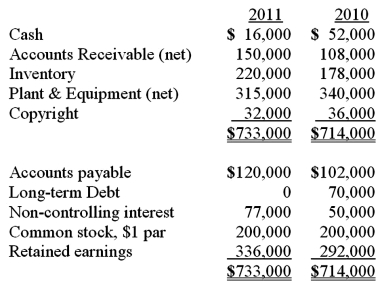 Additional information for 2011:
 Net cash flow from operating activities was:
Additional information for 2011: Net cash flow from operating activities was: (Multiple Choice)
4.9/5  (95)
(95) Which of the following statements is false regarding the assignment of a gain or loss on intercompany bond transfer?
(Multiple Choice)
4.9/5 (80)
(80) A parent acquires 70% of a subsidiary's common stock and 60 percent of its preferred stock. The preferred stock is noncumulative. The current year's dividend was paid. How is the non-controlling interest in the subsidiary's net income assigned?
(Multiple Choice)
4.9/5 (81)
(81) Pursley, Inc. owns 70 percent of Harry, Inc. The consolidated income statement for a year reports $50,000 Non-controlling Interest in Harry, Inc. Income. Harry paid dividends in the amount of $80,000 for the year. What are the effects of these transactions in the consolidated statement of cash flows for the year? 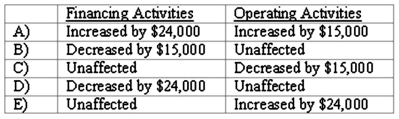
(Multiple Choice)
4.8/5 (73)
(73) Allen Co. held 80% of the common stock of Brewer Inc. and 40% of this subsidiary's convertible bonds. The following consolidated financial statements were for 2010 and 2011.
(Essay)
4.8/5 (86)
(86) The balance sheets of Butler, Inc. and its 70 percent-owned subsidiary, Cassie Corp., are presented below: 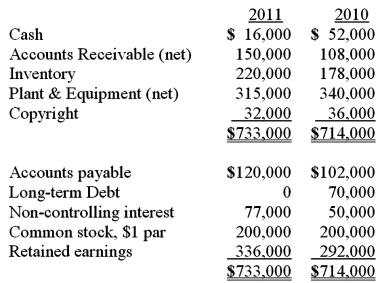 Additional information for 2011:
 Net cash flow from financing activities was:
Additional information for 2011: Net cash flow from financing activities was: (Multiple Choice)
4.8/5 (91)
(91) On January 1, 2009, Nichols Company acquired 80% of Smith Company's common stock and 40% of its non-voting, cumulative preferred stock. The consideration transferred by Nichols was $1,200,000 for the common and $124,000 for the preferred. Any excess acquisition-date fair value over book value is considered goodwill. The capital structure of Smith immediately prior to the acquisition is: 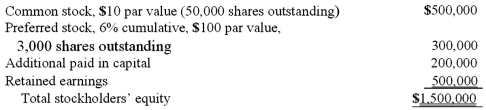 Compute the non-controlling interest in Smith at date of acquisition.
 (Multiple Choice)
4.9/5 (95)
(95) MacDonald, Inc. owns 80 percent of the outstanding stock of Stahl Corporation. During the current year, Stahl made $125,000 in sales to MacDonald. How does this transfer affect the consolidated statement of cash flows?
(Multiple Choice)
4.8/5 (67)
(67) On January 1, 2011, Riley Corp. acquired some of the outstanding bonds of one of its subsidiaries. The bonds had a carrying value of $421,620, and Riley paid $401,937 for them. How should you account for the difference between the carrying value and the purchase price in the consolidated financial statements for 2011?
(Multiple Choice)
4.8/5 (92)
(92) Cadion Co. owned a controlling interest in Knieval Inc. Cadion reported sales of $420,000 during 2011 while Knieval reported $280,000. Inventory costing $28,000 was transferred from Knieval to Cadion (upstream) during the year for $56,000. Of this amount, twenty-five percent was still in ending inventory at year's end. Total receivables on the consolidated balance sheet were $112,000 at the first of the year and $154,000 at year-end. No intra-entity debt existed at the beginning or ending of the year. Using the direct approach, what is the consolidated amount of cash collected by the business combination from its customers?
(Multiple Choice)
4.7/5 (74)
(74) Which one of the following characteristics of preferred stock would make the stock a dilutive security for earnings per share?
(Multiple Choice)
4.9/5 (84)
(84) Franklin Corporation owns 90 percent of the outstanding voting stock of Georgia Company. On January 2, 2009, Georgia sold 7 percent bonds payable with a $5,000,000 face value maturing January 2, 2029 at a premium of $500,000. On January 1, 2011, Franklin acquired 20 percent of these same bonds on the open market at 97.66. Both companies use the straight-line method of amortization. What adjustment should be made to Franklin's 2012 beginning Retained Earnings as a result of this bond acquisition?
(Multiple Choice)
4.8/5 (93)
(93) Parker owned all of Odom Inc. Although the Investment in Odom Inc. account had a balance of $834,000, the subsidiary's 12,000 shares had an underlying book value of only $56 per share. On January 1, 2011, Odom issued 3,000 new shares to the public for $70 per share. How does this transaction affect the Investment in Odom Inc. account?
(Multiple Choice)
4.9/5 (87)
(87) Fargus Corporation owned 51% of the voting common stock of Sanatee, Inc. The parent's interest was acquired several years ago on the date that the subsidiary was formed. Consequently, no goodwill or other allocation was recorded in connection with the acquisition price.
On January 1, 2010, Sanatee sold $1,400,000 in ten-year bonds to the public at 108. The bonds pay a 10% interest rate every December 31. Fargus acquired 40% of these bonds on January 1, 2012, for 95% of the face value. Both companies utilized the straight-line method of amortization.
What consolidation entry would be recorded in connection with these intra-entity bonds on December 31, 2012?
(Essay)
5.0/5 (78)
(78) Parent Corporation recently acquired some of its subsidiary's outstanding bonds, at an amount which required the recognition of a loss. In what ways could the loss be allocated? Which allocation would you recommend? Why?
(Essay)
4.8/5 (78)
(78) What documents or other sources of information would be used to prepare a consolidated statement of cash flows?
(Essay)
4.9/5 (56)
(56) Fargus Corporation owned 51% of the voting common stock of Sanatee, Inc. The parent's interest was acquired several years ago on the date that the subsidiary was formed. Consequently, no goodwill or other allocation was recorded in connection with the acquisition price.
On January 1, 2010, Sanatee sold $1,400,000 in ten-year bonds to the public at 108. The bonds pay a 10% interest rate every December 31. Fargus acquired 40% of these bonds on January 1, 2012, for 95% of the face value. Both companies utilized the straight-line method of amortization.
What consolidation entry would be recorded in connection with these intra-entity bonds on December 31, 2014?
(Essay)
4.8/5 (86)
(86) Knight Co. owned 80% of the common stock of Stoop Co. Stoop had 50,000 shares of $5 par value common stock and 2,000 shares of preferred stock outstanding. Each preferred share received an annual per share dividend of $10 and is convertible into four shares of common stock. Knight did not own any of Stoop's preferred stock. Stoop also had 600 bonds outstanding, each of which is convertible into ten shares of common stock. Stoop's annual after-tax interest expense for the bonds was $22,000. Knight did not own any of Stoop's bonds. Stoop reported income of $300,000 for 2011. What was the amount of Stoop's earnings that should be included in calculating consolidated diluted earnings per share?
(Multiple Choice)
4.9/5 (74)
(74) Ryan Company owns 80% of Chase Company. The original balances presented for Ryan and Chase as of January 1, 2011, are as follows: 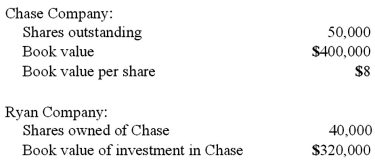 Assume Chase issues 30,000 additional shares common stock solely to Ryan for $12 per share. What is the adjusted book value of Chase Company after the issuance of the shares?
 (Multiple Choice)
4.9/5 (65)
(65) During 2011, Parent Corporation purchased at book value some of the outstanding bonds of its subsidiary. How would this acquisition have been reflected in the consolidated statement of cash flows?
(Essay)
4.8/5 (91)
(91) 
Filters
- Essay(0)
- Multiple Choice(0)
- Short Answer(0)
- True False(0)
- Matching(0)