



 Chat with AI
Exam 6: Intercompany Debt, Consolidated Statement of Cash Flows, and Other Issues

Exam 1: The Equity Method of Accounting for Investments119 Questions
Exam 2: Consolidation of Financial Information118 Questions
Exam 3: Consolidations - Subsequent to the Date of Acquisition121 Questions
Exam 4: Consolidated Financial Statements and Outside Ownership116 Questions
Exam 5: Consolidated Financial Statements - Intercompany Asset Transactions127 Questions
Exam 6: Intercompany Debt, Consolidated Statement of Cash Flows, and Other Issues114 Questions
Exam 7: Consolidated Financial Statements - Ownership Patterns and Income Taxes117 Questions
Exam 8: Segment and Interim Reporting113 Questions
Exam 9: Foreign Currency Transactions and Hedging Foreign Exchange Risk93 Questions
Exam 10: Translation of Foreign Currency Financial Statements97 Questions
Exam 11: Worldwide Accounting Diversity and International Accounting Standards60 Questions
Exam 12: Financial Reporting and the Securities and Exchange Commission76 Questions
Exam 13: Accounting for Legal Reorganizations and Liquidations83 Questions
Exam 14: Partnerships: Formation and Operation88 Questions
Exam 15: Partnerships: Termination and Liquidation70 Questions
Exam 16: Accounting for State and Local Governments78 Questions
Exam 17: Accounting for State and Local Governments51 Questions
Exam 18: Accounting for Not-For-Profit Organizations64 Questions
Exam 19: Accounting for Estates and Trusts80 Questions
Select questions type


Carlson, Inc. owns 80 percent of Madrid, Inc. Carlson reports net income for 2011 (without consideration of its investment in Madrid, Inc.) of $1,500,000. For the same year, Madrid reports net income of $705,000. Carlson had bonds payable outstanding on January 1, 2011 with a carrying value of $1,200,000. Madrid acquired the bonds on the open market on January 3, 2011 for $1,090,000. For the year 2011, Carlson reported interest expense on the bonds in the amount of $96,000, while Madrid reported interest income of $94,000 for the same bonds. What is Carlson's share of consolidated net income?
(Multiple Choice)
4.9/5  (82)
(82) Ryan Company owns 80% of Chase Company. The original balances presented for Ryan and Chase as of January 1, 2011, are as follows:  Assume Chase issues 30,000 additional shares common stock solely to Ryan for $12 per share. After acquiring the additional shares, what adjustment is needed for Ryan's investment in Chase account?
 (Multiple Choice)
4.9/5 (72)
(72) A parent company owns a controlling interest in a subsidiary whose stock has a book value of $27 per share. The last day of the year, the subsidiary issues new shares entirely to outside parties at $33 per share. The parent still holds control over the subsidiary. Which of the following statements is true?
(Multiple Choice)
4.8/5 (76)
(76) Webb Company owns 90% of Jones Company. The original balances presented for Jones and Webb as of January 1, 2011, are as follows:  Jones sells 20,000 shares of previously unissued shares of its common stock to outside parties for $10 per share. What is the adjusted book value of Jones after the sale of the shares?
 (Multiple Choice)
4.8/5 (75)
(75) How does the existence of a non-controlling interest affect the preparation of a consolidated statement of cash flows?
(Essay)
4.7/5 (80)
(80) Regency Corp. recently acquired $500,000 of the bonds of Safire Co., one of its subsidiaries, paying more than the carrying value of the bonds. According to the most practical view of this intra-entity transaction, to whom would the loss be attributed?
(Multiple Choice)
4.7/5 (76)
(76) A parent acquires all of a subsidiary's common stock and 60 percent of its preferred stock. The preferred stock has a cumulative dividend. No dividends are in arrears. How is the non-controlling interest in the subsidiary's net income assigned?
(Multiple Choice)
4.9/5 (85)
(85) The following information has been taken from the consolidation worksheet of Graham Company and its 80% owned subsidiary, Stage Company. (1.) Graham reports a loss on sale of land of $5,000. The land cost Graham $20,000.
(2)) Non-controlling interest in Stage's net income was $30,000.
(3)) Graham paid dividends of $15,000.
(4)) Stage paid dividends of $10,000.
(5)) Excess acquisition-date fair value over book value was expensed by $6,000.
(6)) Consolidated accounts receivable decreased by $8,000.
(7)) Consolidated accounts payable decreased by $7,000.
Using the indirect method, where does the decrease in accounts receivable appear in a consolidated statement of cash flows?
(Multiple Choice)
4.8/5 (91)
(91) The following information has been taken from the consolidation worksheet of Graham Company and its 80% owned subsidiary, Stage Company. (1.) Graham reports a loss on sale of land of $5,000. The land cost Graham $20,000.
(2)) Non-controlling interest in Stage's net income was $30,000.
(3)) Graham paid dividends of $15,000.
(4)) Stage paid dividends of $10,000.
(5)) Excess acquisition-date fair value over book value was expensed by $6,000.
(6)) Consolidated accounts receivable decreased by $8,000.
(7)) Consolidated accounts payable decreased by $7,000.
How is the amount of excess acquisition-date fair value over book value recognized in a consolidated statement of cash flows assuming the indirect method is used?
(Multiple Choice)
4.7/5 (93)
(93) On January 1, 2011, Riney Co. owned 80% of the common stock of Garvin Co. On that date, Garvin's stockholders' equity accounts had the following balances:  The balance in Riney's Investment in Garvin Co. account was $552,000, and the non-controlling interest was $138,000. On January 1, 2011, Garvin Co. sold 10,000 shares of previously unissued common stock for $15 per share. Riney did not acquire any of these shares. What is the balance in Investment in Garvin Co. after the sale of the 10,000 shares of common stock?
 (Multiple Choice)
4.9/5 (82)
(82) A parent company owns a 70 percent interest in a subsidiary whose stock has a book value of $27 per share. The last day of the year, the subsidiary issues new shares for $27 per share, and the parent buys its 70 percent interest in the new shares. Which of the following statements is true?
(Multiple Choice)
4.9/5 (73)
(73) Skipen Corp. had the following stockholders' equity accounts: 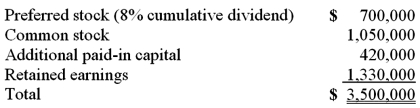 The preferred stock was participating and is therefore considered to be equity. Vestin Corp. acquired 90% of this common stock for $2,250,000 and 70% of the preferred stock for $1,120,000. All of the subsidiary's assets and liabilities were determined to have fair values equal to their book values except for land which is undervalued by $130,000.
Required:
What amount was attributed to goodwill on the date of acquisition?
The preferred stock was participating and is therefore considered to be equity. Vestin Corp. acquired 90% of this common stock for $2,250,000 and 70% of the preferred stock for $1,120,000. All of the subsidiary's assets and liabilities were determined to have fair values equal to their book values except for land which is undervalued by $130,000.
Required:
What amount was attributed to goodwill on the date of acquisition? (Essay)
4.7/5 (70)
(70) On January 1, 2011, Bast Co. had a net book value of $2,100,000 as follows: 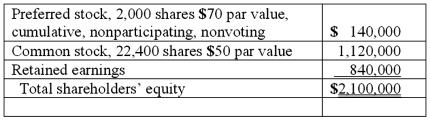 Fisher Co. acquired all of the outstanding preferred shares for $148,000 and 60% of the common stock for $1,281,000. Fisher believed that one of Bast's buildings, with a twelve-year life, was undervalued on the company's financial records by $70,000.
Required:
What is the amount of goodwill to be recognized from this purchase?
Fisher Co. acquired all of the outstanding preferred shares for $148,000 and 60% of the common stock for $1,281,000. Fisher believed that one of Bast's buildings, with a twelve-year life, was undervalued on the company's financial records by $70,000.
Required:
What is the amount of goodwill to be recognized from this purchase? (Essay)
4.8/5 (72)
(72) Ryan Company owns 80% of Chase Company. The original balances presented for Ryan and Chase as of January 1, 2011 are as follows:  Assume Chase reacquired 8,000 shares of its common stock from outsiders at $10 per share. When Ryan's new percent ownership is rounded to a whole number, what adjustment is needed for Ryan's investment in Chase account?
 (Multiple Choice)
4.8/5 (80)
(80) Parent Corporation acquired some of its subsidiary's bonds on the open bond market. The remaining life of the bonds was eight years, and Parent expected to hold the bonds for the full eight years. How would the acquisition of the bonds affect the consolidation process?
(Essay)
4.8/5 (76)
(76) A variable interest entity can take all of the following forms except a(n)
(Multiple Choice)
4.9/5 (90)
(90) Webb Company owns 90% of Jones Company. The original balances presented for Jones and Webb as of January 1, 2011, are as follows:  Jones sells 20,000 shares of previously unissued shares of its common stock to outside parties for $10 per share. What adjustment is needed for Webb's investment in Jones account?
 (Multiple Choice)
4.8/5 (85)
(85) The following information has been taken from the consolidation worksheet of Graham Company and its 80% owned subsidiary, Stage Company. (1.) Graham reports a loss on sale of land of $5,000. The land cost Graham $20,000.
(2)) Non-controlling interest in Stage's net income was $30,000.
(3)) Graham paid dividends of $15,000.
(4)) Stage paid dividends of $10,000.
(5)) Excess acquisition-date fair value over book value was expensed by $6,000.
(6)) Consolidated accounts receivable decreased by $8,000.
(7)) Consolidated accounts payable decreased by $7,000.
How is the loss on sale of land reported on the consolidated statement of cash flows?
(Multiple Choice)
4.9/5 (68)
(68) Stevens Company has had bonds payable of $10,000 outstanding for several years. On January 1, 2011, when there was an unamortized discount of $2,000 and a remaining life of 5 years, its 80% owned subsidiary, Matthews Company, purchased the bonds in the open market for $11,000. The bonds pay 6% interest annually on December 31. The companies use the straight-line method to amortize interest revenue and expense. Compute the consolidated gain or loss on a consolidated income statement for 2011.
(Multiple Choice)
4.9/5 (77)
(77) Panton, Inc. acquired 18,000 shares of Glotfelty Corp. several years ago. At the present time, Glotfelty is reporting the following stockholders' equity: 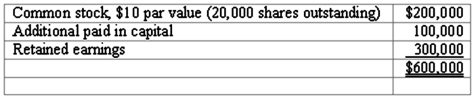 Glotfelty issues 5,000 shares of previously unissued stock to Panton for $35 per share.
Required:
Describe how this transaction would affect Panton's books.
Glotfelty issues 5,000 shares of previously unissued stock to Panton for $35 per share.
Required:
Describe how this transaction would affect Panton's books. (Essay)
4.7/5 (92)
(92) 
Filters
- Essay(0)
- Multiple Choice(0)
- Short Answer(0)
- True False(0)
- Matching(0)