



 Chat with AI
Exam 10: Translation of Foreign Currency Financial Statements

Exam 1: The Equity Method of Accounting for Investments119 Questions
Exam 2: Consolidation of Financial Information118 Questions
Exam 3: Consolidations - Subsequent to the Date of Acquisition121 Questions
Exam 4: Consolidated Financial Statements and Outside Ownership116 Questions
Exam 5: Consolidated Financial Statements - Intercompany Asset Transactions127 Questions
Exam 6: Intercompany Debt, Consolidated Statement of Cash Flows, and Other Issues114 Questions
Exam 7: Consolidated Financial Statements - Ownership Patterns and Income Taxes117 Questions
Exam 8: Segment and Interim Reporting113 Questions
Exam 9: Foreign Currency Transactions and Hedging Foreign Exchange Risk93 Questions
Exam 10: Translation of Foreign Currency Financial Statements97 Questions
Exam 11: Worldwide Accounting Diversity and International Accounting Standards60 Questions
Exam 12: Financial Reporting and the Securities and Exchange Commission76 Questions
Exam 13: Accounting for Legal Reorganizations and Liquidations83 Questions
Exam 14: Partnerships: Formation and Operation88 Questions
Exam 15: Partnerships: Termination and Liquidation70 Questions
Exam 16: Accounting for State and Local Governments78 Questions
Exam 17: Accounting for State and Local Governments51 Questions
Exam 18: Accounting for Not-For-Profit Organizations64 Questions
Exam 19: Accounting for Estates and Trusts80 Questions
Select questions type


Kennedy Company acquired all of the outstanding common stock of Hastie Company of Canada for U.S. $350,000 on January 1, 2011, when the exchange rate for the Canadian dollar (CAD) was U.S. $.70. The fair value of the net assets of Hastie was equal to their book value of CAD 450,000 on the date of acquisition. Any acquisition consideration excess over fair value was attributed to an unrecorded patent with a remaining life of five years. The functional currency of Hastie is the Canadian dollar. For the year ended December 31, 2011, Hastie's trial balance net income was translated at U.S. $25,000. The average exchange rate for the Canadian dollar during 2011 was U.S. $.68, and the 2011 year-end exchange rate was U.S. $.65.
Kennedy's share of Hastie's net income for 2011 would be
(Multiple Choice)
4.8/5  (69)
(69) Quadros Inc., a Portuguese firm was acquired by a U.S. company on January 1, 2010. Selected account balances are available for the year ended December 31, 2011, and are stated in euro, the local currency.  Relevant exchange rates for 1 euro are given below:
 Assume the functional currency is the U.S. dollar, compute the U.S. balance sheet amount for equipment for 2011.
Relevant exchange rates for 1 euro are given below: Assume the functional currency is the U.S. dollar, compute the U.S. balance sheet amount for equipment for 2011. (Multiple Choice)
4.7/5 (77)
(77) Under what circumstances would the remeasurement of a foreign subsidiary's financial statements be required?
(Essay)
4.8/5 (84)
(84) Esposito is an Italian subsidiary of a U.S. company. Esposito's ending inventory is valued at the average cost for the last quarter of the year.
The following account balances are available for Esposito for 2011:  Compute ending inventory for 2011 under the current rate method.
 (Multiple Choice)
5.0/5 (88)
(88) Certain balance sheet accounts of a foreign subsidiary of Parker Company at December 31, 2011, have been restated into U.S. dollars as follows:  Assuming the functional currency of the subsidiary is the U.S. dollar, what total should be included in Parker's consolidated balance sheet at December 31, 2011, for the above items?
 (Multiple Choice)
4.8/5 (93)
(93) Kennedy Company acquired all of the outstanding common stock of Hastie Company of Canada for U.S. $350,000 on January 1, 2011, when the exchange rate for the Canadian dollar (CAD) was U.S. $.70. The fair value of the net assets of Hastie was equal to their book value of CAD 450,000 on the date of acquisition. Any acquisition consideration excess over fair value was attributed to an unrecorded patent with a remaining life of five years. The functional currency of Hastie is the Canadian dollar. For the year ended December 31, 2011, Hastie's trial balance net income was translated at U.S. $25,000. The average exchange rate for the Canadian dollar during 2011 was U.S. $.68, and the 2011 year-end exchange rate was U.S. $.65.
Compute the amount of the patent reported in the consolidated balance sheet at December 31, 2011.
(Multiple Choice)
4.9/5 (69)
(69) In translating a foreign subsidiary's financial statements, what exchange rate should be used for the subsidiary's revenues and expenses?
(Essay)
4.9/5 (69)
(69) Boerkian Co. started 2011 with two assets: Cash of §26,000 (Stickles) and Land that originally cost §72,000 when acquired on April 4, 2008. On May 1, 2011, the company rendered services to a customer for §36,000, an amount immediately paid in cash. On October 1, 2011, the company incurred an operating expense of §22,000 that was immediately paid. No other transactions occurred during the year so an average exchange rate is not necessary. Currency exchange rates were as follows: 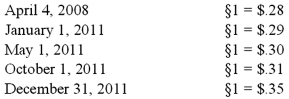 Assume that Boerkian was a foreign subsidiary of a U.S. multinational company and the stickle (§) was the functional currency of the subsidiary. Calculate the translation adjustment for this subsidiary for 2011 and state whether this is a positive or a negative adjustment.
 (Essay)
4.9/5 (85)
(85) What exchange rate should be used to translate (a) revenues and expenses that occur throughout the year and (b) a gain or loss that occurs on a specific day?
(Essay)
4.9/5 (72)
(72) According to U.S. GAAP for a local currency perspective, which method is usually required for translating a foreign subsidiary's financial statements into the parent's reporting currency?
(Multiple Choice)
4.9/5 (80)
(80) A U.S. company's foreign subsidiary had the following amounts in stickles (§), the functional currency, in 2011:  The average exchange rate during 2011 was §1 = $.96. The beginning inventory was acquired when the exchange rate was §1 = $1.20. The ending inventory was acquired when the exchange rate was §1 = $.90. The exchange rate at December 31, 2011 was §1 = $.84. At what amount should the foreign subsidiary's cost of goods sold have been reflected in the 2011 U.S. dollar income statement?
 (Multiple Choice)
4.9/5 (76)
(76) Quadros Inc., a Portuguese firm was acquired by a U.S. company on January 1, 2010. Selected account balances are available for the year ended December 31, 2011, and are stated in euro, the local currency.  Relevant exchange rates for 1 euro are given below:
 Assume the functional currency is the euro, compute the U.S. balance sheet amount for accumulated depreciation for 2011.
Relevant exchange rates for 1 euro are given below: Assume the functional currency is the euro, compute the U.S. balance sheet amount for accumulated depreciation for 2011. (Multiple Choice)
4.9/5 (83)
(83) Quadros Inc., a Portuguese firm was acquired by a U.S. company on January 1, 2010. Selected account balances are available for the year ended December 31, 2011, and are stated in euro, the local currency.  Relevant exchange rates for 1 euro are given below:
 Assume the functional currency is the U.S. dollar, compute the U.S. income statement amount for depreciation expense for 2011.
Relevant exchange rates for 1 euro are given below: Assume the functional currency is the U.S. dollar, compute the U.S. income statement amount for depreciation expense for 2011. (Multiple Choice)
4.9/5 (88)
(88) A U.S. company's foreign subsidiary had the following amounts in stickles (§) in 2011:  The average exchange rate during 2011 was §1 = $.96. The beginning inventory was acquired when the exchange rate was §1 = $1.20. The ending inventory was acquired when the exchange rate was §1 = $.90. The exchange rate at December 31, 2011 was §1 = $.84. Assuming that the foreign country had a highly inflationary economy, at what amount should the foreign subsidiary's cost of goods sold have been reflected in the 2011 U.S. dollar income statement?
 (Multiple Choice)
4.9/5 (98)
(98) Under the current rate method, inventory at market would be translated at what rate?
(Multiple Choice)
4.7/5 (79)
(79) When preparing a consolidation worksheet for a parent and its foreign subsidiary accounted for under the equity method, which of the following statements is false?
(Multiple Choice)
4.9/5 (83)
(83) 
Filters
- Essay(0)
- Multiple Choice(0)
- Short Answer(0)
- True False(0)
- Matching(0)