



 Chat with AI
Exam 10: Translation of Foreign Currency Financial Statements

Exam 1: The Equity Method of Accounting for Investments119 Questions
Exam 2: Consolidation of Financial Information118 Questions
Exam 3: Consolidations - Subsequent to the Date of Acquisition121 Questions
Exam 4: Consolidated Financial Statements and Outside Ownership116 Questions
Exam 5: Consolidated Financial Statements - Intercompany Asset Transactions127 Questions
Exam 6: Intercompany Debt, Consolidated Statement of Cash Flows, and Other Issues114 Questions
Exam 7: Consolidated Financial Statements - Ownership Patterns and Income Taxes117 Questions
Exam 8: Segment and Interim Reporting113 Questions
Exam 9: Foreign Currency Transactions and Hedging Foreign Exchange Risk93 Questions
Exam 10: Translation of Foreign Currency Financial Statements97 Questions
Exam 11: Worldwide Accounting Diversity and International Accounting Standards60 Questions
Exam 12: Financial Reporting and the Securities and Exchange Commission76 Questions
Exam 13: Accounting for Legal Reorganizations and Liquidations83 Questions
Exam 14: Partnerships: Formation and Operation88 Questions
Exam 15: Partnerships: Termination and Liquidation70 Questions
Exam 16: Accounting for State and Local Governments78 Questions
Exam 17: Accounting for State and Local Governments51 Questions
Exam 18: Accounting for Not-For-Profit Organizations64 Questions
Exam 19: Accounting for Estates and Trusts80 Questions
Select questions type


A foreign subsidiary uses the first-in first-out inventory method. The following inventory balances are given at December 31, 2011 in local currency units (LCU):  Compute the December 31, 2011, inventory balance using the lower of cost or market method under the temporal method.
 (Multiple Choice)
4.7/5  (87)
(87) Gunther Co. established a subsidiary in Mexico on January 1, 2011. The subsidiary engaged in the following transactions during 2011:  What amount of foreign exchange gain or loss would have been recognized in Gunther's consolidated income statement for 2011?
 (Multiple Choice)
4.7/5 (81)
(81) A foreign subsidiary uses the first-in first-out inventory method. The following inventory balances are given at December 31, 2011 in local currency units (LCU):  Compute the December 31, 2011, inventory balance using the current rate method.
 (Multiple Choice)
4.9/5 (79)
(79) Under the current rate method, depreciation expense would be translated at what rate?
(Multiple Choice)
5.0/5 (89)
(89) A net asset balance sheet exposure exists and the foreign currency appreciates. Which of the following statements is true?
(Multiple Choice)
4.7/5 (70)
(70) Under the temporal method, common stock would be remeasured at what rate?
(Multiple Choice)
4.7/5 (89)
(89) In translating a foreign subsidiary's financial statements, which exchange rate does the current method require for the subsidiary's assets and liabilities?
(Multiple Choice)
4.8/5 (79)
(79) Farley Brothers, a U.S. company, had a subsidiary in Italy. Under what conditions would the U.S. dollar be the functional currency for this subsidiary?
(Essay)
4.8/5 (79)
(79) Ginvold Co. began operating a subsidiary in a foreign country on January 1, 2011 by acquiring all of the common stock for §50,000 Stickles, the local currency. This subsidiary immediately borrowed §120,000 on a five-year note with ten percent interest payable annually beginning on January 1, 2012. A building was then purchased for §170,000 on January 1, 2011. This property had a ten-year anticipated life and no salvage value and was to be depreciated using the straight-line method. The building was immediately rented for three years to a group of local doctors for §6,000 per month. By year-end, payments totaling §60,000 had been received. On October 1, §5,000 were paid for a repair made on that date and it was the only transaction of this kind for the year. A cash dividend of §6,000 was transferred back to Ginvold on December 31, 2011. The functional currency for the subsidiary was the Stickle (§). Currency exchange rates were as follows: 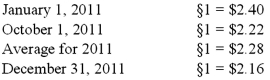 Prepare a balance sheet for this subsidiary in stickles and then translate the amounts into U.S. dollars.
 (Essay)
4.8/5 (82)
(82) Boerkian Co. started 2011 with two assets: Cash of §26,000 (Stickles) and Land that originally cost §72,000 when acquired on April 4, 2008. On May 1, 2011, the company rendered services to a customer for §36,000, an amount immediately paid in cash. On October 1, 2011, the company incurred an operating expense of §22,000 that was immediately paid. No other transactions occurred during the year so an average exchange rate is not necessary. Currency exchange rates were as follows: 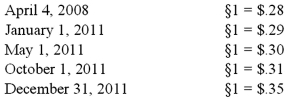 Assume Boerkian was a foreign subsidiary of a U.S. multinational company and the U.S. dollar was the functional currency of the subsidiary. Prepare a schedule of changes in the net monetary assets of Boerkian for the year 2011 and properly label the resulting gain or loss.
 (Essay)
4.8/5 (66)
(66) Under the current rate method, property, plant & equipment would be translated at what rate?
(Multiple Choice)
5.0/5 (79)
(79) Under the current rate method, common stock would be translated at what rate?
(Multiple Choice)
5.0/5 (79)
(79) Dilty Corp. owned a subsidiary in France. Dilty concluded that the subsidiary's functional currency was the U.S. dollar. Which one of the following statements would justify this conclusion?
(Multiple Choice)
4.8/5 (80)
(80) Ginvold Co. began operating a subsidiary in a foreign country on January 1, 2011 by acquiring all of the common stock for §50,000 Stickles, the local currency. This subsidiary immediately borrowed §120,000 on a five-year note with ten percent interest payable annually beginning on January 1, 2012. A building was then purchased for §170,000 on January 1, 2011. This property had a ten-year anticipated life and no salvage value and was to be depreciated using the straight-line method. The building was immediately rented for three years to a group of local doctors for §6,000 per month. By year-end, payments totaling §60,000 had been received. On October 1, §5,000 were paid for a repair made on that date and it was the only transaction of this kind for the year. A cash dividend of §6,000 was transferred back to Ginvold on December 31, 2011. The functional currency for the subsidiary was the Stickle (§). Currency exchange rates were as follows: 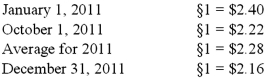 Prepare a statement of retained earnings for this subsidiary in stickles and then translate the amounts into U.S. dollars.
 (Essay)
4.8/5 (64)
(64) Perkle Co. owned a subsidiary in Belgium; the subsidiary's functional currency was the Belgian franc. During 2011, Perkle engaged in hedging transactions to offset part of the subsidiary's net asset position. How should the effects of exchange rate fluctuations on the currency hedge be accounted for?
(Essay)
4.9/5 (92)
(92) Under the temporal method, retained earnings would be remeasured at what rate?
(Multiple Choice)
4.9/5 (85)
(85) Which accounts are remeasured using current exchange rates?
(Multiple Choice)
5.0/5 (82)
(82) Quadros Inc., a Portuguese firm was acquired by a U.S. company on January 1, 2010. Selected account balances are available for the year ended December 31, 2011, and are stated in euro, the local currency.  Relevant exchange rates for 1 euro are given below:
 Assume the functional currency is the euro, compute the U.S. statement of retained earnings amount for dividends for 2011.
Relevant exchange rates for 1 euro are given below: Assume the functional currency is the euro, compute the U.S. statement of retained earnings amount for dividends for 2011. (Multiple Choice)
4.9/5 (78)
(78) Under the temporal method, how would cost of goods sold be remeasured?
(Multiple Choice)
4.8/5 (91)
(91) Quadros Inc., a Portuguese firm was acquired by a U.S. company on January 1, 2010. Selected account balances are available for the year ended December 31, 2011, and are stated in euro, the local currency.  Relevant exchange rates for 1 euro are given below:
 Assume the functional currency is the U.S. dollar, compute the U.S. income statement amount for sales for 2011.
Relevant exchange rates for 1 euro are given below: Assume the functional currency is the U.S. dollar, compute the U.S. income statement amount for sales for 2011. (Multiple Choice)
4.9/5 (80)
(80) 
Filters
- Essay(0)
- Multiple Choice(0)
- Short Answer(0)
- True False(0)
- Matching(0)