



 Chat with AI
Exam 10: Translation of Foreign Currency Financial Statements

Exam 1: The Equity Method of Accounting for Investments119 Questions
Exam 2: Consolidation of Financial Information118 Questions
Exam 3: Consolidations - Subsequent to the Date of Acquisition121 Questions
Exam 4: Consolidated Financial Statements and Outside Ownership116 Questions
Exam 5: Consolidated Financial Statements - Intercompany Asset Transactions127 Questions
Exam 6: Intercompany Debt, Consolidated Statement of Cash Flows, and Other Issues114 Questions
Exam 7: Consolidated Financial Statements - Ownership Patterns and Income Taxes117 Questions
Exam 8: Segment and Interim Reporting113 Questions
Exam 9: Foreign Currency Transactions and Hedging Foreign Exchange Risk93 Questions
Exam 10: Translation of Foreign Currency Financial Statements97 Questions
Exam 11: Worldwide Accounting Diversity and International Accounting Standards60 Questions
Exam 12: Financial Reporting and the Securities and Exchange Commission76 Questions
Exam 13: Accounting for Legal Reorganizations and Liquidations83 Questions
Exam 14: Partnerships: Formation and Operation88 Questions
Exam 15: Partnerships: Termination and Liquidation70 Questions
Exam 16: Accounting for State and Local Governments78 Questions
Exam 17: Accounting for State and Local Governments51 Questions
Exam 18: Accounting for Not-For-Profit Organizations64 Questions
Exam 19: Accounting for Estates and Trusts80 Questions
Select questions type


Quadros Inc., a Portuguese firm was acquired by a U.S. company on January 1, 2010. Selected account balances are available for the year ended December 31, 2011, and are stated in euro, the local currency. 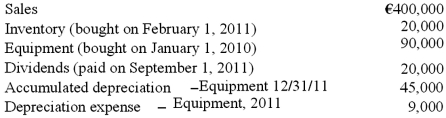 Relevant exchange rates for 1 euro are given below:
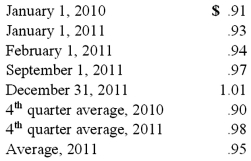 Assume the functional currency is the euro, compute the U.S. balance sheet amount for inventory at December 31, 2011.
Relevant exchange rates for 1 euro are given below: Assume the functional currency is the euro, compute the U.S. balance sheet amount for inventory at December 31, 2011. (Multiple Choice)
4.8/5  (86)
(86) Esposito is an Italian subsidiary of a U.S. company. Esposito's ending inventory is valued at the average cost for the last quarter of the year.
The following account balances are available for Esposito for 2011: 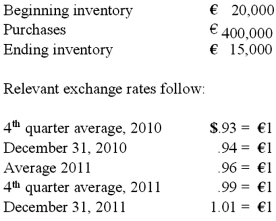 Compute the cost of goods sold for 2011 in U.S. dollars using the temporal method.
 (Multiple Choice)
5.0/5 (77)
(77) Certain balance sheet accounts of a foreign subsidiary of the Tulip Co. had been stated in U.S. dollars as follows: 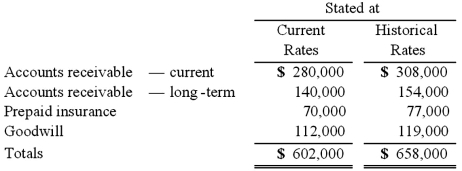 If the subsidiary's local currency is its functional currency, what total amount should be included in Tulip's balance sheet in U.S. dollars?
 (Multiple Choice)
4.8/5 (71)
(71) Where is the disposition of a translation loss reported in the parent company's financial statements?
(Multiple Choice)
4.9/5 (75)
(75) The translation adjustment from translating a foreign subsidiary's financial statements should be shown as
(Multiple Choice)
4.8/5 (83)
(83) Which method of remeasuring a foreign subsidiary's financial statements is correct?
(Multiple Choice)
4.9/5 (76)
(76) A subsidiary of Porter Inc., a U.S. company, was located in a foreign country. The functional currency of this subsidiary was the Stickle (§), the local currency where the subsidiary is located. The subsidiary acquired inventory on credit on November 1, 2010, for §120,000 that was sold on January 17, 2011 for §156,000. The subsidiary paid for the inventory on January 31, 2011. Currency exchange rates between the dollar and the Stickle were as follows: 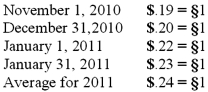 What amount would have been reported for this inventory in Porter's consolidated balance sheet at December 31, 2010?
 (Multiple Choice)
4.7/5 (92)
(92) Westmore, Ltd. is a British subsidiary of a U.S. company. Westmore's functional currency is the pound sterling (≤). The following exchange rates were in effect during 2011: 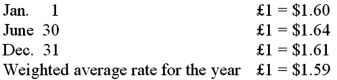 Westmore reported sales of ≤1,500,000 during 2011. What amount (rounded) would have been included for this subsidiary in calculating consolidated sales?
 (Multiple Choice)
4.8/5 (78)
(78) Esposito is an Italian subsidiary of a U.S. company. Esposito's ending inventory is valued at the average cost for the last quarter of the year.
The following account balances are available for Esposito for 2011: 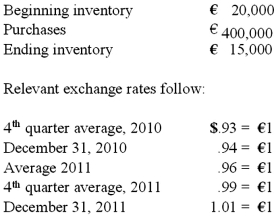 Compute the cost of goods sold for 2011 in U.S. dollars using the current rate method.
 (Multiple Choice)
4.8/5 (71)
(71) A U.S. company's foreign subsidiary had the following amounts in stickles (§), the functional currency, in 2011:  The average exchange rate during 2011 was §1 = $.96. The beginning inventory was acquired when the exchange rate was §1 = $1.20. The ending inventory was acquired when the exchange rate was §1 = $.90. The exchange rate at December 31, 2011 was §1 = $.84. Assuming that the foreign nation for the subsidiary had a highly inflationary economy, at what amount should that foreign subsidiary's purchases have been reflected in the 2011 U.S. dollar income statement?
 (Multiple Choice)
5.0/5 (83)
(83) Certain balance sheet accounts of a foreign subsidiary of Parker Company at December 31, 2011, have been restated into U.S. dollars as follows: 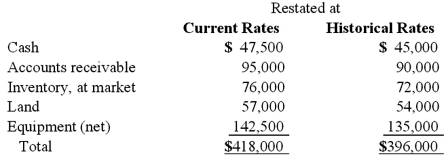 Assuming the functional currency of the subsidiary is the local currency, what total should be included in Parker's consolidated balance sheet at December 31, 2011, for the above items?
 (Multiple Choice)
4.8/5 (72)
(72) What is the justification for the remeasurement of foreign currency transactions?
(Essay)
4.9/5 (75)
(75) Kennedy Company acquired all of the outstanding common stock of Hastie Company of Canada for U.S. $350,000 on January 1, 2011, when the exchange rate for the Canadian dollar (CAD) was U.S. $.70. The fair value of the net assets of Hastie was equal to their book value of CAD 450,000 on the date of acquisition. Any acquisition consideration excess over fair value was attributed to an unrecorded patent with a remaining life of five years. The functional currency of Hastie is the Canadian dollar. For the year ended December 31, 2011, Hastie's trial balance net income was translated at U.S. $25,000. The average exchange rate for the Canadian dollar during 2011 was U.S. $.68, and the 2011 year-end exchange rate was U.S. $.65.
Amortization of the patent, translated, for 2011 would be
(Multiple Choice)
4.8/5 (83)
(83) A subsidiary of Porter Inc., a U.S. company, was located in a foreign country. The functional currency of this subsidiary was the Stickle (§), the local currency where the subsidiary is located. The subsidiary acquired inventory on credit on November 1, 2010, for §120,000 that was sold on January 17, 2011 for §156,000. The subsidiary paid for the inventory on January 31, 2011. Currency exchange rates between the dollar and the Stickle were as follows: 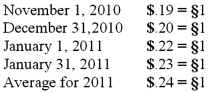 What amount would have been reported for cost of goods sold on Porter's consolidated income statement at December 31, 2011?
 (Multiple Choice)
4.7/5 (78)
(78) A net liability balance sheet exposure exists and the foreign currency appreciates. Which of the following statements is true?
(Multiple Choice)
4.9/5 (79)
(79) Certain balance sheet accounts of a foreign subsidiary of the Tulip Co. had been stated in U.S. dollars as follows: 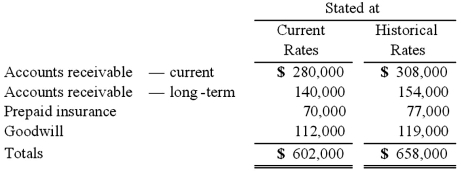 If the U.S. dollar is the functional currency of this subsidiary, what total amount should be included in Tulip's balance sheet in U.S. dollars?
 (Multiple Choice)
4.8/5 (83)
(83) Contrast the purpose of remeasurement with the purpose of translation.
(Essay)
4.7/5 (94)
(94) A net asset balance sheet exposure exists and the foreign currency depreciates. Which of the following statements is true?
(Multiple Choice)
4.8/5 (63)
(63) Under the current rate method, how would cost of goods sold be translated?
(Multiple Choice)
4.8/5 (76)
(76) 
Filters
- Essay(0)
- Multiple Choice(0)
- Short Answer(0)
- True False(0)
- Matching(0)