



 Chat with AI
Exam 12: The Economics of Information

Exam 1: The Fundamentals of Managerial Economics143 Questions
Exam 2: Market Forces: Demand and Supply150 Questions
Exam 3: Quantitative Demand Analysis170 Questions
Exam 4: The Theory of Individual Behavior179 Questions
Exam 5: The Production Process and Costs173 Questions
Exam 6: The Organization of the Firm157 Questions
Exam 7: The Nature of Industry123 Questions
Exam 8: Managing in Competitive, Monopolistic, and Monopolistically Competitive Markets130 Questions
Exam 9: Basic Oligopoly Models134 Questions
Exam 10: Game Theory: Inside Oligopoly140 Questions
Exam 11: Pricing Strategies for Firms With Market Power140 Questions
Exam 12: The Economics of Information128 Questions
Exam 13: Advanced Topics in Business Strategy89 Questions
Exam 14: A Managers Guide to Government in the Marketplace112 Questions
Select questions type


Suppose you are a risk-neutral manager attempting to hire a new sales manager. All of the workers in the market have the same ability to manage and sell, but they differ with respect to the wage at which they are willing to work for your company. The market for sales managers is composed of three types of individuals: 85 percent are willing to work for $75,000 and 15 percent are willing to work for $85,000. The first interviewee is only willing to work for $85,000. If the human resource director spends five hours interviewing each candidate and the opportunity cost of this director's time is $500, then the director should:
(Multiple Choice)
4.9/5  (64)
(64) You are a hotel manager and you are considering four projects that yield different payoffs, depending upon whether there is an economic boom or a recession. The potential payoffs and corresponding payoffs are summarized in the following table.  Which project yields the greatest return, regardless of whether a boom or a recession occurs?
 (Multiple Choice)
4.8/5 (75)
(75) If a manager adopted both project A and project B simultaneously, the variance in returns associated with this joint project would be: 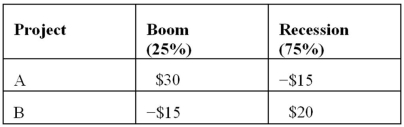
(Multiple Choice)
4.8/5 (64)
(64) Suppose that 20 percent of the firms selling good X charge the low price. If the remaining 80 percent of firms charge $80 per unit and the expected benefit of an additional search is $5, then the lowest price in the market for good X is:
(Multiple Choice)
4.8/5 (87)
(87) A consumer spends less time searching for a good when her reservation price is:
(Multiple Choice)
4.9/5 (79)
(79) Consider an auctioneer who is selling an item through an auction. It is known that the 25 risk-neutral bidders have affiliated values that are distributed between $0 and $500 million. Based on this information, the auction type that will maximize expected revenue is:
(Multiple Choice)
4.8/5 (88)
(88) 
Filters
- Essay(0)
- Multiple Choice(0)
- Short Answer(0)
- True False(0)
- Matching(0)