



 Chat with AI
Exam 12: The Economics of Information

Exam 1: The Fundamentals of Managerial Economics143 Questions
Exam 2: Market Forces: Demand and Supply150 Questions
Exam 3: Quantitative Demand Analysis170 Questions
Exam 4: The Theory of Individual Behavior179 Questions
Exam 5: The Production Process and Costs173 Questions
Exam 6: The Organization of the Firm157 Questions
Exam 7: The Nature of Industry123 Questions
Exam 8: Managing in Competitive, Monopolistic, and Monopolistically Competitive Markets130 Questions
Exam 9: Basic Oligopoly Models134 Questions
Exam 10: Game Theory: Inside Oligopoly140 Questions
Exam 11: Pricing Strategies for Firms With Market Power140 Questions
Exam 12: The Economics of Information128 Questions
Exam 13: Advanced Topics in Business Strategy89 Questions
Exam 14: A Managers Guide to Government in the Marketplace112 Questions
Select questions type


Which of the following statements is NOT correct about information?
(Multiple Choice)
4.8/5  (75)
(75) John is a seller in an affiliated-values auction environment where bidders are risk neutral. Which auction yields John the greatest expected revenue?
(Multiple Choice)
4.9/5 (79)
(79) You are the bidder in an independent private values auction. Each bidder perceives that valuations are evenly distributed between $0 and $1,000. Your own valuation of the item is $900. Determine your optimal bidding strategy in a first-price, sealed-bid auction with:
a. Two bidders.
b. Three bidders.
c. 20 bidders.
(Essay)
4.9/5 (90)
(90) Suppose that there are two types of cars, good and bad. The qualities of cars are not observable but are known to the sellers. Risk-neutral buyers and sellers have their own valuation of these two types of cars as follows: 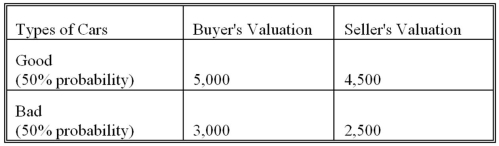 When buyers do not observe the quality, what happens in the market?
 (Multiple Choice)
4.8/5 (85)
(85) Jane wants to buy a beautiful doll as a gift for her sister's birthday. She knows that the same product is offered in different shops with prices of $120, $100, and $80 with odds of one-third of finding each price. She just stopped at a shop and knows that the price is $100. Suppose that there is a search cost of $5 for each search. Should she search one more time?
(Multiple Choice)
4.8/5 (82)
(82) If a manager adopted both project A and project B simultaneously, the expected value of this joint project would be: 
(Multiple Choice)
4.8/5 (67)
(67) You are a hotel manager and you are considering four projects that yield different payoffs, depending upon whether there is an economic boom or a recession. The potential payoffs and corresponding payoffs are summarized in the following table. 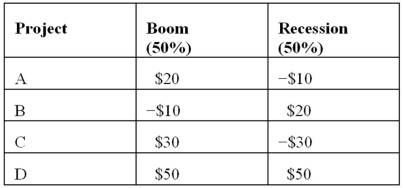 The expected value of project B is:
 (Multiple Choice)
4.7/5 (74)
(74) Which of the following statements is true regarding the expected revenues of auctions with risk-neutral bidders where value estimates are affiliated?
(Multiple Choice)
4.9/5 (92)
(92) As a personnel director of a major consulting firm, you have been asked to decide whether to hire new employees. At present the economy is in a recession, and you have more people than you need to operate the business. Next year there is a 65 percent chance you will need more people and a 35 percent chance you will need fewer people. What additional information would you need when making this decision? Explain.
(Essay)
4.9/5 (86)
(86) During the recession in the early 1990s, retailers observed that consumers were spending a lot more time searching for good bargains than ever before, which led the retailers to lower prices. Why?
(Essay)
4.8/5 (66)
(66) Suppose that 90 percent of the firms selling good X charge the low price. If the remaining 10 percent of firms charge $50 per unit and the expected benefit of an additional search is $10, then the lowest price in the market for good X is:
(Multiple Choice)
4.8/5 (86)
(86) Which of the following phenomena shows that risk aversion is the characteristic of many people?
(Multiple Choice)
4.8/5 (76)
(76) Which of the following is a possible critique of the decision theory under uncertainty presented in the text?
(Multiple Choice)
4.8/5 (83)
(83) Will consumers spend more time searching when stores are located in a mall or when they are spread all over town? Explain. 
(Essay)
4.9/5 (75)
(75) An apple farmer must decide how many apples to harvest for the world apple market. He knows that there is a one-third probability that the world price will be $1, a one-third probability that it will be $1.50, and a one-third probability that it will be $2. His cost function is C(Q) = 0.01Q2. What is the expected price in the world apple market?
(Multiple Choice)
4.7/5 (62)
(62) A risk-neutral monopoly must set output before it knows the market price. There is a 50 percent chance the firm's demand curve will be P = 20 - Q and a 50 percent chance it will be P = 40 - Q. The marginal cost of the firm is MC = Q. The profits are maximized in the expected sense when:
(Multiple Choice)
4.7/5 (69)
(69) A consumer spends more time searching for a good when her reservation price is:
(Multiple Choice)
4.8/5 (94)
(94) 
Filters
- Essay(0)
- Multiple Choice(0)
- Short Answer(0)
- True False(0)
- Matching(0)