



 Chat with AI
Exam 5: The Production Process and Costs

Exam 1: The Fundamentals of Managerial Economics143 Questions
Exam 2: Market Forces: Demand and Supply150 Questions
Exam 3: Quantitative Demand Analysis170 Questions
Exam 4: The Theory of Individual Behavior179 Questions
Exam 5: The Production Process and Costs173 Questions
Exam 6: The Organization of the Firm157 Questions
Exam 7: The Nature of Industry123 Questions
Exam 8: Managing in Competitive, Monopolistic, and Monopolistically Competitive Markets130 Questions
Exam 9: Basic Oligopoly Models134 Questions
Exam 10: Game Theory: Inside Oligopoly140 Questions
Exam 11: Pricing Strategies for Firms With Market Power140 Questions
Exam 12: The Economics of Information128 Questions
Exam 13: Advanced Topics in Business Strategy89 Questions
Exam 14: A Managers Guide to Government in the Marketplace112 Questions
Select questions type


Your firm produces two products, Q1 and Q2. An economic consulting firm has estimated your cost function to be  a. Are there economies of scope?
b. Are there cost complementarities?
c. Your market for Q1 is not very good, and an overseas firm has offered to buy the division of your company that produces Q1. What will happen to your marginal cost of producing Q2 if you sell the division?
a. Are there economies of scope?
b. Are there cost complementarities?
c. Your market for Q1 is not very good, and an overseas firm has offered to buy the division of your company that produces Q1. What will happen to your marginal cost of producing Q2 if you sell the division?
Free
(Essay)
4.8/5  (87)
(87) Correct Answer: Verified
a. For a quadratic multiproduct cost function, economies of scope exist if 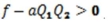 Here, f = 100 and a = 1, so economies of scope exist whenever
 b. Since a = 1 > 0, there are no cost complementarities.
c. Since a = 1 > 0, the marginal cost of producing product 2 will fall if the division producing product 1 is sold.
Suppose the production function is given by Q = 2K + L. If w = $4 and r = $4, how many units of K and L will be utilized in the production process?
Free
(Multiple Choice)
4.8/5 (83)
(83) Correct Answer:Verified
VerifiedA
Given a cost function C(Q) = 200 + 14Q + 8Q2, what is the marginal cost function?
Free
(Multiple Choice)
4.9/5 (64)
(64) Correct Answer:Verified
VerifiedA
Suppose the cost function is C(Q) = 50 + Q - 10Q2 + 2Q3. At 10 units of output, the average cost curve is:
(Multiple Choice)
4.8/5 (87)
(87) Given the Leontief production function Q = min{5.5K, 6.7L}, how much output is produced when K = 40 and L = 35?
(Multiple Choice)
4.9/5 (83)
(83) According to the table below, at what level of output is marginal cost minimized? 
(Multiple Choice)
4.9/5 (90)
(90) The total costs for Morris Industries are summarized in the following table. Based on this information, fill in the missing entries in the table for fixed cost, variable cost, average fixed cost, average variable cost, average total cost, and marginal cost. 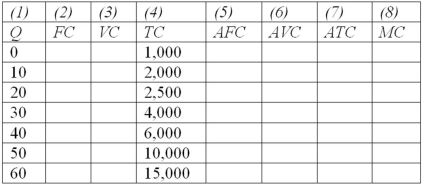
(Essay)
5.0/5 (76)
(76) Which of the following profit functions exhibits a linear production function?
(Multiple Choice)
4.8/5 (85)
(85) The production function is Q = K.4 L.6. The marginal rate of technical substitution is:
(Multiple Choice)
4.8/5 (69)
(69) The recipe that defines the maximum amount of output that can be produced with K units of capital and L units of labor is the:
(Multiple Choice)
4.8/5 (77)
(77) The minimum average cost of producing alternate levels of output, allowing for optimal selection of all variables of production is defined by the:
(Multiple Choice)
4.7/5 (65)
(65) The change in total output attributable to the last unit of an input is the:
(Multiple Choice)
4.8/5 (89)
(89) Which curve(s) does the marginal cost curve intersect at the (their) minimum point?
(Multiple Choice)
4.8/5 (75)
(75) Suppose the long-run average cost curve is U-shaped. When LRAC is in the increasing stage, there exist:
(Multiple Choice)
4.7/5 (80)
(80) According to the table below, what is the average variable cost of producing 50 units of output? 
(Multiple Choice)
4.7/5 (75)
(75) Suppose that production for good X is characterized by the following production function, Q = K0.5L0.5, where K is the fixed input in the short run. If the per-unit rental rate of capital, r, is $25 and the per-unit wage, w, is $15, then the average variable cost of using 81 units of capital and 9 units of labor is:
(Multiple Choice)
4.7/5 (66)
(66) Suppose the production function of automobiles is given by  a. Show that the marginal product of any given quantity of labor increases as capital is increased.
b. Suppose Japanese and U.S. automakers produce on identical isoquants with this Cobb-Douglas production function and that labor costs are higher in Japan than in the United States. Do autoworkers in Japan have a higher marginal product than American autoworkers? Explain carefully.
c. Now suppose Japanese automakers produce on a different isoquant from U.S. firms, but the prices of Japanese and American cars are identical. Do Japanese or American autoworkers have a higher marginal product? Why?
a. Show that the marginal product of any given quantity of labor increases as capital is increased.
b. Suppose Japanese and U.S. automakers produce on identical isoquants with this Cobb-Douglas production function and that labor costs are higher in Japan than in the United States. Do autoworkers in Japan have a higher marginal product than American autoworkers? Explain carefully.
c. Now suppose Japanese automakers produce on a different isoquant from U.S. firms, but the prices of Japanese and American cars are identical. Do Japanese or American autoworkers have a higher marginal product? Why? (Essay)
4.9/5 (79)
(79) Suppose the cost function is C(Q) = 50 + Q - 10Q2 + 2Q3. What is the total cost of producing 10 units?
(Multiple Choice)
5.0/5 (87)
(87) In order for isoquants to have a diminishing marginal rate of substitution, they must be:
(Multiple Choice)
4.8/5 (83)
(83) 
Filters
- Essay(0)
- Multiple Choice(0)
- Short Answer(0)
- True False(0)
- Matching(0)