



 Chat with AI
Exam 5: The Production Process and Costs

Exam 1: The Fundamentals of Managerial Economics143 Questions
Exam 2: Market Forces: Demand and Supply150 Questions
Exam 3: Quantitative Demand Analysis170 Questions
Exam 4: The Theory of Individual Behavior179 Questions
Exam 5: The Production Process and Costs173 Questions
Exam 6: The Organization of the Firm157 Questions
Exam 7: The Nature of Industry123 Questions
Exam 8: Managing in Competitive, Monopolistic, and Monopolistically Competitive Markets130 Questions
Exam 9: Basic Oligopoly Models134 Questions
Exam 10: Game Theory: Inside Oligopoly140 Questions
Exam 11: Pricing Strategies for Firms With Market Power140 Questions
Exam 12: The Economics of Information128 Questions
Exam 13: Advanced Topics in Business Strategy89 Questions
Exam 14: A Managers Guide to Government in the Marketplace112 Questions
Select questions type


Cost complementarity exists in a multiproduct cost function when:
(Multiple Choice)
4.9/5  (83)
(83) Suppose the production function is given by Q = min{K, L}. How much output is produced when 10 units of labor and 9 units of capital are employed?
(Multiple Choice)
4.9/5 (78)
(78) For given input prices, isocosts farther from the origin are associated with:
(Multiple Choice)
4.8/5 (80)
(80) You are the manager of a firm that sells output at a price of $40 per unit. You are interested in hiring a new worker who will increase your firm's output by 2,000 units per year. Several other firms also are interested in hiring this worker.
a. What is the highest annual salary you should be willing to pay this worker to come to your firm?
b. What will determine whether or not you actually have to offer this much to the worker to induce him to join your firm?
(Essay)
4.9/5 (89)
(89) The difference between average total costs and average variable costs is:
(Multiple Choice)
4.8/5 (90)
(90) Which of the following cost functions exhibits economies of scope when three (3) units of good one and two (2) units of good two are produced?
(Multiple Choice)
4.9/5 (70)
(70) Which of the following is NOT a means of acquiring product and process innovations?
(Multiple Choice)
4.9/5 (78)
(78) In the text, we showed that the multiproduct cost function  exhibits cost complementarity whenever
 and economies of scope whenever
 a. Can cost complementarity exist without economies of scope?
b. Can there be economies of scope when cost complementarities exist?
exhibits cost complementarity whenever and economies of scope whenever a. Can cost complementarity exist without economies of scope?
b. Can there be economies of scope when cost complementarities exist? (Essay)
5.0/5 (81)
(81) Suppose that production for good X is characterized by the following production function, Q = K0.5L0.5, where K is the fixed input in the short run. If the per-unit rental rate of capital, r, is $25 and the per-unit wage, w, is $15, then the average fixed cost of using 81 units of capital and 9 units of labor is:
(Multiple Choice)
4.8/5 (70)
(70) You are the manager of Telecall Inc., a small telemarketing company. Your company pays $10,000 per month for office space. A real estate agent has noticed that you are only using 75 percent of your available space and tells you that Telecall could add $800 per month to its bottom line by renting out the space it does not use. Telecall has been asked to do a new telemarketing campaign for a large credit card company, but this would require it to use the remaining office space. What is the opportunity cost of using the extra office space to handle the credit card company's promotion?
(Essay)
4.7/5 (80)
(80) Which of the following relations is the slope along a given isoquant?
(Multiple Choice)
4.7/5 (71)
(71) Suppose that production for good X is characterized by the following production function, Q = K0.5L0.5, where K is the fixed input in the short run. If the per-unit rental rate of capital, r, is $15 and the per-unit wage, w, is $5, then the average fixed cost of using 16 units of capital and 25 units of labor is:
(Multiple Choice)
4.9/5 (70)
(70) Given the linear production function Q = 10K + 5L, if Q = 10,000 and K = 500, how much labor is utilized?
(Multiple Choice)
4.9/5 (78)
(78) Suppose that production for good X is characterized by the following production function, Q = K0.5L0.5, where K is the fixed input in the short run. If the per-unit rental rate of capital, r, is $15 and the per-unit wage, w, is $25, then the average fixed cost of using 9 units of capital and 81 units of labor is:
(Multiple Choice)
4.8/5 (75)
(75) The average product of capital of producing 2,991 units of output (find point B) in the table below is: 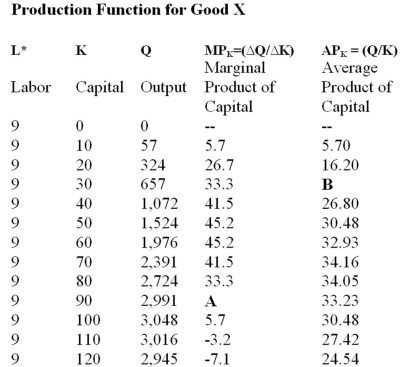
(Multiple Choice)
4.7/5 (86)
(86) The production function is Q = K.6 L.4. The marginal rate of technical substitution is:
(Multiple Choice)
4.9/5 (65)
(65) 
Filters
- Essay(0)
- Multiple Choice(0)
- Short Answer(0)
- True False(0)
- Matching(0)