



 Chat with AI
Exam 12: The Economics of Information

Exam 1: The Fundamentals of Managerial Economics143 Questions
Exam 2: Market Forces: Demand and Supply150 Questions
Exam 3: Quantitative Demand Analysis170 Questions
Exam 4: The Theory of Individual Behavior179 Questions
Exam 5: The Production Process and Costs173 Questions
Exam 6: The Organization of the Firm157 Questions
Exam 7: The Nature of Industry123 Questions
Exam 8: Managing in Competitive, Monopolistic, and Monopolistically Competitive Markets130 Questions
Exam 9: Basic Oligopoly Models134 Questions
Exam 10: Game Theory: Inside Oligopoly140 Questions
Exam 11: Pricing Strategies for Firms With Market Power140 Questions
Exam 12: The Economics of Information128 Questions
Exam 13: Advanced Topics in Business Strategy89 Questions
Exam 14: A Managers Guide to Government in the Marketplace112 Questions
Select questions type


People with a bad driving record find it difficult to buy automobile insurance because insurance companies fear that ___________ may happen if they raise the premiums.
(Multiple Choice)
4.9/5  (70)
(70) Suppose that there are two types of cars, good and bad. The qualities of cars are not observable but are known to the sellers. Risk-neutral buyers and sellers have their own valuation of these two types of cars as follows: 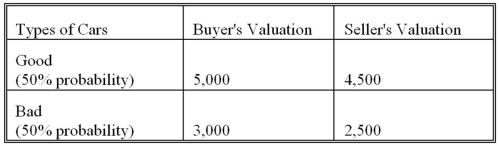 Now suppose that sellers value a good car at $4,500 and a bad car at $2,500, and quality is not observed by the buyers. What is the highest price that risk-neutral buyers will offer for a used car if they recognize adverse selection?
 (Multiple Choice)
4.8/5 (76)
(76) Tim is offered two gambles. With gamble A, he either gains $2 or loses $1 with a 50 percent probability. With gamble B, he either gains $3 or loses $2 with a 50 percent probability. Tim prefers gamble B to gamble A. What can we conclude?
(Multiple Choice)
4.9/5 (84)
(84) Suppose a risk-neutral competitive firm must produce output before the market price is known. If the uncertain price is given by p = p* + e, where e is a random term with an expected value of zero, a competitive firm should shut down in the short run if:
(Multiple Choice)
5.0/5 (69)
(69) When managers of firms are given fixed salaries, which are not tied to the firm's profits, they generally put forth less effort than they otherwise would. This is an example of:
(Multiple Choice)
4.8/5 (76)
(76) An apple farmer must decide how many apples to harvest for the world apple market. He knows that there is a one-third probability that the world price will be $1, a one-third probability that it will be $1.50, and a one-third probability that it will be $2. His cost function is C(Q) = .01Q2. If the farmer is risk neutral:
(Multiple Choice)
5.0/5 (78)
(78) Consider an antique auction where bidders have independent private values. There are two bidders, each of whom perceives that valuations are uniformly distributed between $100 and $1,000. One of the bidders is Sue, who knows her own valuation is $200. What is Sue's optimal bidding strategy in a Dutch auction?
(Multiple Choice)
4.9/5 (71)
(71) Holding the mean value of a gamble constant, the larger the standard deviation, the:
(Multiple Choice)
4.9/5 (79)
(79) Jane wants to buy a beautiful doll as a gift for her sister's birthday. She knows that the same product is offered in different shops with prices of $120, $100, and $80 with odds of one-third of finding each price. She just stopped at a shop and knows that the price is $100. If the search cost is $8 per time, what should she do?
(Multiple Choice)
4.9/5 (80)
(80) Consider a game that pays 2n cents if the first tail is on the nth toss of a fair-headed coin. Determine the expected value of this game.
(Multiple Choice)
4.9/5 (73)
(73) You are a hotel manager considering four projects that yield different payoffs, depending upon whether there is an economic boom or a recession. The potential payoffs and corresponding payoffs are summarized in the following table. 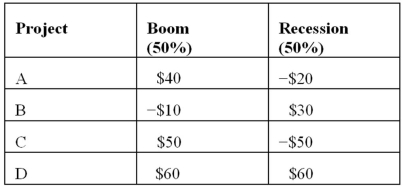 Which project has the highest variance?
 (Multiple Choice)
4.8/5 (74)
(74) Consider an antique auction where bidders have independent private values. There are two bidders, each of whom perceives that valuations are uniformly distributed between $100 and $1,000. One of the bidders is Sue, who knows her own valuation is $200. What is Sue's optimal bidding strategy in an English auction?
(Multiple Choice)
4.8/5 (87)
(87) Which of the following types of auctions was NOT described in the text?
(Multiple Choice)
4.8/5 (68)
(68) After a person buys insurance for his car, he will generally not care for his car as much as he otherwise would. This is an example of:
(Multiple Choice)
4.9/5 (86)
(86) Suppose you are a risk-neutral manager attempting to hire a new sales manager. All of the workers in the market have the same ability to manage and sell, but they differ with respect to the wage at which they are willing to work for your company. The market for sales managers is composed of two types of individuals: 35 percent are willing to work for $50,000 and 65 percent are willing to work for $75,000. The first interviewee is only willing to work for $75,000. The expected benefit from an additional search is:
(Multiple Choice)
4.8/5 (78)
(78) Which of the following is NOT an example of a managerial decision with risk-averse consumers?
(Multiple Choice)
4.9/5 (83)
(83) "… two prostitutes came to the king (Solomon) and stood before him. One of them said, 'My lord, this woman and I live in the same house. I had a baby while she was there with me. The third day after my child was born, this woman also had a baby. We were alone; there was no one in the house but the two of us.
During the night this woman's son died because she lay on him. So she got up in the middle of the night and took my son from my side while I your servant was asleep. She put him by her breast and put her dead son by my breast. The next morning, I got up to nurse my son-and he was dead! But when I looked at him closely in the morning light, I knew that it wasn't the son I had borne.'
The other woman said, 'No! The living one is my son; the dead one is yours.'
The king said, 'Bring me a sword.' So they brought a sword for the king. He then gave an order: 'Cut the living child in two and give half to one and half to the other.'
The woman whose son was alive was filled with compassion for her son and said to the king, 'Please, my lord, give her the living baby. Do not kill him; she is his mother.'
But the other said, 'Neither I nor you shall have him. Cut him in two!'
Then the king gave his ruling: 'Give the living baby to the first woman. Do not kill him; she is his mother.'" 1 Kings 3:16-27 (NIV).
King Solomon's actions in this passage illustrate the concept of:
(Multiple Choice)
4.9/5 (89)
(89) 
Filters
- Essay(0)
- Multiple Choice(0)
- Short Answer(0)
- True False(0)
- Matching(0)