



 Chat with AI
Exam 12: The Economics of Information

Exam 1: The Fundamentals of Managerial Economics143 Questions
Exam 2: Market Forces: Demand and Supply150 Questions
Exam 3: Quantitative Demand Analysis170 Questions
Exam 4: The Theory of Individual Behavior179 Questions
Exam 5: The Production Process and Costs173 Questions
Exam 6: The Organization of the Firm157 Questions
Exam 7: The Nature of Industry123 Questions
Exam 8: Managing in Competitive, Monopolistic, and Monopolistically Competitive Markets130 Questions
Exam 9: Basic Oligopoly Models134 Questions
Exam 10: Game Theory: Inside Oligopoly140 Questions
Exam 11: Pricing Strategies for Firms With Market Power140 Questions
Exam 12: The Economics of Information128 Questions
Exam 13: Advanced Topics in Business Strategy89 Questions
Exam 14: A Managers Guide to Government in the Marketplace112 Questions
Select questions type


Risk-averse persons sometimes prefer to play some gambles even if they know that those gambles are not fair, i.e., on average people lose by playing them. One plausible explanation for this seemingly paradoxical phenomenon is that:
(Multiple Choice)
4.8/5  (80)
(80) Consider an antique auction where bidders have independent private values. There are two bidders, each of whom perceives that valuations are uniformly distributed between $100 and $1,000. One of the bidders is Sue, who knows her own valuation is $200. What is Sue's optimal bidding strategy in a second-price, sealed-bid auction?
(Multiple Choice)
4.9/5 (78)
(78) Many tout that the Internet has lowered consumers' search costs. If this is true, ceteris parabis, the consumer reservation price should:
(Multiple Choice)
4.9/5 (77)
(77) You are a hotel manager and you are considering four projects that yield different payoffs, depending upon whether there is an economic boom or a recession. The potential payoffs and corresponding payoffs are summarized in the following table. 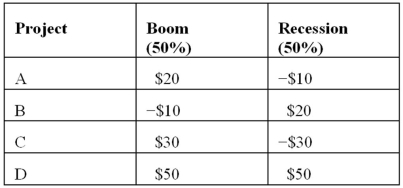 Which project has the greatest expected value?
 (Multiple Choice)
4.8/5 (81)
(81) Suppose that there are two types of cars, good and bad. The qualities of cars are not observable but are known to the sellers. Risk-neutral buyers and sellers have their own valuation of these two types of cars as follows: 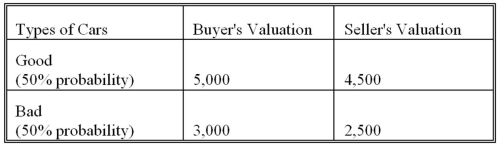 Suppose that both buyers and sellers observe the quality. What happens?
 (Multiple Choice)
4.9/5 (75)
(75) At Econ Tech, the average grade in a course that all students know to be a "blow-off" course is the same as the average grade in the toughest math course. Why?
(Essay)
4.8/5 (80)
(80) A risk-neutral monopoly must set output before it knows the market price. There is a 50 percent chance the firm's demand curve will be P = 20 - Q and a 50 percent chance it will be P = 40 - Q. The marginal cost of the firm is MC = Q. What is the expression for the expected marginal revenue function?
(Multiple Choice)
4.8/5 (72)
(72) In order to reduce the undesirable effects of moral hazard, an insurance company can:
(Multiple Choice)
4.9/5 (88)
(88) You are a hotel manager and you are considering four projects that yield different payoffs, depending upon whether there is an economic boom or a recession. The potential payoffs and corresponding payoffs are summarized in the following table. 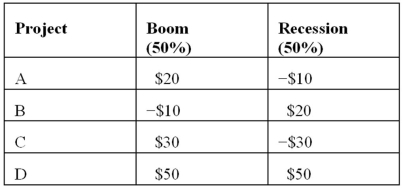 Which project has the lowest expected value?
 (Multiple Choice)
4.9/5 (74)
(74) A risk-neutral monopoly must set output before it knows the market price. There is a 50 percent chance the firm's demand curve will be P = 40 - Q and a 50 percent chance it will be P = 60 - Q. The marginal cost of the firm is MC = 3Q. The expected profit-maximizing price is:
(Multiple Choice)
4.9/5 (75)
(75) Joe's search costs are $5 per search. He wants to buy a video player for his wife for Christmas, and the lowest price he's found so far is $200. Joe thinks 50 percent of the stores charge $200 for video players and 50 percent charge $190. Based on this information:
(Multiple Choice)
4.8/5 (67)
(67) A manager is attempting to assess the probability of a recession ending in the next six months and its impact on expected profitability. The manager believes there is a 75 percent chance the recession will end in six months and profits will return to $400 million. However, there is a 25 percent chance the recession will not end in six months, resulting in a $5 million loss. The expected profits over the next six months are:
(Multiple Choice)
4.9/5 (88)
(88) Susan's search costs are $7 per search. She wants to buy a coat, and the lowest price she has found so far is $180. Susan thinks 25 percent of the stores charge $180 for this coat, 50 percent charge $160, and the other 25 percent charge $150. Susan's optimal decision is to:
(Multiple Choice)
4.8/5 (76)
(76) You are considering opening your own hamburger restaurant. List the information that will influence your decision about whether to start your own restaurant or go with a franchise.
(Essay)
4.8/5 (78)
(78) The optimal strategy for a risk-neutral bidder in a second-price, sealed-bid auction with independent private values is to bid:
(Multiple Choice)
4.8/5 (91)
(91) Joe's search costs are $5 per search. He wants to buy a video player for his wife for Christmas, and the lowest price he's found so far is $300. Joe thinks 80 percent of the stores charge $300 for video players and 20 percent charge $200. Joe's optimal decision is to:
(Multiple Choice)
4.9/5 (78)
(78) Suppose that there are two types of cars, good and bad. The qualities of cars are not observable but are known to the sellers. Risk-neutral buyers and sellers have their own valuation of these two types of cars as follows: 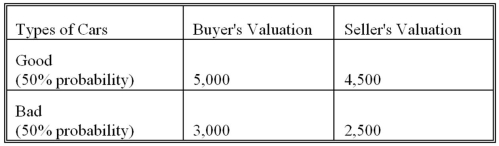 When a buyer does not observe the quality, what is the highest price she will offer for a used car if she ignores adverse selection?
 (Multiple Choice)
4.9/5 (91)
(91) Consider an auctioneer who is selling an item through an auction. It is known that the 10 risk-neutral bidders have independent private values that are uniformly distributed between $1,000 and $2,000. Based on this information, we can conclude that the expected revenue in this auction will be:
(Multiple Choice)
4.8/5 (62)
(62) The expected revenues in auctions with risk-averse bidders with independent private values will be:
(Multiple Choice)
4.9/5 (83)
(83) A risk-neutral monopoly must set output before it knows the market price. There is a 50 percent chance the firm's demand curve will be P = 20 - Q and a 50 percent chance it will be P = 40 - Q. The marginal cost of the firm is MC = Q. The expected profit-maximizing price is:
(Multiple Choice)
4.7/5 (82)
(82) 
Filters
- Essay(0)
- Multiple Choice(0)
- Short Answer(0)
- True False(0)
- Matching(0)