



 Chat with AI
Exam 10: Savings, Investment Spending, and the Financial System

Exam 1: First Principles233 Questions
Exam 2: Economic Models319 Questions
Exam 3: Supply and Demand292 Questions
Exam 5: International Trade 5274 Questions
Exam 6: Macroeconomics: the Big Picture168 Questions
Exam 7: Gdp and Cpi: Tracking the Macroeconomy434 Questions
Exam 8: Unemployment and Inflation354 Questions
Exam 9: Long-Run Economic Growth316 Questions
Exam 10: Savings, Investment Spending, and the Financial System402 Questions
Exam 13: Fiscal Policy Appendix Taxes and the Multiplier382 Questions
Exam 14: Money, Banking, and the Federal Reserve System468 Questions
Exam 15: Monetary Policy359 Questions
Exam 16: Inflation, Disinflation, and Deflation240 Questions
Exam 17: Crises and Consequences214 Questions
Exam 18: Events and Ideas322 Questions
Exam 19: Open-Economy Macroeconomics467 Questions
Exam 20: Graphs in Economics75 Questions
Exam 21: toward a Fuller Understanding of Present Value36 Questions
Select questions type


Use the following to answer questions:
Scenario: Closed Economy S = I
GDP is $12 trillion this year in a closed economy. Consumption is $8 trillion and government spending is $2 trillion. Taxes are $0.5 trillion.
-(Scenario: Closed Economy S = I) Look at the scenario Closed Economy S = I. How much is private saving?
(Multiple Choice)
4.7/5  (73)
(73) Use the following to answer questions :  -(Table: Investment Spending, Private Spending, and Capital Inflows) Look at the table Investment Spending, Private Spending, and Capital Inflows. What is the budget balance as a percentage of GDP in Northlandia?
 (Multiple Choice)
4.8/5 (71)
(71) Which of the following is an index of 30 leading companies, such as Microsoft, Walmart, and General Electric?
(Multiple Choice)
4.7/5 (82)
(82) Use the following to answer questions :
Scenario: Open Economy S = I
In an open economy GDP is $12 trillion this year. Consumption is $8 trillion, and government spending is $2 trillion. Taxes are $0.5 trillion. Exports are $1 trillion, and imports are $3 trillion.
-(Scenario: Open Economy S = I) Look at the scenario Open Economy S = I. How much is the net capital inflow?
(Multiple Choice)
4.8/5 (69)
(69) Suppose that Jim just got a $20,000 loan from his credit union to buy a new car. The loan is a _____ for Jim and a _____ for the credit union.
(Multiple Choice)
5.0/5 (65)
(65) If the NASDAQ is down and the Dow Jones Industrial Average is higher on a particular day, which of the following is likely to be TRUE?
(Multiple Choice)
4.9/5 (72)
(72) Use the following to answer questions :
Scenario: Open Economy S = I
In an open economy GDP is $12 trillion this year. Consumption is $8 trillion, and government spending is $2 trillion. Taxes are $0.5 trillion. Exports are $1 trillion, and imports are $3 trillion.
-(Scenario: Open Economy S = I) Look at the scenario Open Economy S = I. How much is national saving?
(Multiple Choice)
4.9/5 (75)
(75) If the interest rate in the market for loanable funds is above the equilibrium rate:
(Multiple Choice)
4.8/5 (87)
(87) The supply of loanable funds is _____ sloping because _____ respond to lower interest rates by _____ their quantity supplied of loanable funds.
(Multiple Choice)
4.9/5 (78)
(78) Use the following to answer questions :
Table: National Income Accounts
 -(Table: National Income Accounts) Look at the table National Income Accounts. The value of private savings is:
 (Multiple Choice)
4.8/5 (81)
(81) If all retail stores announce unexpectedly high sales volumes, holding other things constant, stock prices in the retail sector will:
(Multiple Choice)
4.9/5 (77)
(77) When a corporation borrows money from lenders in exchange for a fixed share of the firm's assets and potential profits, the corporation is:
(Multiple Choice)
4.8/5 (87)
(87) In a closed economy government spending was $30 billion, consumption was $70 billion, taxes were $20 billion, and GDP was $110 billion this year. Investment spending was $10 billion. As a result:
(Multiple Choice)
4.8/5 (72)
(72) Use the following to answer question :
Figure: The Market for Loanable Funds with Government Borrowing 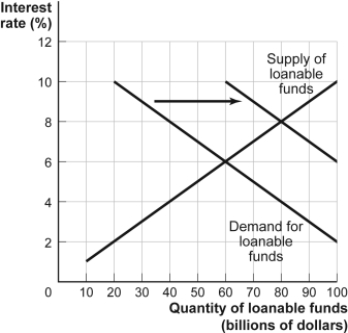 -(Figure: The Market for Loanable Funds with Government Borrowing) Look at the figure The Market for Loanable Funds with Government Borrowing. After an increase in government borrowing, the new equilibrium interest rate will rise from 6% to _____ and the amount of private savings will _____.
 (Multiple Choice)
4.7/5 (90)
(90) If a project costs $100,000 and is expected to return $105,000 in a year and if the interest rate is 6%, then the company will want to take out a loan to undertake the project.
(True/False)
4.9/5 (79)
(79) 
Filters
- Essay(0)
- Multiple Choice(0)
- Short Answer(0)
- True False(0)
- Matching(0)