



 Chat with AI
Exam 10: Savings, Investment Spending, and the Financial System

Exam 1: First Principles233 Questions
Exam 2: Economic Models319 Questions
Exam 3: Supply and Demand292 Questions
Exam 5: International Trade 5274 Questions
Exam 6: Macroeconomics: the Big Picture168 Questions
Exam 7: Gdp and Cpi: Tracking the Macroeconomy434 Questions
Exam 8: Unemployment and Inflation354 Questions
Exam 9: Long-Run Economic Growth316 Questions
Exam 10: Savings, Investment Spending, and the Financial System402 Questions
Exam 13: Fiscal Policy Appendix Taxes and the Multiplier382 Questions
Exam 14: Money, Banking, and the Federal Reserve System468 Questions
Exam 15: Monetary Policy359 Questions
Exam 16: Inflation, Disinflation, and Deflation240 Questions
Exam 17: Crises and Consequences214 Questions
Exam 18: Events and Ideas322 Questions
Exam 19: Open-Economy Macroeconomics467 Questions
Exam 20: Graphs in Economics75 Questions
Exam 21: toward a Fuller Understanding of Present Value36 Questions
Select questions type


Use the following to answer questions:
Table: Investment Projects  -(Table: Investment Projects) Look at the table Investment Projects. If the market interest rate is 13%, the amount of planned investment spending is:
 (Multiple Choice)
4.9/5  (83)
(83) The present value of $1 realized one year from now equals:
(Multiple Choice)
4.8/5 (70)
(70) The purchaser of a share of stock receives interest each year from the stock and then receives the purchase price of the stock at its maturity.
(True/False)
4.9/5 (76)
(76) Use the following to answer questions:
Figure: Loanable Funds  -(Figure: Loanable Funds) Look at the figure Loanable Funds. Which of the following might produce a new equilibrium interest rate of 4% and a new equilibrium quantity of loanable funds of $75 billion?
 (Multiple Choice)
4.8/5 (83)
(83) If you are paid $10,500 in one year on a $10,000 loan made today, then your annual interest rate is:
(Multiple Choice)
4.8/5 (74)
(74) Which of the following is (are) source(s) of funds for Facebook's investment spending?
I. investors who purchase shares of stock in the company
II. borrowing from savers
(Multiple Choice)
4.9/5 (77)
(77) Use the following to answer questions :
Figure: The Market for Loanable Funds II  -(Figure: The Market for Loanable Funds II) Look at the figure The Market for Loanable Funds II. Other things being equal, if there is an increase in the interest rate above 8%, _____ quantity of loanable funds will be demanded.
 (Multiple Choice)
4.9/5 (76)
(76) A bubble is a large decrease in asset prices caused by unrealistic expectations about future prices.
(True/False)
5.0/5 (88)
(88) Use the following to answer question :
Figure: Demand for Loanable Funds 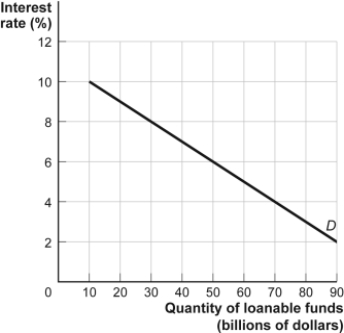 -(Figure: Demand for Loanable Funds) Look at the figure Demand for Loanable Funds. When the interest rate is 6%, the quantity demanded of loanable funds will equal:
 (Multiple Choice)
4.9/5 (78)
(78) All of the following scenarios are associated with government budget deficits EXCEPT that:
(Multiple Choice)
4.9/5 (67)
(67) Borrowers who cannot be served by the stock and bond markets:
(Multiple Choice)
4.8/5 (72)
(72) Use the following to answer questions:
Figure: Loanable Funds
-(Figure: Loanable Funds) Look at the figure Loanable Funds. Which of the following might produce a new equilibrium interest rate of 8% and a new equilibrium quantity of loanable funds of $150 billion?
-(Figure: Loanable Funds) Look at the figure Loanable Funds. Which of the following might produce a new equilibrium interest rate of 8% and a new equilibrium quantity of loanable funds of $150 billion? (Multiple Choice)
4.9/5 (69)
(69) 
Filters
- Essay(0)
- Multiple Choice(0)
- Short Answer(0)
- True False(0)
- Matching(0)