



 Chat with AI
Exam 8: Technology, production, and Costs

Exam 1: Economics: Foundations and Models160 Questions
Exam 2: Trade-Offs, comparative Advantage, and the Market System191 Questions
Exam 3: Where Prices Come From: the Interaction of Demand and Supply241 Questions
Exam 4: Market Efficiency and Market Failure226 Questions
Exam 5: The Economics of Healthcare169 Questions
Exam 6: Firms,the Stock Market,and Corporate Governance255 Questions
Exam 7: Consumer Choice and Elasticity270 Questions
Exam 8: Technology, production, and Costs277 Questions
Exam 9: Firms in Perfectly Competitive Markets351 Questions
Exam 10: Monopoly and Antitrust253 Questions
Exam 11: Monopolistic Competition and Oligopoly304 Questions
Exam 12: GDP: Measuring Total Production and Income200 Questions
Exam 13: Unemployment and Inflation207 Questions
Exam 14: Economic Growth, the Financial System and Business Cycles172 Questions
Exam 15: Aggregate Demand and Aggregate Supply Analysis120 Questions
Exam 16: Money, banks, and the Federal Reserve System139 Questions
Exam 17: Monetary Policy180 Questions
Exam 18: Fiscal Policy131 Questions
Exam 19: Comparative Advantage, international Trade, and Exchange Rates247 Questions
Select questions type


Table 8-2
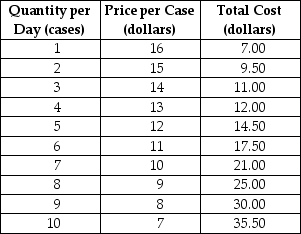 The government of a small developing country has granted exclusive rights to Linden Enterprises for the production of plastic syringes. Table 8-2 shows the cost and demand data for this government protected monopolist.
-Refer to Table 8-2.What is the profit-maximising quantity and price for the monopolist?
The government of a small developing country has granted exclusive rights to Linden Enterprises for the production of plastic syringes. Table 8-2 shows the cost and demand data for this government protected monopolist.
-Refer to Table 8-2.What is the profit-maximising quantity and price for the monopolist? (Multiple Choice)
4.8/5  (75)
(75) Economic efficiency requires that a natural monopoly's price be
(Multiple Choice)
4.8/5 (69)
(69) A monopoly is defined as a firm that has the largest market share in an industry.
(True/False)
5.0/5 (88)
(88) Which of the following statements applies to a monopolist but not to a perfectly competitive firm at their profit-maximising outputs?
(Multiple Choice)
4.9/5 (77)
(77) Figure 8-2  Figure 8-2 above shows the demand and cost curves facing a monopolist.
-Refer to Figure 8-2.The firm's profit-maximising price is
Figure 8-2 above shows the demand and cost curves facing a monopolist.
-Refer to Figure 8-2.The firm's profit-maximising price is (Multiple Choice)
4.7/5 (86)
(86) Which of the following products allows the seller to identify different groups of consumers (segment the market)and practice price discrimination?
(Multiple Choice)
5.0/5 (78)
(78) Suppose an industry is made up of 25 firms,all with equal market share.The four-firm concentration ratio of this industry
(Multiple Choice)
4.7/5 (99)
(99) If Mort's House of Flowers sells one dozen roses to different customers at different prices,economists would consider this an example of
(Multiple Choice)
4.8/5 (90)
(90) A virtuous cycle refers to the development of new products that follows when a monopoly earns economic profits.
(True/False)
4.8/5 (89)
(89) Unlike a perfect competitor,a monopolist faces the market demand curve.
(True/False)
4.8/5 (76)
(76) If you own the only bookstore in a small town,do you have a monopoly?
(Essay)
4.9/5 (79)
(79) If a firm's average total cost is less than price where MR = MC,
(Multiple Choice)
4.9/5 (74)
(74) If we use a narrow definition of monopoly,then a monopoly is defined as a firm
(Multiple Choice)
4.8/5 (73)
(73) A monopoly is a firm that is the only seller of a good or service that does not have
(Multiple Choice)
4.8/5 (89)
(89) Which of the following is not a way by which price-discriminating firms can segment a market?
(Multiple Choice)
4.9/5 (90)
(90) Figure 8-10  -Refer to Figure 8-10.The deadweight loss due to a monopoly is represented by the area
 (Multiple Choice)
4.8/5 (94)
(94) If a natural monopoly regulatory commission sets a price where marginal cost is equal to demand,
(Multiple Choice)
4.9/5 (73)
(73) Figure 8-3  Figure 8-3 above shows the demand and cost curves facing a monopolist.
-Refer to Figure 8-3.Suppose the monopolist represented in the diagram produces positive output.What is the profit/loss per unit?
Figure 8-3 above shows the demand and cost curves facing a monopolist.
-Refer to Figure 8-3.Suppose the monopolist represented in the diagram produces positive output.What is the profit/loss per unit? (Multiple Choice)
4.8/5 (85)
(85) 
Filters
- Essay(0)
- Multiple Choice(0)
- Short Answer(0)
- True False(0)
- Matching(0)