



 Chat with AI
Exam 8: Technology, production, and Costs

Exam 1: Economics: Foundations and Models160 Questions
Exam 2: Trade-Offs, comparative Advantage, and the Market System191 Questions
Exam 3: Where Prices Come From: the Interaction of Demand and Supply241 Questions
Exam 4: Market Efficiency and Market Failure226 Questions
Exam 5: The Economics of Healthcare169 Questions
Exam 6: Firms,the Stock Market,and Corporate Governance255 Questions
Exam 7: Consumer Choice and Elasticity270 Questions
Exam 8: Technology, production, and Costs277 Questions
Exam 9: Firms in Perfectly Competitive Markets351 Questions
Exam 10: Monopoly and Antitrust253 Questions
Exam 11: Monopolistic Competition and Oligopoly304 Questions
Exam 12: GDP: Measuring Total Production and Income200 Questions
Exam 13: Unemployment and Inflation207 Questions
Exam 14: Economic Growth, the Financial System and Business Cycles172 Questions
Exam 15: Aggregate Demand and Aggregate Supply Analysis120 Questions
Exam 16: Money, banks, and the Federal Reserve System139 Questions
Exam 17: Monetary Policy180 Questions
Exam 18: Fiscal Policy131 Questions
Exam 19: Comparative Advantage, international Trade, and Exchange Rates247 Questions
Select questions type


Although some economists believe network externalities are important barriers to entry,other economists disagree because
(Multiple Choice)
4.9/5  (73)
(73) Figure 8-5 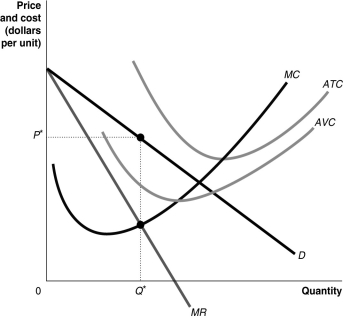 -Refer to Figure 8-5.If the monopolist charges price P* for output Q*,in order to maximise profit or minimise loss in the short run,it should
 (Multiple Choice)
4.8/5 (75)
(75) Suppose a monopoly is producing its profit-maximising output level.Now suppose the government imposes a lump-sum tax on the monopoly,independent of its output.As a result,the monopolist will increase the price of its product to cover its higher cost.
(True/False)
4.9/5 (64)
(64) Figure 8-8 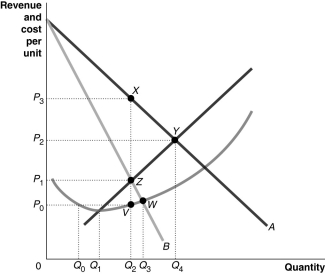 Figure 8-8 reflects the cost and revenue structure for a monopoly that has been in business for a very long time.
-Refer to Figure 8-8.Use this figure to answer the following questions.
a. Identify the curves labelled A and B.Identify the curve that contains both point Y and point Z.Identify the curve that contains both point V and point W.
b.What is the profit-maximising quantity and what price will the monopolist charge?
c.What area represents total revenue at the profit-maximising output level?
d.What area represents total cost at the profit-maximising output level?
e.What area represents profit?
f.What is the profit per unit (average profit)at the profit-maximising output level?
g.If this industry were organised as a perfectly competitive industry,what would be the profit-maximising price and quantity?
h.What area represents the deadweight loss as a result of a monopoly?
Figure 8-8 reflects the cost and revenue structure for a monopoly that has been in business for a very long time.
-Refer to Figure 8-8.Use this figure to answer the following questions.
a. Identify the curves labelled A and B.Identify the curve that contains both point Y and point Z.Identify the curve that contains both point V and point W.
b.What is the profit-maximising quantity and what price will the monopolist charge?
c.What area represents total revenue at the profit-maximising output level?
d.What area represents total cost at the profit-maximising output level?
e.What area represents profit?
f.What is the profit per unit (average profit)at the profit-maximising output level?
g.If this industry were organised as a perfectly competitive industry,what would be the profit-maximising price and quantity?
h.What area represents the deadweight loss as a result of a monopoly? (Essay)
4.9/5 (92)
(92) Figure 8-15  -Refer to Figure 8-15.What is the consumer surplus received under perfect price discrimination?
 (Multiple Choice)
4.8/5 (82)
(82) If a monopolist's price is $50 per unit and its marginal cost is $25,then to maximise profit
(Multiple Choice)
4.9/5 (71)
(71) A successful strategy of price discrimination requires that a firm be a price taker.
(True/False)
4.7/5 (78)
(78) When the government makes a firm the exclusive legal provider of a good or service,it grants the firm
(Multiple Choice)
4.8/5 (74)
(74) Which of the following are necessary condition(s)for successful price discrimination?
a.zero transactions cost
b.a perfectly competitive market structure
c.an imperfectly competitive market structure
d.at least two different markets with different price elasticities of demand
e.at least two different markets with different price elasticities of supply
(Multiple Choice)
4.8/5 (67)
(67) One reason why McDonald's charges a single price for its products is that it is difficult and costly for the company to determine each individual consumer's willingness to pay.
(True/False)
4.7/5 (78)
(78) If a firm knew every consumer's willingness to pay and could prevent arbitrage,it could charge every consumer a different price.This practice is known as
(Multiple Choice)
4.8/5 (85)
(85) Figure 8-3  Figure 8-3 above shows the demand and cost curves facing a monopolist.
-Refer to Figure 8-3.What happens to the monopolist represented in the diagram in the long run?
Figure 8-3 above shows the demand and cost curves facing a monopolist.
-Refer to Figure 8-3.What happens to the monopolist represented in the diagram in the long run? (Multiple Choice)
4.8/5 (70)
(70) Table 8-3
 Julie plans to start a pet-sitting service. She surveyed her neighbourhood to determine the demand for this service. Assume that each person surveyed demands only one hour of pet sitting services per period. Table 8-3 above shows a portion of her survey results.
-Refer to Table 8-3.Suppose Julie's marginal cost of providing this service is constant at $7 and she decides to charge each customer according to his or her willingness to pay.What is Julie's total revenue and how many hours of service will be purchased?
Julie plans to start a pet-sitting service. She surveyed her neighbourhood to determine the demand for this service. Assume that each person surveyed demands only one hour of pet sitting services per period. Table 8-3 above shows a portion of her survey results.
-Refer to Table 8-3.Suppose Julie's marginal cost of providing this service is constant at $7 and she decides to charge each customer according to his or her willingness to pay.What is Julie's total revenue and how many hours of service will be purchased? (Multiple Choice)
4.7/5 (86)
(86) a.What is the difference between a horizontal merger and a vertical merger?
b.Give an example of each type of merger.
c.Could a horizontal merger be welfare improving?
(Essay)
4.8/5 (73)
(73) Calling long distance is often more expensive on weekdays between 8 am and 5 pm than in the evening hours.Why is this the case?
(Multiple Choice)
4.9/5 (79)
(79) A firm that is the only seller of a good or service that does not have a close substitute is called
(Multiple Choice)
4.8/5 (75)
(75) Figure 8-15
-Refer to Figure 8-15.What is the economically efficient output level?
-Refer to Figure 8-15.What is the economically efficient output level? (Multiple Choice)
4.7/5 (75)
(75) If a monopolist engages in first-degree price discrimination,it will produce the same output level as a perfectly competitive industry.
(True/False)
4.7/5 (86)
(86) 
Filters
- Essay(0)
- Multiple Choice(0)
- Short Answer(0)
- True False(0)
- Matching(0)