



 Chat with AI
Exam 8: Technology, production, and Costs

Exam 1: Economics: Foundations and Models160 Questions
Exam 2: Trade-Offs, comparative Advantage, and the Market System191 Questions
Exam 3: Where Prices Come From: the Interaction of Demand and Supply241 Questions
Exam 4: Market Efficiency and Market Failure226 Questions
Exam 5: The Economics of Healthcare169 Questions
Exam 6: Firms,the Stock Market,and Corporate Governance255 Questions
Exam 7: Consumer Choice and Elasticity270 Questions
Exam 8: Technology, production, and Costs277 Questions
Exam 9: Firms in Perfectly Competitive Markets351 Questions
Exam 10: Monopoly and Antitrust253 Questions
Exam 11: Monopolistic Competition and Oligopoly304 Questions
Exam 12: GDP: Measuring Total Production and Income200 Questions
Exam 13: Unemployment and Inflation207 Questions
Exam 14: Economic Growth, the Financial System and Business Cycles172 Questions
Exam 15: Aggregate Demand and Aggregate Supply Analysis120 Questions
Exam 16: Money, banks, and the Federal Reserve System139 Questions
Exam 17: Monetary Policy180 Questions
Exam 18: Fiscal Policy131 Questions
Exam 19: Comparative Advantage, international Trade, and Exchange Rates247 Questions
Select questions type


How does a network externality serve as a barrier to entry? Is this barrier surmountable? Explain.
(Essay)
4.7/5  (91)
(91) Figure 8-11  Figure 8-11 shows the cost and demand curves for a monopolist.
-Refer to Figure 8-11.If the firm maximises its profits,the deadweight loss to society due to this monopoly is equal to the area
Figure 8-11 shows the cost and demand curves for a monopolist.
-Refer to Figure 8-11.If the firm maximises its profits,the deadweight loss to society due to this monopoly is equal to the area (Multiple Choice)
4.8/5 (81)
(81) From an economic perspective,price discrimination is desirable because
(Multiple Choice)
4.7/5 (83)
(83) Which of the following products allows the seller to identify different groups of consumers (segment the market)at virtually no cost?
(Multiple Choice)
4.8/5 (88)
(88) Many biologic drug manufacturers are pushing for patent protection to be extended by an additional 12 years before generics are allowed to be introduced to the market.This reflects which of the following barriers to entry?
(Multiple Choice)
4.8/5 (82)
(82) Perfect price discrimination will lead a firm to produce up to the point where price equals marginal cost,the efficient level of output.
(True/False)
4.9/5 (79)
(79) Figure 8-13  Figure 8-13 shows the market demand and cost curves facing a natural monopoly.
-Refer to Figure 8-13.In the absence of any government regulation,the profit-maximising owners of this firm will produce ________ units and charge a price of ________.
Figure 8-13 shows the market demand and cost curves facing a natural monopoly.
-Refer to Figure 8-13.In the absence of any government regulation,the profit-maximising owners of this firm will produce ________ units and charge a price of ________. (Multiple Choice)
4.8/5 (80)
(80) Because each customer pays according to her willingness to pay,a consumer maximises her consumer surplus under first-degree price discrimination.
(True/False)
4.7/5 (86)
(86) Figure 8-7 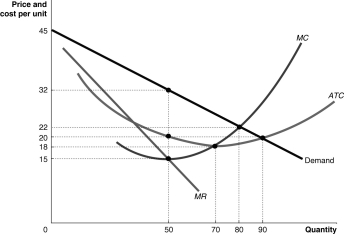 -Refer to Figure 8-7.Use this figure to answer the following questions.
a.What is the profit-maximising quantity and what price will the monopolist charge?
b.What is the total revenue at the profit-maximising output level?
c.What is the total cost at the profit-maximising output level?
d.What is the profit?
e.What is the profit per unit (average profit)at the profit-maximising output level?
f.If this industry were organised as a perfectly competitive industry,what would be the profit-maximising price and quantity?
-Refer to Figure 8-7.Use this figure to answer the following questions.
a.What is the profit-maximising quantity and what price will the monopolist charge?
b.What is the total revenue at the profit-maximising output level?
c.What is the total cost at the profit-maximising output level?
d.What is the profit?
e.What is the profit per unit (average profit)at the profit-maximising output level?
f.If this industry were organised as a perfectly competitive industry,what would be the profit-maximising price and quantity? (Essay)
4.9/5 (76)
(76) Figure 8-9  Figure 8-9 shows the demand and cost curves for a monopolist.
-Refer to Figure 8-9.What is the difference between the monopoly's price and the perfectly competitive industry's price?
Figure 8-9 shows the demand and cost curves for a monopolist.
-Refer to Figure 8-9.What is the difference between the monopoly's price and the perfectly competitive industry's price? (Multiple Choice)
5.0/5 (84)
(84) Figure 8-4  Figure 8-4 shows the demand and cost curves for a monopolist.
-Refer to Figure 8-4.What is the amount of the monopoly's total revenue?
Figure 8-4 shows the demand and cost curves for a monopolist.
-Refer to Figure 8-4.What is the amount of the monopoly's total revenue? (Multiple Choice)
4.9/5 (78)
(78) Figure 8-11 Figure 8-11 shows the cost and demand curves for a monopolist.
-Refer to Figure 8-11.If this industry were organised as a perfectly competitive industry,the market output and market price would be
Figure 8-11 shows the cost and demand curves for a monopolist.
-Refer to Figure 8-11.If this industry were organised as a perfectly competitive industry,the market output and market price would be (Multiple Choice)
4.9/5 (74)
(74) Joss is a marketing consultant.Iris and Daphne are potential customers interested in commissioning Joss to undertake a market survey and compile the findings in a report.Iris is willing to pay $500 for the service while Daphne is willing to pay $800.Suppose that the opportunity cost of Joss's time is $1200.Assume that Iris and Daphne do not know each other.If Joss charges the same price per copy to both Iris and Daphne,
(Multiple Choice)
5.0/5 (86)
(86) Figure 8-6  Figure 8-6 shows the cost and demand curves for a monopolist.
-Refer to Figure 8-6.The monopolist's total cost is
Figure 8-6 shows the cost and demand curves for a monopolist.
-Refer to Figure 8-6.The monopolist's total cost is (Multiple Choice)
4.9/5 (78)
(78) Table 8-3
 Julie plans to start a pet-sitting service. She surveyed her neighbourhood to determine the demand for this service. Assume that each person surveyed demands only one hour of pet sitting services per period. Table 8-3 above shows a portion of her survey results.
-Refer to Table 8-3.Suppose Julie's marginal cost of providing this service is constant at $7 and she charges $7.How many hours will be purchased and what is her total revenue?
Julie plans to start a pet-sitting service. She surveyed her neighbourhood to determine the demand for this service. Assume that each person surveyed demands only one hour of pet sitting services per period. Table 8-3 above shows a portion of her survey results.
-Refer to Table 8-3.Suppose Julie's marginal cost of providing this service is constant at $7 and she charges $7.How many hours will be purchased and what is her total revenue? (Multiple Choice)
4.9/5 (92)
(92) Figure 8-4 Figure 8-4 shows the demand and cost curves for a monopolist.
-Refer to Figure 8-4.What is the amount of the monopoly's total cost of production?
Figure 8-4 shows the demand and cost curves for a monopolist.
-Refer to Figure 8-4.What is the amount of the monopoly's total cost of production? (Multiple Choice)
4.9/5 (64)
(64) 
Filters
- Essay(0)
- Multiple Choice(0)
- Short Answer(0)
- True False(0)
- Matching(0)