



 Chat with AI
Exam 19: Comparative Advantage, international Trade, and Exchange Rates

Exam 1: Economics: Foundations and Models160 Questions
Exam 2: Trade-Offs, comparative Advantage, and the Market System191 Questions
Exam 3: Where Prices Come From: the Interaction of Demand and Supply241 Questions
Exam 4: Market Efficiency and Market Failure226 Questions
Exam 5: The Economics of Healthcare169 Questions
Exam 6: Firms,the Stock Market,and Corporate Governance255 Questions
Exam 7: Consumer Choice and Elasticity270 Questions
Exam 8: Technology, production, and Costs277 Questions
Exam 9: Firms in Perfectly Competitive Markets351 Questions
Exam 10: Monopoly and Antitrust253 Questions
Exam 11: Monopolistic Competition and Oligopoly304 Questions
Exam 12: GDP: Measuring Total Production and Income200 Questions
Exam 13: Unemployment and Inflation207 Questions
Exam 14: Economic Growth, the Financial System and Business Cycles172 Questions
Exam 15: Aggregate Demand and Aggregate Supply Analysis120 Questions
Exam 16: Money, banks, and the Federal Reserve System139 Questions
Exam 17: Monetary Policy180 Questions
Exam 18: Fiscal Policy131 Questions
Exam 19: Comparative Advantage, international Trade, and Exchange Rates247 Questions
Select questions type


A rise in the dollar price of the Chinese yuan signals an appreciation of the yuan and a depreciation of the dollar.
(True/False)
4.9/5  (85)
(85) In an open economy,contractionary monetary policy will have a secondary effect on GDP because
(Multiple Choice)
4.8/5 (78)
(78) Explain the difference between a floating exchange rate,a managed float,and a fixed exchange rate.
(Essay)
4.8/5 (78)
(78) Graph the demand for and supply of Australian dollars for euros.Suppose the Reserve Bank of Australia decides to follow a contractionary monetary policy.Show graphically and explain the effect of this policy on the demand and supply of dollars and the resulting change in the exchange rate of euros for dollars.
(Essay)
4.8/5 (74)
(74) Purchasing power parity is the theory that,in the long run,exchange rates move to equalise
(Multiple Choice)
4.8/5 (95)
(95) Foreign currency prices of the Australian dollar are currently determined by a managed float exchange rate system.
(True/False)
4.9/5 (85)
(85) When a country's exchange rate is allowed to vary within a particular target zone against the currencies of other countries,the country's exchange rate system is
(Multiple Choice)
4.9/5 (91)
(91) Expansionary monetary policy lowers interest rates and forces a real appreciation of the dollar in international currency markets.
(True/False)
4.9/5 (91)
(91) The record of a country's transactions in goods,services and assets with the rest of the world is its
(Multiple Choice)
4.9/5 (89)
(89) Explain how a floating exchange rate can cause problems for countries that have a substantial number of foreign loans denominated in United States (US)dollars.How might a fixed exchange rate pegged to the US dollar help the country avoid these problems?
(Essay)
4.8/5 (84)
(84) Since the 1970s,Australia's imports and exports have both grown from approximately ________ of GDP,to approximately ________ of GDP by 2013.
(Multiple Choice)
4.9/5 (84)
(84) Which of the following is not a source of demand for the Australian dollar?
(Multiple Choice)
4.8/5 (83)
(83) Figure 19.4 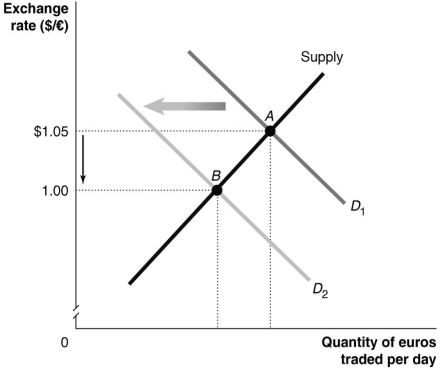 -Which of the following would cause the change depicted in Figure 19.4? Note that the figure depicts the quantity of euros traded.
 (Multiple Choice)
4.8/5 (72)
(72) Speculators who anticipate a(n)________ in the future value of the dollar relative to the future value of the yen will ________.
(Multiple Choice)
4.9/5 (73)
(73) If inflation in Australia is higher than inflation in Japan,what will happen to the exchange rate between the Australian dollar and the Japanese yen in the long run,ceteris paribus?
(Multiple Choice)
4.8/5 (80)
(80) Net exports in Australia are negative so Australia must be a net lender abroad.
(True/False)
4.9/5 (70)
(70) Which of the following is not a source of demand for Japanese yen?
(Multiple Choice)
4.7/5 (75)
(75) 
Filters
- Essay(0)
- Multiple Choice(0)
- Short Answer(0)
- True False(0)
- Matching(0)